BOOK I
PROLOGUE
Aloha ka kou,
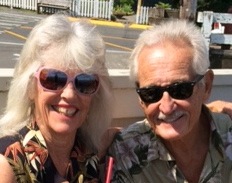
Smitty & Roberta (aka Kapalili o’ Makana) are the Free-Range Kupuna, off on a scouting mission to warm Mediterranean climes. We’re disconnecting ourselves from US news, social media and the anglo-centric world in general, at least for a time, We’ll keep in touch here, and hope you’ll follow along, ask questions, and comment on our adventures.
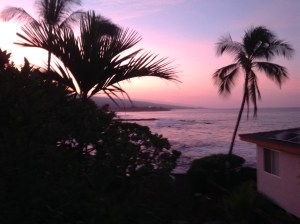
Bidding aloha to our Ala Ka La hale in Kailua-Kona, HI
We say farewell to our island home for a season, and hope that those staying in our hale-by-the sea enjoy, and are nurtured by it’s beauty, tranquility, and healing sea breezes. After we are done adventuring we will return, and meanwhie, we hope we can share your memories here, as we share ours abroad. Please feel free to comment any time
Smitty & Kapalili o’ Makana
European adventure note: R=Rober’ta. S=Smitty, dates are approximate, we update when we have WiFi and can remember where we are, we are not responsible for GoogleMap misplacements. Remember, we’re unphoned and un FaceBooked, contact us via comments, e-mail, or WhatsApp.
note: Due to popular demand, well a request by one follower, we are adding dates at trip pivot points.
BOOK I
LEAVING THE ROCK – 10/19/17
And we’re off … no wait, after more than a month of housecleaning storing things away’ we are finally loading up and heading out to the airport. We have so many bags — how will we ever manage to move around. We are definitely in the final stages of getting off to THE adventure … and of course we’re leaving late. But we think that we can make the flight that has already been delayed an hour; however, there is a lot of Mamalahoa highway construction and traffic and we arrive even later. We called JB, our neighbor & manager extrodenaire of Singnature Flight Support, and ask him to meet us at Alaska departure to help transfer our car to its new owner, Cathy. Well long story, JB manages a swirl of activity with all of us there at Departure. Cathy gets the car, and, finally, we line up at security screening. It’s a change of shift. TSA people are leaving. There’s a line all the way out to the curb. As it turns out, there’s no way that we can make the flight. We try to make reservations for tonight’s red-eye. They are not running the flight this night. So now what? We sit down on a rock wall and discuss options, which are not many. We get a ride over to Signature and hang out there in its lovely lobby area. We use the time to decompress, catch your breath, and re-organize. Well, we catch a ride home with JB at the end of his shift, which works out well for us. We managed to catch up with friends and final things that we needed to do on the phone, R finishes the final chapter of a book she’s been reading and had left behind, and go out for dinner and have a great time with Cathy.
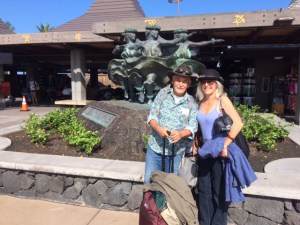
Finally, we set out from our home airport, Ellison Onizuka Keahole-Kona
Starting the adventure over again, we get to the airport early and all goes as one would normally expect. Get your books out, sit in the waiting area, and people-watch; there are some amazing characters. Soon comes an announcement that our flight will be delayed and we get a little anxious. Another announcement comes over the system that we will be delayed a little bit longer but they will keep us informed. 10 minutes later we get another announcement that the flight crew has had some difficulty with their car enroute to the airport — a little bit delayed a little bit longer. Well at this point there’s nothing more we can do but laugh — this is going to be an adventure all right. Alaska is able to get another crew on board pretty quickly so we’re not too delayed. Boarding our Alaska flight, we start the 5 1/2 hour cattle car class flight, brief layover in Seattle and onto the Alaska red-eye to JFK in New York. We arrive at the crack of dawn. We hustle our wheelies, totes, coats, etc. And get to the curb. Smitty calls Richard, S’s cousin-in-law, waiting at the cell lot to come and pick us up. There’s lots of people, of course, all around taxis are honking, families are picking up relatives and juggling cars by the curb. The sun is coming up, the skies orangey on top of a palette of blue. Really a beautiful day. We arrive in North Hampton, MA (the corner where Massachusetts, Connecticut, and New York join).
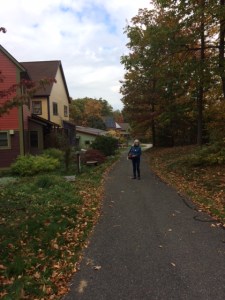
Kapalili walking the village path at Janet & Richard’s co-housing village.
MEET THE COHOUSERS.
Janet, Smitty‘s cousin, and husband Richard’s cohousing home is in a forested no-automobile setting of duplexes, walking-bicycling paths, playground areas for children, and a community center where activities, meetings, and at least once-weekly meals are shared. A small townhouse village. It’s very interesting and an up-and-coming type of housing that people are using. You can look it up on line and learn more about co-housing. Janet serves great food and we eat non-stop. She invited her friends over for lunch, to explain to us how the original design and concept was developed, in case we were interested in starting one in Hawaii.
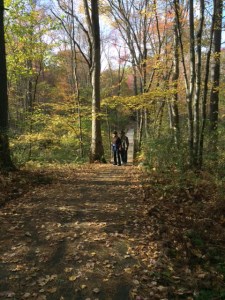
Wandering through the New England fall colors.
We start exploring the area by visiting an old used bookstore filled with nooks and crannies, bookshelves, and piles and piles of every kind of book you can imagine. They’re grouped in categories but not cataloged individually. R is sure if there is any book on earth that one wants, they could call Grays bookstore and be able to access the book. S found some little self-help parody that he wants to take with him. We have so much stuff now we can’t even imagine caring one more thing. Looking for dinner we end up at a Tibetan restaurant; we sampled most of the menu. Everything was delicious (except the buttered tea, yuck!-S).
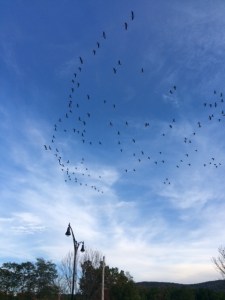
Heading south … a sure sign of autumn.
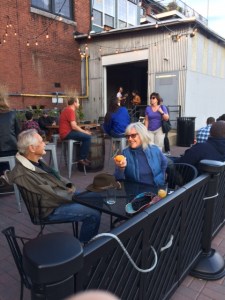
Mid-walk rewards, ginger beer mimosas & music al fresco.
Next day we we walk to enjoy the beautiful fall colors of the trees and see the ducks in ponds, geese flying overhead, and happened upon a little outside coffee/beer shop in an old mill warehouse. There was a young couple playing guitar and banjo. Of course we have to stop and enjoy a ginger beer mimosa. Ahhh life is good. In the evening we attend the community center where we were served dinner by the children of the community who joined together to make a great little noodle bowls dinner accompianed by lots of handmade sushi, all done by the kids.
Later in the evening R starts making the Ti leaf lei that will be given to Natalie when we arrive in Israel. Richard documents R twisting these leaves wrapped through her toes to hold the leaves taught. R explains the connection of hula, Lei making, and Natalie. The question is now ‘will she be able to get them through Israel customs* upon arrival? (We had no problem getting through Lisbon to Rome. We shall see.)
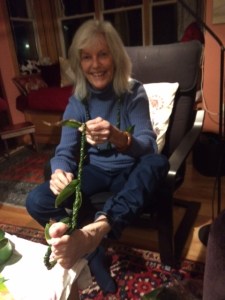
Making of the ti leaf lei * Despite all the tales of Israeli extra tight security there was no customs screening at all!
R leaves all the extra TI leaves for Janet to put in her garden over the winter. Chickens will be released from their pen soon and start scratching in the garden, or, they will have the man come and pick them up because no resident wants to kill them. ‘The man’, however, is not afraid of decapitating the feathered critters. These hens are very fat and they are not laying eggs. So the community has to make a decisionhave. New hens will be brought in.
After our few days of ‘flight-induced-fatigue’ recovery, we are ready to get back to New York to catch the flight to Portugal and then Italy. We ride with Richard, who goes in to Tarrytown where he is has a small condo unit and keeps his photography hobby corralled. He’s constantly taking pictures, anything and everything that is of interest. After settling in we went out on a ‘last time in America’ burger hunt. It was delicious, but we both felt that last burger through the entire next day in NYC! After dinner, we join him with his photography club group to visit and enjoy a presentation of birds and wildlife seen in Costa Riica.
What we found out: We had been curious about cohousing as a possibility in our dotage, but after observing the interactions between all of the people during a ‘community meeting’ that we attended, we think that our Ala Ka La condo home is close enough to communal living for us.
LAST DAY IN AMERICA, N’YAWK, N’YAWK
Richard (our ‘Unter’ car service driver) morning drop-off at the station in Tarrytown to catch a commuter train to New York City, where we have all day until our flight out late tonight. We end up in Grand Central Station. This is a world of activity, and we don’t know which direction we’re headed. We ask questions and it’s a challenge figuring out the N’yakese. We’re looking for some place to store our luggage so that we are free to move around unencumbered. Everyone has a different opinion. Even Google. Even the tourist information center. Even the newsstand. Eventually, after near exhaustion & trudging with our three wheelies, duffle bag, backpack, and R’s enormous sling purse, about six or seven blocks, manage to find the one we need. Ahhh now we are liberated.
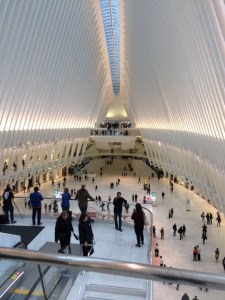
World Trade Center station atrium, not your usual subway.
Diving into the NYC subway system we arrived at the World Trade Center Station, a huge white arched roof many stories tall, and wall to wall expensive shops. It looked like we had been dropped into Ala Moana Center. Braving the oncoming rain showers we walked around the 911 memorial to the lives lost in the twin towers destruction.
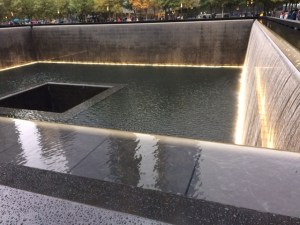
The drizzling cold rain just added to the melancholy.
Getting a little tired we Flagged down a red bus, free transit around the financial district. We looked at all the beautiful sites along the route. R asked the driver where to get it off to catch the free Staten Island ferry to see the Statue of Liberty. Driver gets huffy. He doesn’t know where it is; says that We should ask the people on the bus. We do, getting lots to opinions. We hop off at a spot where we board the ferry that acts as commuter for the people that live there locally. The sky is foggy and misty, but it is still beautiful. We capture a couple pictures and enjoy the ride.
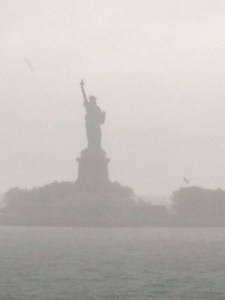
Lady Liberty undaunted through fog, lies, and disrespect.
We could just see the Statue of Liberty through the intermittent rain squalls and were cold for the first time since last winter in Montana. We duck into the national American Indian museum (as an Indian, I was glad to see no references to ‘native Americans’), where after a TSA style screening we spent an hour or so gazing at an incredable collection of artifacts, craftsmanship, and contemporary Indian art, but very little of my Wendat/Wyandot tribe.
New York City is one of those amazing places for people watching, street food and magazine kiosks, hustlers, homeless, genders of every sort, and the terminally wierd hip. Times square is as bustling (and hustling) as ever under that amazing array of electronic advertising, all looking like a Bladerunner scene under dark, drizzling skies.
The new trade center tower, reaching into the clouds.
The women here are walking around with jeans and stiletto heels. Most of the men – pants, jackets and shoes. But there are a lot of people and visitors wearing jeans and tennis shoes. The style here is anything goes. And we see it ALL. We walk and walk. R is so glad for her flat shoes, S is one of those tennis shoe wearing tourists. After viewing the 911 Memorial (the pictures say just a part of the story). We decide that it’s about time to find our way back to where our luggage is and get something to eat before we start our escapade to the airport.
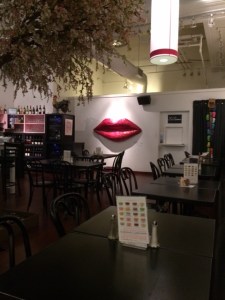
A cheeky farewell to America repast, buhbye ‘Murrica.
We find a little hole in the wall for a light soup and salad dinner. To our delight, at happy hour, you pay for a glass of wine and you get a glass of wine free. Next stop, our airport shuttle to arrival at the airport and on to our Portuguese airline to Lisbon.
Lesson learned from New York City: that in response to a query for directions, N’wakeres will tell you any damn thing, just to get rid of you.
ARE WE THERE YET? – 10/23/17
The (another red-eye) flight to Europe on the national Portuguese airline TAP was relaxing. Even though it was an all-nighter, it was fairly comfortable as the seating is larger than American airliners, the service was very accommodsting and friendly (I wonder if the box of Caramacs had anything to do with – S), there are pillows and blankies for every passenger, and the Airbus even has cupholders at each seat, Get the hint US carriers and Boeing? After landing in Lisbon, the Portuguese customs agents escorted us into Europe Uni.
Lisbon is the center of passport control for the TAP (Portuguese National Airways)EU flights. And we spent two hours in a line that snaking back n forth. The airport area is huge, so much space. Now we know why—to accommodate many large international arrival flights. IF one is a member of a country that belongs to the EU, there is a separate area to be waved through customs. IF NOT A MEMBER, you have to wait in line and people-watch to kill time. So what did we observe? We got caught behind a large flight from China. Many Chinese adults of 50+ age all tapping away on their cell phones, sharing with each other new tricks, taking pictures of each other, and selfies. Like the Japanese culture, there was a younger female leading the pack with her flag on a pole. R noticed that their teeth were in much better condition than she remembered. There were very few Americans but, in line, we also noticed a foursome traveling together that S had noticed at JFK, and were boarding our TAP connecting fight to Rome. Finding our connecting flight departure was difficult. Signage directions were poor and we wandered here and there until we struck out at something, a TSA type setup. If shaking heads and wagging fingers pointed to another sign or direction, we moved on — schlepping all our stuff—to somewhere else.
We eventually arrive at our gate and meet an American woman who looks part Hawaiian and she had just missed her flight and was waiting to get on the same one we were on to Rome … such is international travel in today’s jet age. We waited an hour or so and boarded our next last flight leg (of four) to Rome, Italy. A cafe’ for S, and water for R, and pit stops for both (restrooms are so modern with sanitation dispensers before you enter the toilette and then in each stall and then when you exit) and we boarded for our afternoon/ evening flight to our first destination-Rome.
CIAO ROMA! – 25/10/17 (note switch to European date format)
Arrival surprised us, there is no customs process, and greeters mill about the arrival lobby at will. The airport cambio (money exchange) gives the typical lousy exchange rate one gets in any international airport, but we need the euros. We stop at a kiosk and purchased a sim card for Smitty’s phone, which subsequently fails to work in any activity. Smitty hikes back to the kiosk only to discover it has closed, then gets lost trying to find his way back to the parking garage where R is waiting. Between us, we managd to find the pin number required to activate the European Sim card, duh … so now using the iPhone hotspot we are able to have our iPad’s function as GPS navigation … more about this later.
There was a short harrowing relearning curve driving our FIAT 500 stick shift … clutch? So that’s what the left foor is for! Exiting the parking garage maze (which took a few laps around before the clerk came out to point us in the correct direction), and finally managing the exit barrier card insert (which required R getting out of the car and asking the car — now stuck in behind us, how to operate the system. Well, the man didn’t speak any English, but with sign language, we got it. We are now dropped into the Machismo Italian Drivers Challange (believe me, the women are as machismo behind the wheel as any man). Driving the autostrada (freeway) in the dark caused us to miss our exit (Italian road signs are far different to ours) and we ended up on the streets of Roma centrali. A few loops around a confusing junction, and we finally found a route to our AirB&B, about 1/2 way BACK toward the airport. Once we arrived on the destination map, we peered into the dark looking for the house number, and finally giving up, called our host now 11:30 pm. SORPRESSA! (surprise) we are directly in front of the gate, which opens to our smiling host, Maria, a steep driveway-drop and we slide snuggly into her garage.
Our bedroom was up four flights of stairs, so it required a couple of trips to get our travel essentials gathered up. We open and plug in our new multi-national electrical plug, and voila! We are charging up our devices. A hot shower to wash away 24 hours of travel, and we are snuggled cozy in a comfortable bed piled with comforters. Bene notte, we’ll see you in the morning to continue our travel to our Italian resort destination.
ROMA > CANALICCHIO:
We had a great late sleep-in. Our bed so comfy, the room so dark and quiet, and the night before so late, we slept until late morning. Maria and Mama fed us a hearty breakfast with fresh fruit, wonderful home-baked breakfast cake and fresh-brewed espresso, and sent us on our way with hugs and kisses. Our only regret was that they were booked on the days after our resort stay, and before flying to Israel (more about THAT, later).
After we loaded our route into our iPad, hooked into the usb port, and said our alohas, we ventured out into the vias of Roma … where we promptly got lost, again, in daylight this time. The combination of iPad navigation, Italian highway signs, and doing battle with machismo Italian drivers led us to near distraction (I swear we went through the same intersection thrice, in a different direction each time) before we sorted ourselves out, and got off the autostrada, and onto the local roads to Umbria.
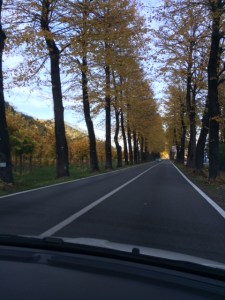
Finally, the roads our driverr and FIAT 500 were made for.
After that, we only missed turns a ‘few’ times before reaching our destination, Canalicchio. To be fair to ourselves, some of those ‘missed’ turns were actually correct, we just couldn’t believe THAT was our road!
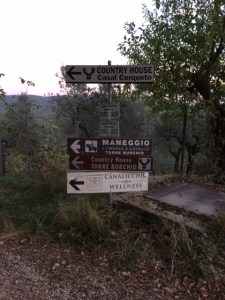
Italian road signs … I do not think ‘directional road signage’ means what you think it means.
A stop at a supermercado stocked us up with fruit, cheese, bread and wine– our daily non-trattoria staples. We traveled at a pace entirely too liesurely for the Italian drivers, who expressed their displeasure by hanging out on our rear bumper at 70 kph with much flashing of headlights and gestures. By late afternoon we arrived at our destination, Relaise Il Canalicchio, a four-star resort hotel, perched at the apex of an Umbrian hilltop.
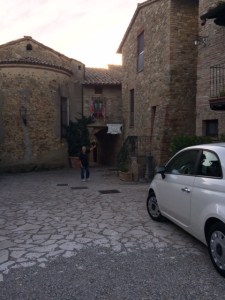
We have arrived, now to find the check-in desk.
The hotel is a reconstruction of an early Renaissance barony. Built as a retreat from local strife, the castle grew into a small hill-top cittia, which was subsequently abandoned, and fell into ruin. In the mid 1990’s it was purchased, rebuilt, and opened as ‘Relaise’ a ‘mid-level’ resort. Perhaps mid-level by definition, but certainly worth each of it’s four stars to our simple tastes In the pictures you see what we met when we finally got there.
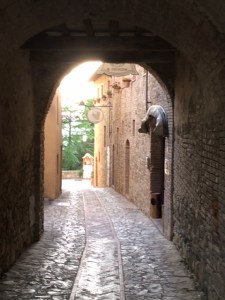
Entrance on the right, leading into a true castle.
Just like a storybook castle. Our room was huge, the doors were huge, and the stone floors had walkways and ramps all made out of huge rocks. Surely Rapunzel could’ve been staying in one of the rooms next to us, letting her hair down to some lover down below.
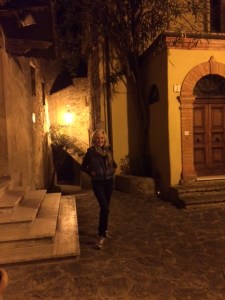
An evening stroll led us along the alleyways to the chapel.
Our room was so quiet, and the bed so comfy we almost missed breakfast in the morning (are you sensing a pattern, here?), which would have been too bad, not only because their breakfast was very good (except for the scrambled eggs which were dry, and floating in water, and the Italian preferance for half-raw bacon), but because it’s a ten kilomater trip on the winding one-lane road to Canalicchio to the nearest breakfast! At our first breakfast we learned from guests we met (and recognized from JFK, LIS, and FCO, all ending up at the same hotel) that the restaurant was overpriced, and the quality not up to expectations. They directed us to a trattortia at the bottom of the resort driveway … what a find.
La Loconda del Colle is a small inn with a wonderful restaurant. So, we found affordable and delicious dinner right next-door to our luxurious castle where the food was much better. We were in the land of mushrooms and wild boar. The wild boar stew and pasta with fungi, penne with spicey tomato sauce, veal, and pasta with truffles were some of our favorite meals. We ate lots of salad with oil & vinegar – always after the main meal, all accompanied by lots of half liters of wine. Everything we had was excellent (especially the wild boar stew with tagliatoni & truffles), the local wines were good, and everything was really affordable … we ate there almost every night.
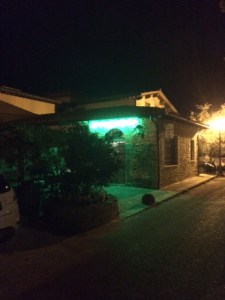
Sneaking out to dinner with la familia once again.
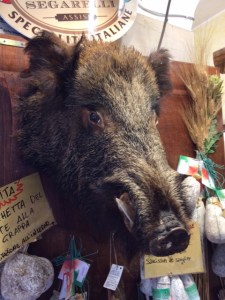
Ugly, but they sure taste good … Hawaiians would agree.
We always felt guilty passing the Relaise desk going out to dinner; they knew that we, and half the other guests, were passing their almost empty restaurant to go down the hill. The ‘kids’ served, while Mama cooked, and Papa watched the news or football (soccer to us Yanks) on the big telly in the corner of the dining room, truely family style dining. We became good friends with the family who owned the Inn. We met the cook at the end who we envisioned was a Big mama Mia with big apron on, large, and a typical older style Italian. She was about 50 years old, very young looking, and had a type of chef hat that looked like a squashed white chef hat. Very pleasant; her children helped us translate and we all had hugs before we ended our final night there. Before we departed, we were served a taste of their freshly made olive oil from the family’s orchard: first flavor on the front of the tongue was of flowers then an astringent taste in the back of the tongue then a touch of salt to clear the palate.
It didn’t take long to explore the resort and plan our outings for the rest of our week’s stay on our castle redoubt. We managed to spend several days walking around the area, having picnic lunches, and finding a time to just REST and sleep – in. It was luscious.


A balcony picnic … while enjoying the view of Umbria.
One hour a day was also included with our visit for the Spa, which included the hot tub, sauna, steam room, showers, and a special room to recline and listen to calming meditation music when you were all done with the preliminaries. This is the way to go. Roberta even had a massage that was on a table about the size of a pool table with water on it that had blue lights bubbling through it. That was a new experience.
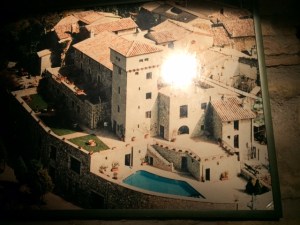
Aerial photo of Relaise Il Canalicchio, and that’s not all of it.
Other new Experiences: square toilet seats, bidets of different shape and squirt outlets, flies that don’t seem to bother the folks here, coffee that after two sips stands your hair on end, and Grappa-a drink that tastes like Diamond Doug’s Whitefish home brew.
OFF TO ASSISI AND SAN FRANCISCO (St. Francis)
After a day or so recovery from our travels, we headed out again onto the back roads of Umbria toward Assisi, the home of St. Francis, patron saint of animals and wayward souls like us. We chose a route that picked the smallest of the roads that went to Assisi from Canalicchio, and there was a few times where we really wondered whether we had made the right choice or actually gone off the track and ended up in some farm lane. It was a great view of the wine and olive country of Umbria … so glad we did go the route that was less traveled.
Our navigational aids are sketchy at best, using the Italian SIM card in Smitty’s phone to hopefully connect to the iPad, giving us a screen large enough to actually see. Unfortunately, there seems to be connection problems between the phone and the iPad on Bluetooth even though they’re only inches from each other. We finally gave up and just did it on the phone, regardless of the fact the screen is too small to really see anything … weeks and half a continent later, we still have the same problem.


Typical via of Assisi, and all the hill towns, now add pedestrians and cars wall to wall … now yourself as driver.


Modern pack horse/mini trucks shoulder-to-shoulder with pedestrians and still functioning Roman horse troughs.
Assisi is another hilltop cittia filled with winding narrow vias choked with pedestrian tourists, cars and delivery trucks, and the plaza checkpoint manned by the national police to check bags before allowing you into the Cathedral of St. Francis, which as most cathedrals in Italy and Spain are a tribute to the gold and silver stolen from occupied nations in the past.


The plunder of the new world to glorify the saints of the old.
It is most poignant when you think of Saint Francis of Assisi who gave up everything, and now has a cathedral dedicated to him with millions of dollars worth of artwork, frescoes gold, silver, stained glass, and all with beggars at the entrances asking for coins. The dungeons and lower levels below the main parts of the cathedral turned out to be more interesting than all the glory above … well the frescoes are pretty interesting, if you could keep track of the stories. In the late medieval and renaissance periods, artists painted the faces and opulant dress of their patrons as the characters of the biblical stories they were illustrating. I wonder what you had to do in offence to be portrayed as Judas Iscariot?
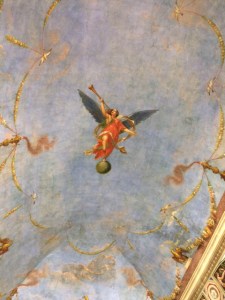
Fresco Gabriel letting us know the gate to heaven is closing.
It’s really amazing how far from the the words of Jesus, St. Francis, and other holy people the church has strayed. It must be said however that, the Italians and the Spanish for the most part, remain firm believers in the dogma of the Catholic Church.
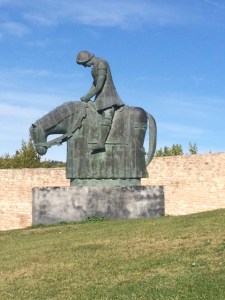
Not sure who this, doesn’t seem to relate to St. Francis. We’re trying to decide if it’s a state of humble prayer, or he and the horse are just beat … Smit favors the latter.
We had a hard time finding our way out of the assisi because the navigational map on Google maps kept reversing itself, and we didn’t know which way to turn. Eventually we ended up on the main highway to Perugia which wasn’t our choice, but was leading us in more or less the correct direction. Purugia is a major regional commercial and industrial city, and we had no desire to leave the autostrada and explore it. We were finally able to find ourselves at the road back up to Canalicchio, and after a lovely dinner and after-dinner drinks in front of the fire including our first taste of grappa provided by our illustrias chef Luigi, we said good night to the towns, highways, and byways of Italy and climbed into a hot bath, and back to our snug bed.
COOKING CLASS & SPA
Two of the surprise highlights of Canalicchio resort turned out to be the cooking class which we had booked, but didn’t realize the extent, and the spa which unbeknownst to us, was part of our stay. It turns out that an hour of spa time each day was included in our booking, so we took advantage of the sauna, steam room, and a relaxation room with reclining chaise lounges and quiet meditative mood music for a very relaxing afternoon break each day that we were at the resort. Kapalili treated herself to an ayuvedic massage on a water massage table, but that’s a story for her to tell.
‘Berta – One hour a day was also included with our visit for the Spa, which included the hot tub, sauna, steam room, showers, and a special room to recline and listen to calming music when you were all done with the preliminaries. This is the way to go, down for a quick siesta. I even had a massage that was on a table about the size of a pool table with water on it that had blue lights bubbling through it. That was a new experience.
The cooking class turned out to be one of the highlights of the whole Italian trip. We had thought that only Smit was registered, but it turned out that we were both signed up for the class. We did end up both paying €30 but it was well worth the time and the money. We learned how to make pasta fresh, which is much easier than it might sound, and you can’t imagine the difference from reboiled dry noodles.


Cooking class from beginning to end …
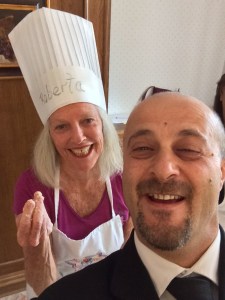
Chef de Mason Luigi and the teacher’s pet.
We learned all the way from mixing the flour and water (by hand) to rolling the dough out and running it through the noodle slicer. We made a ‘potato surprise’ which is a poor person’s dinner served throughout the central Italian farm areas (basically a cupcake made of mashed potatoes mixed with cheese, formed in a muffin tin, filled with whatever could be found to eat that day, capped with more mash mix, and broiled), and finally we made tiramisu; not my favorite dessert in the past, but when it’s freshly done and you know how it’s made, Delicious. We then took turns in the kitchen with supervision around the giant stoves and vats to cook everything.
While the tiramisu chilled and the potato surprise baked, we dropped our freshly made noodles on the boil (four minutes), and whipped up a wild boar sausage in be’chamel sauce, (all in the same four minutes) dashed in the pasta and headed from the kitchen to the dining room, en masse. The entire class then set around together at the big family style table, and had a wonderful Italian style family dinner all the while being regaled with stories, jokes, comments, and critiques by Chef Luigi. When we asked if it would be possible to buy one of the aprons which were so handy, and emblazoned with the logo of the resort in embroidery on the breast, he graciously offered each of the couples in the class an apron free. One of the perks of being the last class of the season I suppose, but a gracious gift nonetheless.
Things we learned: don’t put olive oil in the water when boiling your pasta. This is only done if you are cooking for a large number of people. This just keeps pasta from sticking together. If you don’t have a pasta machine, you can use a bottle or a rolling pin to roll out your dough prior to cutting.
NOTSOHOT SPRINGS
One of our most anticipated side trips from Canalicchio was to Termi di Saturnia, a natural hot spring flowing from a bank, and forming the headwaters of a small river. A giant water fall of gushing fresh water pouring out of a hillside. Open to the public. Free. Of course, we had to go but it was no easy feat to get there on the back roads. Our gps system stopped working and we didn’t have a clue where we were. (Rent a car places do NOT provide one with a map when renting a car.) While Smit is having an argument with his electronics, and we are on the wrong side of the road because that is where there was a tiny place to pull of, an older spanish man pulls off the road in his car to get something in the back seat. Roberta jumps out and asks him directions to the Saturnia springs. Ah Ha. He pulls out a map. They do exist. So, through some gesticulating, sign language, and a word or two of spanish from R, we get back on the road to Oz. We are now on a secondary road with home made signs, which we’d manage to spot in time to make the Correct turns without crashing into anything. Eventually we found out where to park after having seen the springs from quite a distance.
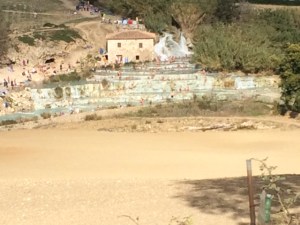
The springs from a distance, huge and hotter the further up.
They are truly striking. We were looking forward to the springs, having seen pictures posted by our friend Patti Ferrington from Kona and Whitefish Montana, and her tale of her visit to the Hot Springs. We arrive and change into our bathing suits under our pareos, behind the car—no modesty in these here parts of the country of travelers from all over. Adults and children and lovers soak n float, move around to find a different spot, and find mud to give yourself a facial. It felt glorious finding our way into the waters through the many layers of pools formed by accretions of limestone. The flat bottoms of the different levels were coated with pebbles of rolled up bits of limestone, and there were pockets of mud, which people smeared on their faces in an effort to, we presume, improve their skin tone. I’m not sure the mud did any good (see photo), but the waters did leave one’s skin feeling very smooth and soft.


Is it working? I don’t think it’s working, I’m going back up the waterfalls.
We found the water to be not so much hot, as pleasantly warm and after a couple of hours lolling about, wallowing, and slipsliding to the different pool levels, we headed onward to our next destination. Patti and her friends had hired a limo, and made the trip in the back with bottles of champagne, much laughter, and letting someone else do the hours of driving. I’m sure that was the way to go, but we were on the do-it-yourself tour and it made for a fun day overall. We saw a lot of that part of Italy which we had missed before, and, actually, we were officially in tourist-sought Tuscany rather than it’s poor cousin, Umbria.
What we learned: Frankly, we saw little, if any, difference. It’s all the same geology, landscape, saints, and towns named after saints. The entire region is bisected by the north-south autostrada running from Roma to Firenzi; the west side is the much praised Tuscany, while the east is Umbria. They are both lovely, and if you want to buy a villa, look to the east, greater availability, and far cheaper.
GET THEE TO A NUNNERY! – 01/11/17
On the last day of operations for the season we said farewell to Canalicchio and the friendly (and no doubt, relieved) staff, stopped by for one last look at our favorite little trattoria at the bottom of the hill, and headed off to Orvieto, Italy … an ancient hilltown not to be confused with Oviedo, Spain an ancient hilltown … which comes later.
Our residential booking in Orvieto was in a cloistered convent, calculated for a two night stay. The convent turned out to be in the very old section of town. To navigate these small roads with buildings so high that the GPS couldn’t keep track of us and find our way. Our salvation was Smitty‘s built in navigational system in his head. Amazing that we found this convent on the side road of one of the main squares.
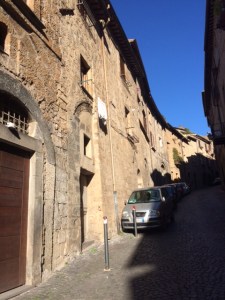
I think that’s it, no, it’s the one just in front of the silver car.
We managed to find parking, find the entrance to the convent, and bang on the door. It was like something out of an ancient movie of the gladiators. Push the doorbell, and a loud noise buzzed inside and outside from the bellringer, a clanging noise happened and a giant gate opened into which we entered. Everything echoed. The door clanked behind us. It was like being in a Jabba the Hutt jail cell. One nun in her 70s (Mother Superior) in her white surplice came to meet us. She fortunately had a nun, Katrina, who could speak some Spanish which I (‘Berta) can speak a little, and we managed to coordinate the reservation we had made, and were showed up an elevator which could hold no more than three people. From an upper floor hallway we had access to our room with the key that must be hung on the lobby wall when leaving. To re-enter, ring the doorbell at which time one of the nuns comes to the door to let us into our room, which was two single beds, firm but comfortable, a single crucifix on the wall as the sole decoration, and a double door to a small balcony that looked out over the city … beautiful.
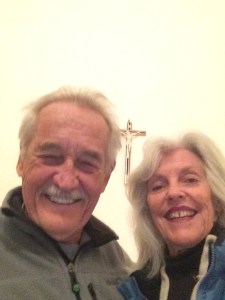
No hanky-panky with HIM watching, hmmmmmm?
Our cell and it’s compact private bathroom (think shipboard) was clean, serene, quiet … and cold (apparantly Italian heating systems run on calendars, not thermostats)–no heat til mid November and don’t be out later than 11 o’clock or you are locked out! Roberta asked for another blanket. By the second night we were popsicles. When nun Katrina pleaded for us, the Mother Superior provided more blankets and managed to turn on the heat. There was one small common area where we could plug-in to Wi-Fi and do our business. They were only three nuns in this giant building of hallways and rooms — eerie. There were beautiful vistas from the windows, lush gardens, and a giant pomegranate tree in its full glory. There was a parking lot on their premises and you had to push the button, run to your car, wait for the metal gate to swing open and get out before you got caught anywhere in between. The nuns were very gracious, when we did interact. We got our passports back and left after two days, but it was a great place to stay for a couple of days while we explored the town and the surrounding area.
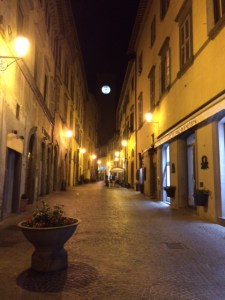
Hard to believe, but during the day we drove down this via. That’s a clockface on the center tower, not the moon.
Orvieto has a large web of narrow cobbled streets that are autovias by day, and paseos by night, Hundreds of people, including kids, toddlers, and babies are out and about until 23:00, when dinner finishes. There are shops of every kind, including many shops selling crucifixes, icons, statues, and simulated relics of the saints … and there are SO MANY saints, to the faithful. One shop was a truly amazing toy store, with incredibly accurate model cars, trains, airplanes, dolls, doll houses and furnishings. Tucked down at knee height, under the lip of a counter was a model to offend every political correctness in America, and enflame the neofascists that have bloomed under our current excuse for an administration. It was an extraordinarily accurate, 30 cm (12″) long model of Adolf Hitler’s Mercedes convertible limousine. Benito Musselini was standing, giving the fascist salute, with Hitler, detailed to his silly little moustache sitting next to him. It was a beautifully executed thing … and all for only €250, such a deal I tell you. I (Smitty) could have bought it and sold it on Amazon to some white pride nut case for ten times the cost plus shipping … but I didn’t. The owner claimed no agenda, it is for ‘historical interest only’, but he wouldn’t let me take a picture of it. Pinnochio is a bit of an obsession here in Orvieto. Never did get to the root of the tale, creator, and the town.
One of the highlights of the surrounding area is the city hilltop town of Cittia Bagnoregio, one of the most famed and photographed of the ancient hilltop fortress towns.
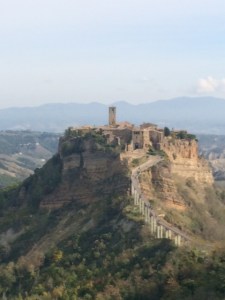
Now imagine the bridge hasn’t been built, and you’re climbing up from the fields in the valley with 30 kilos of grapes or olives on your back.
Although it is listed in Rick Steves’ Italy guidebook as deteriorated, depressed, and basically abandoned; it appears to have been through somewhat of a renaissance. We found it to be lively and active, with a number of lodging options, trattorias, tavernas, and quite the most beautiful hilltown we encountered.


A hilltop trattoria lunch followed by a postprandial stroll.
This town sits on the top of a citadel with the mountain eroding around it. The ruins are so old with caves dug out and down to where a burro could pull a mill wheel and turn olives into oil and/or grapes into wine. Tunnels are carved into the solid rock, and narrow walkways cling to the cliffsides, and lead to the pre-Roman Etruscan caves. These caves are way pre iron-age, the best metals they had were bronze. I can’t imagine how they accomplished all they did with such soft metal tools.
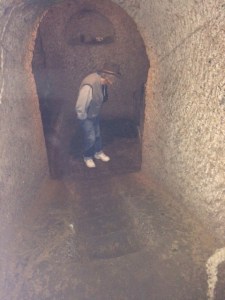
HEY HONEY, I found it … the wine cellar (it really was, too).
The mountain top is riddled with carved-out rooms used for stables, homes (sometimes in the same room), olive oil and wine crushing mills, graneries, and deep cisterns where rainwater was collected from the roofs, streets and walkways above. I guess if you are under siege, you don’t mind that your drinking water dripped down from the same streets the donkeys used … with predictable results.
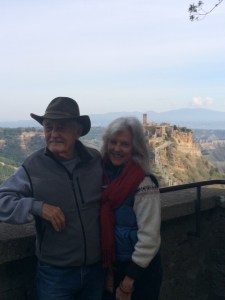
Survived the hike up and down … and still smilin’.
If there was any place you wanted to have a retreat to write the great Italian novel, this would be the town … isolated by a long bridge with several hundred foot climb to the top*, it has a 360° view of the entire region around it and quite the loveliest place we encountered in Italy.
* To this day, all the food, water, wine, fuel, and furnishings are hauled to the top, and refuse returned, by mini-trucks. I can’t imagine the effort to haul everything, including the tons of olives and grapes for the mills, up steep, winding trails and stairways, on the backs of donkeys and humans.
Back into the car to get to our final destination before dark — the near-coastal town of Tarquinia, another old renovated castle town with cobbled stoned streets you have to hold your breath to get through, and the most non-descript of the hilltowns we visited. Smitty’s sixth sense and inner compass gets us to the spot, and we eventually find our way into a post renaissance, Romanesque style building.
Smitty bangs on the giant wooden door, no answer, only echoing noise. He rings the doorbell with only reveberation sounding in our ears, it is now late in the afternoon. What should we do. There is an older Italian woman sitting on the bench out in front with not much expressin on her face and no movement to assist. smitty yells: hello a couple of times. Well with all that racket, someone in the neighborhood callled the owner, and an older gentleman comes to let us in.


Kapalili cavorting with the house guardian while across the hall the matron of the house looks on disapprovingly.
The giant door creaks open, statues line the entry way before we start the climb upstairs to our room with a small kitchette for the night. It is cold and with Roberta’s body language, gets the old man Alberto to turn up the heat. It’s small but cozy and we only need one night. Parking is always an issue—there isn’t any. And the color coding and times of various stripes on the road make it a crap shoot; and, yes, we got a ticket, even though we can’t figure out why, since the car was in a marked space. Maybe it’s because we were in front of the Catholic Church and la Policia de Cittia realized we were heathens. What are we gonna do now.? No time. Send a check, I don’t think so. We’ll probably get a citation in the mail that will charge us an arm and a leg for late fees. Of course, we won’t be home for several months. This should make a good story. Well, at least the car wasn’t towed away. That would have been a horror story. The town was another hilltown of narrow streets, cobblestones, the inevitable cathedral, and the traffic compromised even more by the fact that somebody was shooting a movie right next to the square where we were staying, causing them to block access to anybody wanting to go down the street, which was the only exit to anywhere, so eventually you ended up just driving the wrong way down a one-way street so that you could get out of the neighborhood … such is driving in Italy.
New experiences: being totally reliant on a language which one does not know well, espanol. Having breakfast that consists of nothing more than a coffee and a croissant – no protein. That has to hold you til about 14:00 (2:00 pm). By that time, we’re so hungry we could chew the wood on the table leg. Business door grates roll down between 14:00 & 14:30, shops close & restaurants lure you in for a meal. Lunch, wine and a siesta make perfect sense.
We, however, have not become accustomed to gearing up again and going out at 8:00 pm. But do we must. That is when dinner and the postprandial night life stroll happens and it’s amazing. Women of all ages, babies in prambulaters, old men and women in woolen clothes and hats walking arm in arm, young hipsters out meeting, smoking cigarettes and drinking beer or wine … everyone smokes.
ARRIVEDERCI ROMA
After our stay we get an after breakfast start, and head out again toward the coast where we wend our way on the coastal road toward the airport at Rome to return the rental car.
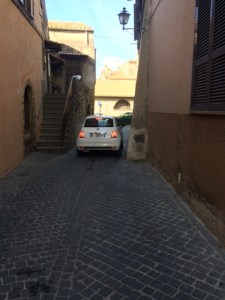
Our trusty FIAT 500* squeezes through the last hilltown via * See gearhead car critique later in blog progress.
It’s such a simple, straightforward drive along the coast to Fiumicino, surely we couldn’t get lost but, yes, we did. That darn bouncing blue ball on the GPS just does not move fast enough and we missed an exit, so now we are dumped onto a toll road to who knows where. Plus, these people drive like maniacs. OMG … Long story short. We manage to get off on secondary roads and end up at the old Roma harbor, where all the homeless live and the dumpster havens are. We opted to get to the airport at all costs, never mind if we were 5 hours too early or even 13 hours, just get us out of the car. Next: attempt to find our airline, in preparation for our next adventure – off to Israel, the most unholy of holy lands.
ISRAEL, GET ON BOARD, OR GET OUT OF THE WAY! – 04/11/17
Getting into Israel was a piece of matzos compared to getting OUT of Italy. if you recall, we arrived way early, and headed to the Iberia Airlines check-in counter. “Tel Aviv”? We have no flight to Tel Aviv”. I show the agent ‘Berta’s iPad with the confirmation. “Sorry, not Iberia”. I point to the Iberia logo clearly displayed on the page. “Sorry, not Iberia, some other airline, check the monitor … ciao”, So We find a monitor that shows a flight to Tel Aviv, that is departing at the correct time … Vueling? whatthehell is Vueling. We trudge the entire length of the international airline counters … no Vueling. The information agent directs us around a corner and behind the counters, where we find a check-in counter with a man sitting at a monitor. Me, “Hello, do you have a Tel Aviv flight tonight”. Him, “Not open yet, come back in one hour”. Me, “OK, can you just tell me if you are the correct airline code-sharing with Iberia for a Tel Aviv flight tonight”. Him, “Not open yet, come back in one hour”. Must be interrupting his Solitaire, Tetris, or Candy Crush game, I guess. An ever-increasing phalanx of confused would-be passengers collect, until an hour later the backdrop lights come on, the baggage belts start, and a second agent comes out. They both then stare at their screens for another 15 minutes, and finally without acknowledging the destination, start processing tickets and baggage. Me, “Excuse me, there’s no boarding gate on our pass, can you tell us the gate, please”? Him,“Check the monitor display … NEXT”! OK, I get it, off to the Italian version of TSA, which is a LOT more pleasant than ours, people actually smile, and even joke a little, even to the obviously Arab passengers being screened.
TSA, can you hear me now?: In fact by now having gone through screening in three foreign countries, including the supposedly notorious Isearli, I can say definately the our ‘Homeland Security Agency’ has a serious attitude problem … we are not the enemy!
We stare at an overhead monitor, look, there’s our flight in the next-to-last gate in the furthest wing of the airport, so we start our hike, but first we must brave the glittering, gaudy, over illuminated, and feared “Forest of the Duty-Free shops” This is not your usual line of shops facing a concourse. This is a twisting, convoluted, gold-flecked, marble paved, yellow brick road, winding its way through every overpriced name-brand shop known to modern man. Watches, diamonds, leathers, furs, perfumes, candy, wine, whiskey, toiletries, wigs, shoes, all placed so as to create an obstacle course of wretched excess … hell, it wouldn’t surprise me to learn that I’ve missed the opportunity to buy a duty-free Ferrari, gift-wrap and shipping free!
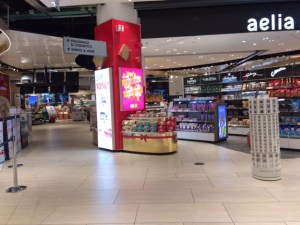
Picturing only a shadow of of it’s former glittering self, when still open … packed with shoppers and desperate gate-seeking passengers, like us.
After an interminable hike to the furthest reaches, we arrive at our gate, blank backboard, monitor, and unstaffed. We find a display, our gate number has disappeared, now what? A number of passengers have collected, and are attempting to communicate in a babble of languages. We latch on to a woman who speaks Spanish and has a smattering of English … good enough, ‘Berta Speaks English and has a smattering of Spanish, we can talk. A new gate pops up on the display, good. We follow to find another abandoned, vacant gate counter. After milling around awhile another gate number appears, leading us clear back to the now-closed and gated duty-free gauntlet ! Someone notices an escalator leading down, so we follow and find … another empty gate. As the empty room fills up airline staff arrive, set up, and again without mentioning the destination, begin the boarding process, directly onto a bus … shoot, I thought we were flying to Israel. When we got to our plane, climbed aboard and strapped in, we waited another 1/2 hour before starting to taxi out, and taxi we did, for miles. So, we aren’t going in a bus, but they’re driving the Airbus instead. And all this on a red-eye.
We had gotten communication from Natalie that the trains were stopped and, therefore, she wouldn’t be able to meet us at the airport and travel with us via train to her city. At the airport station we managed to purchase train tickets to Netanya and entered out to the platforms. But which direction to face to catch the train? ‘Berta had high school Spanish and Smit Latin, so Italian language was relatively easy compared to trying to figure out Hebrew. We can’t even read the alphabet to try and sound something out. This was going to be a challenge. So, we’re on the train going in some direction and attempted asking some of the young men around us which direction to Natanya. Of course everybody had a different idea. We came to a platform stop and decided to hop off and get somebody in some capacity of looking like a train station agent and figure out what direction we should be going. Yep, we were going the wrong direction. Change to the other side of the platform started us going in the proper direction. Called Natalie to give her an update of our status. She suggested asking somebody on the train to let us know when we were at the Netanya station. Thanks goodness there was an elderly man going a stop past our stop, and each time we came to a platform, Roberta would stand up and look at him, he would turn around and look at her and indicate handshaking, no no not yet more farther down or something like that. On the train we started to see the common, everyday militarization of the Israeli society. Israel has a minimum two-year mandatory military service in the Israeli Defence Force (IDF), for everyone, men and women. It is perfectly ordinary to see a uniformed young man or woman, strolling, riding an electric bike (more about that later), having a snack, or on their smartphone with a machine gun slung over their shoulder.
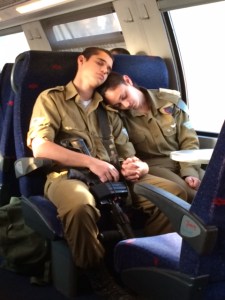
This, my ‘Murrican 2nd Amendment ‘defenders’ with your Glocks on your hips, and your AR-15 clones over your shoulder, scaring the old ladies and kids in Wal-Mart … THIS is what ‘open-carry’ looks like in a free nation!
If someone declines to carry a weapon for ethics, or personal belief, or if they have a disability, they may serve a non-combatant role, such as medic, intelligence, or clerical functions … but serve they will. This has the positive effect of uniting everyone in a common bond of service to the nation, and an unrelenting awareness of the nation’s precarious status in the middle-east. It has the negative effect of marking non-participating citizens as ‘others’. Oddly enough, there is a blanket draft exemption for religious reasons, which is mostly used by the ultra-orthodox jews, and they were the first targets of the fascist anti-jewish holocaust in WWII, and the eastern bloc countries pogroms for centuries. Ultra-orthodox do serve at their decision as do Arab citizens of Israel, to no apparent discrimination. We saw many couples, groups, and at the western wall in old Jerusalem, throngs of uniformed young people, armed to the teeth, laughing, singing, and dancing together in joyous camaraderie. In fact, Israelis are likely to burst out in song and/or dance at the drop of a kippah.
After many months of communication with our friend Natalie, who is the hula sister from Kona Hawaii, who made Aliyah*, the return home for any Jew who wishes to live in Israel; we were actually going to meet. Remember the ti leaf lei? Well R/I hadn’t forgotten it in Italy. I had managed to keep it somewhat fresh wrapped in a cloth and periodically hung it out, so it wouldn’t get slimey, next to where Rapunzel would be letting down her hair out of the window from our castle. I got the lei all ready to present to Natalie upon arrival. Of course, the big question was, what’s going to happen at customs. We wore the leis, reasoning that wearing a lei is known, while a curled rope of green leaves in a baggie might arouse interest, and possible confiscation. Going through customs into the “State of Israel“ as the border patrol calls it, there was no hesitation about giving us the go ahead to go through, with no scrutiny other than checking passports and asking how long and where were we staying.
* Any Jew that wants to ‘come home’ to Israel … ‘Make Aliyah’ must prove their religious bona fides. They will then be flown to Israel, provided with six months of supported housing and medical insurance, and given assimilation counseling, and Hebrew lessions. If they are of serving age, they go straight into the IDF, or equivalent service.
So we eventually arrive at Netanya. We hop off the train and there she is, we were all so excited. She had managed to get in through the barrier by sweet talking some of the guards. We were able to give her the leis, the two ti leaf ones braided and carried for three weeks. She explained in her new Hebrew language to the guards at the train station what was happening. They got excited. Natalie was ready to have us all do a hula right there. But we didn’t. We got in a taxi and went to see Natalie‘s Israel. After a short rest at her apt., we were off for a walking tour of her neighborhood and down to the Mediterranean Sea where we stopped for an “Israeli breakfast” at a seaside restaurante: platter of about ten small dishes of cucumber & tomato, humus, tuna, egg salad, fried fish, and more. Over lattes and an Americano for Smitty, we caught each other up on the latest haps of our lives.
Israel is a country [or State as border control called it] that is in a constant growth spurt. There are huge cranes (referred to as the national bird of Israel) on the top of every building with the assembling of the square brick edifices growing up out of the sand. Unfortunately, the quality of construction, fit, and finish pales when compared to Italy. They seem to be following the Russian soviet era proverb ‘Perfection is the enemy of good enough’. Indeed, that may well be the source, as after the collapse of the USSR removed travel bans, thousands of Russian Jews made Aliyah*, and many, if not most, of them entered the construction trades.
Transportation is covered by cars, buses, sheruts, taxis and bicycles*, and of course cars. Mass transportation is well used, and works very well. Israel has worked out a simple solution to the logjam of traffic, and making mass transit, not only viable, but preferable to driving. Every major street and all highways have a dedicated transit lane. Busses, sheroots, and taxis may use it, and they keep right on moving through stalled traffic jams. If you are in a personal car, don’t even THINK about driving in the far right lane, in fact you’ll get a ticket for moving into it to soon or lingering to long after a turn off or on the roadway.

* The cities are literally swarming with fast little 20″ super-fat tire electric/folding ‘beach bikes’, they are everywhere, in traffic, on the sidewalks, in the shops (they’re good for 25 mph and 50 miles pedal assist range). They are just so tres kewel the Smit chased down the manufacturer and we have two psrked on our lanai, we probably now use our car 30% less for local errands … watch out Kailua-Kona!
Sheruts are a unique Israeli form of mass transportation, mini-busses that hold fourteen or so passengers, and run fixed routes, but no schedule. The driver waits until the bus is full, or he’s bored, then leaves toward the destination. As passengers board, they pass their fare up hand-to-hand to the driver, who then starts the chain back if any change is due. It works perfectly, with the driver never even having to put down his cell phone. Wouldn’t last a day in NYC!
Natalie has many friends in many different sectors since her immigration to “her home land”: Dance Class-Israeli line dancing in a circle, and with partners—not as easy as it looks but lots of fun and a great work out. We three all did a couple of hulas for the class one evening. Someone took a video of one of them and sent it to her (not sure it will attach to the blog but it wasn’t too bad).
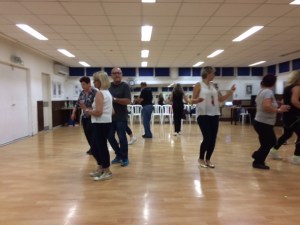
‘Hava nagila’ this ain’t. Some of these dances were complex interweavings of dancers with complex steps, think western line dancing meets square dance, in a big circle … this one we sat out.
Ulpan (language class) – there was no way we were even going to attempt this one. Natalie has done an incredible job learning this difficult language in 8 months and actually venturing forth to speak to anyone she bumped into along her walks. She even manages to get around the city and the public transportation system reading schedules and asking questions of the bus drivers – all in Hebrew. of our own. Natalie attends Hebrew school and is repidly becoming fluent in the language.
We suggest you don’t go to Israel without a Natalie along with you. And don’t even think about driving. Italian drivers will challenge you, but there is a certain logic to their machismo driving style. Israeli streets are pure chaos theory in action. Israelis drive with one hand holding a cell phone to their ear and the other on the horn. Don’t ask me how they also manage the ubiquitous cigarette at the same time.
Social gatherings – She also meets with friends she has made to form a kind of expat culture group – mixture of Sabras (born in Israel), Russians, Arabs, Americans, & Australians. She meets with them to practice her Herbrew and help others with English, as well as go on outings or excursions with them.
We were fortunate to get to go on a bus tour with them to a place called Ben-Shemen youth Village, which is a boarding school for children-at-risk, that functions like (and was indeed, started as) a kibbutz. The story is more than can be explained here but here’s the web link: http://www.ben-shemen.org.il . Basically, it is a very large farm that assists young children and teenagers to be schooled into a viable trade to support themselves at graduation. It started with the original Zionist movement in the 1920’s, and grew after WWII to support young survivors of the holocaust. Today it is a thriving chicken farm that produces thousands of chicks that are pampered like you wouldn’t believe. Perhaps it was 30,000 baby chicks that I saw when I was allowed to peer through a small window into a facility that is electronically controlled at the perfect temperature, humidity, and air quality for the sweet ones to grow. Small little troughs run the length of the facility providing the water and nutrients for them.


That’s a lotta schnitzels on the hoof, the all come ready to ‘harvest’ at the same time, when they are herded into trucks and shipped for processing. Adjacent is our not-an-E-ticket ride around the school. A couple of the guys were excited because the trailer was full and they got to ride on the tractor fenders. Smit declined, having spent enough time on a John Deere or Caterpillar seat as a kid on family farms.
There are no hormones given to these chickens. The chickens are sold to markets for schnitzels, and they’re also served in a cafeteria style diningroom where the public is allowed to come and pay for a meal. Guess what we had for lunch? Veggies and schnitzel (also a nice curry on rice … chicken of course). All the students participate in all activities but can eventually decide on a preference. The students board and only a limited number of students are accepted. And it is not all the smartest ones. They look at the life-style situation of the child, they have a psychological evaluation, and a determination is made as to whether or not they can help the child. We were driven around part of the property in a John Deere tractor trailer with the general director, Dr. Ilana Tischler, explaining the history and operation. She is the ninth director of the facility. Quite amazing when you think of all the years this village has been in operation. One success story she shared with us was of a young Ethiopian man whose time it was to graduate. He asked the board if they would allow him to stay on because he wanted to train as a long-distance runner. This young man knew if he had to work in the city and support himself,he would not be able to train as he needed. He was granted permission and eventually became a trophy winner, and is an Israeli athlete in the Olympics.
We also visited a workshop where a woodworker of amazing skill with a bandsaw and lathe, fashioned whimsical models and primitive wooden toys, and still had all his fingers. Interesting, and certainly unique, but not our cup of tea.
Around the area Pine trees had been planted a number of years back. It was 1967 when countries were asked for money to help plant trees in Israel. They planted small Pines and saplings that have since grown-up. Somewhere along the trip it was decided we should take a refreshing walk in the forest. This resulted in several attempts to enter a primitive reforestation recreational park, on rough dirt roads … basically off-roading a huge tour bus. After a couple of dead-ends where we were certain we would be stuck, the driver and tour leader finally gave up, and we headed back toward Netanya. My uncle, Ben Lillien had a tree planted in each of the cousin’s names, so one of those trees may have been mine!
Our last stop was the Mazor, a quarried limestone block mausoleum building built by the Romans. Israelis tried to tear it down but an archeologist was able to discourage them from doing so. It remains one of the few surviving Roman arched vault buildings. The site is open, and not manned. There were wedding photos going on, although why they chose a mausoleum was beyond us. Israelis are notorious litterbugs, and the site was no different, being well covered with tiny silver mylar stars from previous wedding shoots, one presumes, snd prophylactics … whether from after the wedding photos, or in place of them, one will never know.


An amazingly complete two millenia old building, one of the few remaining anywhere in the Roman Empire with an intact barrel vault roof.
While on the bus moving from place to place, one of the friends, who is a licensed tour guide, would trade off with another to interpret the sights in Russian (right side of the aisle) & English (left side of the aisle).
One Saturday we accompanied her to Synagog. She asked for permission for Smitty and I to accompany her up to the altar area to read a scripture from the old testament scroll, in Hebrew. She wanted to make sure that we could go up at a particular time so that the scroll would be open and we could see the Torah. There is a lot of protocol involved here (Smit was given a kippah/yarmulka to cover his head) and when she got the nod to go ahead and read, and she did it all in Hebrew before the “superiors” standing around the alatr, it was real chicken-skin time.
On Shabbat, Saturdays, EVERYTHING stops, even the busses and trains, so that no one can be forced to work on the Sabbath. Almost no one drives, so the streets are eerily empty and quiet. Not much else to do after our “spiritual” morning but go to the beach. That we did, and laying in the sun, eating dates and nuts was heaven.
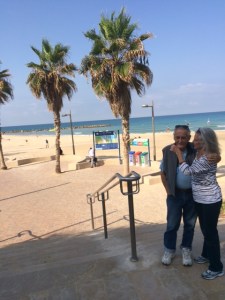
Comeon honey, let’s jump in, it can’t be THAT cold, can it?
Kapalili actually made it into the chilly water for a swim in the Mediterranean Sea. Natalie found some friends to visit with while Smit and Kapalili snoozed on the sand. A late afternoon visit to Natalie’s friends home got us involved in an interesting conversation about Aussies and Vegemite. We were gifted a small jar of “a new blend” of vegemite, which happens to be one of our most favorite spreads on toast. Don’t know where we are going to fit it in our luggage (but we do, nonetheless). If you’ve ever heard the Aussie Men at Work song … goes something like this … I come from the land down under, where …
… he just smiled and gave me a vegemite sandwich… This is it, the real stuff. Come on over when we get home and we’ll give you a down under experience on toast. Let’s see, where were we … oh, Natalie’s many connections.
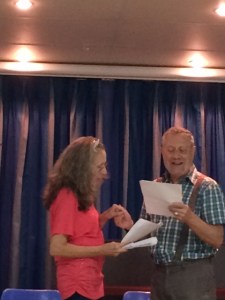
A pre-rehersal reading of a farcical one-act play.
Acting – Ahh, yes, she is also a thespian, who knew. So, off we went for a rehearsal of a play that she is in. By now we had met a few folks through all her various connections, so it was not only her, but her friends we were watching.
JAFFA AND JERUSALEM
Our first excursion was to Jaffa, on the coast just south of Tel Aviv. A major port dating from pre-history, Jaffa has served the Phoenicians, Jews, Greeks, Romans, Turks, Britian, Palistine, and now Israel … all of which have keft their marks on the ancient town. Although the port has lost it’s import as a commercial facility, it serves fishing boats and recreational mariners to this day. Jaffa was where we saw our first biblical site (actually verifiable, more about THAT later), the home of Simon, the tailor. We walked through the warren-like ‘streets’, that even a donkey cart couldn’t fit, and could feel the antiquity seemingly seeping out from the stones. This was the first of our ‘Free Walking Tours’ excursions, a unique business model we have never seen before. The guides are unpaid. They are schooled, tested, and certified by the Israeli Board of Antiquities, and licensed to represent the Free Tours parent company. After the tour, tourists (see, that’s why weʻre called ʻtourists’, eh?) tip whatever they feel is appropriate, and the guide pays a percentage to the company. We tipped the equivalent of a paid tour, as our guide was knowledgable, engaging, entertaining, and funny, as were all the Free Tour guides we walked with. They better be, or they would be let go by the corporate overlords! I asked how it worked for him (he was originally from New Jersey), and he said very well, and thanks for the generous tip. Of all the cities, towns, settlements, and kibbutzim we saw, if I were to live in Israel, it would be, somehow, in Jaffa. Not only did it feel warm (it faces west, so the afternoon sun heats all that stone), sheltering, and quiet, it overlooks the Med, with the harbor at the south, and a long crescent white sand beach to the north … that had a respectable shifting peak offshore surfing break!


A sculpture consisting of a tree planted in a ceramic pot, and hanging in space (look carefully) meant to represent new growth in an ancient place … or something. A long-shot of the beach at Jaffa, with the towers of Tel Aviv behind. If I were ever to move to Israel, this is where I would choose to live … even as a decent surf break below!


Playing around at Jaffa tourist trap and riding the ubiquitous Tel Aviv public transit.
Jaffa, with it’s ‘Jerusalem Gate’ facing east, was the precurser to our visit to Jerusalem where we met our Free Tour guide at the west facing ‘Jaffa Gate’. We three had come in on an inter-city bus from Tel Aviv (you go through a mini-TSA screening at all Israeli bus stations, but surprisingly, not the train stations), after a Sherut ride from Netanya. A tram took us from the modern central station to the perimeter wall of old Jerusalem. As we were early we entered the old city on our own, and walked around before the day’s business began.
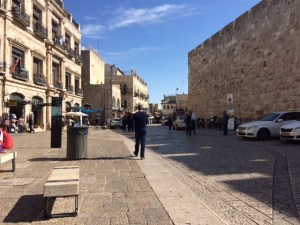
Awaiting the morning tourist crush in the old city.
After the city wakes up to the new crop of suc … tourists, you’re being hustled by shop-keepers, unlicensed free-lance ‘tour guides’, buskers, hustlers, fake Rolex sellers, and for all we know pimps. We were careful to never lose sight of the court adjacent to the Jaffa gate, we may never have found our way out again! The tour assembly plaza outside the Jaffa gate was a mosh pit of tourists, guides, tour brokers, and beggars, all talking loudly (some with bullhorns) and animatedly-like a cornacopia of languages. We sorted out the English from the international gaggle, and like a flock of compliant ducklings, followed our guide into the ancient maze that is old Jerusalem.
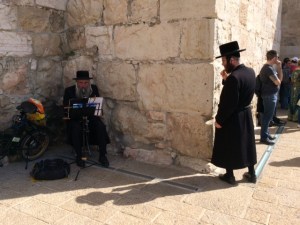
A Chassid busker playing clarinet for the tour group assembly, note the small folding bike against the wall, he may be ultra-orthodox, but he’s with it!
Oh, remember that list of attributes of the successful guide from Jaffa? For Jerusalem add TALL … it’ a great nav aid if your guide’s red hat can be seen above the crush of bodies at the holy sites. And crush is the only word that can describe the mass of the faithful, tourists, kids, elders, pickpockets, priests, residents (yes, people actually live in the old city, in fact among the orthadox of all three faiths, there is no better place to live) shopkeepers, delivery boys, and old ladies in black that swarm the narrow streets and courtyards of this city-within-a-city.
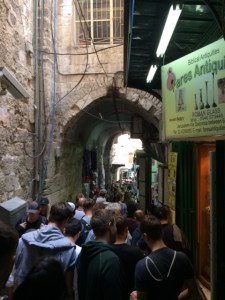
Just an idea of the crush of tourists in the vias of the old city … and this is off-season!
As we went from ‘holy site’ to holy site, we walked the same streets the bible tells us of Jesus and his followers who walked, including the Via Dolorosa, where he was led to Golgotha (the hill of the skulls) for his execution by the Romans by crucifixion.
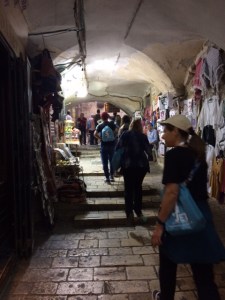
This is the last verifiable Christian holy site in the old city, the Via Dolorosa, all else is pure conjecture.
Each of the stations of the cross (as reproduced in every large Catholic church on earth) are clearly marked, above stalls and shops selling everything from dates to toy machine guns. Ancient religion vs commercialism on a single photograph. Mostly run by Arabs, the number of tiny shops and stalls, each about five meters deep, and two wide, with wares spilling into the already narrow streets is astounding, there must be thousands. There is a certain limit to the content of shops served only by walking streets, and offering to people always on foot. One passes a sweet shop, then one selling religious souvenires and fake memoriabilia, then fruit or vegetables,
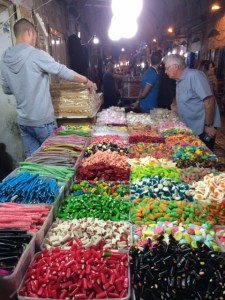
Enough candy to satisfy anyone’s sweet tooth, but nary a drop of chocolate, move on.
leather goods, toys, shawls and burkahs, shoes and sandals t-shirts (‘I visited Jerusalem, and all I got was a lousy crucifixion’), hats, brasswares, flutes and lutes, replica weapons … and then it repeats, in random order. As you pass, you are ragaled with peans to each shop’s quality over all others, with the most aggresive having a runner that follows you down the via. At least they no longer tug at your sleeve as in the old days, deliberate personal contact being a security issue. Looking at the (often desultary) faces of the shopkeepers sitting in front of their tiny warren (as often as not, smoking) one wonders how they can make a living. And all this traversing of this scene out of a Star Wars movie is leading us to … the HOLY SITES.
There is one sacred place that no one doubts, the Western Wall*, the remains of the great second temple built by King Solomon, and subsequently destroyed by the Romans. The great courtyard and wall are the very center of Jewish faith and history.
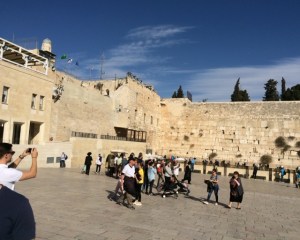
Everyone visiting the Western Wall and it’s courtyard takes away a small bit of history in their cameras, and in their hearts.


Natalie, at the women’s worship wall, and returning to the physical world spiritually refreshed.
Jews of every nationality, color, religious conviction from ultra-orthodox to non-observent secular humanists (there’s a lot of those, they invented the philosophy, after all) come to the wall to pray, reflect, or just bask in the warmth of the massive stones and eons of history. This is the core, the very reason for the existence of the city of Jerusalem, and indeed, the modern state of Israel, to come home to that place for direct communion with God, or however one defines the focus of one’s faith.


The temple mount regulated by Muslims rises above the wall, and overlooks West Bank, annexed after the ’67 war.


Hangin’ out at a (non-worship) section of the wall, in the archeological excavation/restoration site.
The wall is huge, and courtyard facing it an immense plain of fitted stone, parade gound, picnic meadow, playground, assembly point, and more. People from tours, religious goups of all faiths, rabbis, priests, families, individuals, men and women (separated by a fence, and segregated to different segments of the face), military cohorts, official and casual, wedding parties, and old people napping in the sun in their wheelchairs are all gathered an a constantly changing kaleidoscope of humanity. As one approaches the wall a hush falls, and the babble of voices and crowd noises falls away, leaving only the quiet murmur of prayers in many languages. People tend to stand , often swaying or repeatedly bowing forward and back (davening) in a hypnotic trance state, or kneel apart from others, as if actually alone, which in a sense, you are. The cracks and crevasses in the stone face are filled with thousands of folded up notes, written as a physical remnant of prayers. They may be on fine paper if planned in advance, or a bit of napkin, a receipt found in a purse or pocket, or even a bank deposit slip torn from a checkbook. I’m (Smit here) one of those previously described non-observent secular humanists, but I still felt a sense of peace as I stood with my forehead resting on those ancient stones, standing in a place I first learned of in Sunday school, in some forgotten air force base chapel. I (Bert here), on the other hand, wrote a note with my prayer and tucked it into a crevice.
* Formerly referred to as ‘The wailing wall’ referencing the laments of those few Jews who could reach it while it remained under Muslim control, the name was changed after unilateral annexation (Israel would say ‘liberation’) of the West Bank during the 1967 ‘Six Days’ war.
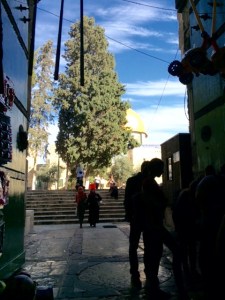
This is as close as the Palistinian police guards would allow us to the Dome of the Rock, the site of veneration by Christians and Muslims is controlled by Muslim imams.
The Dome of the Rock above the wall (closed to non-Muslims during our visit) rises above, and can be reached by a long slanting covered ramp (which in the opinion of this writer is a visual abomination, and should be removed immediately, tourist access be damned). There is also, this being the 21st century, facing the wall and accessed by a glass door, an air-conditioned enclosed foyer for the faithful but faint worshipers. From the main courtyard, we progressed to the foundations of the temple, being excavated and preserved by archeologists. There one can observe from platforms and catwalks, the exposed tumbled and still standing building blocks of the wall and the bridge that originally spanned the moat-like perimeter of the temple. As deep as the excavations are, they’ve yet to reach the true base. Leaving the temple grounds our walking tour passed through a gap in the original defending wall of old Jerusalem and entered the West Bank, siezed by the IDF in the ’67 war, lands still claimed by Syria and Jordan, on our way to the purported ‘Upper Room’, one of the very foundations of Christian dogma.
We’ll let the photos describe the various churches, tombs, osuaries, rooms, and shrines, words fail. What all have in common is mobs of people being led by a veritable U.N. of guides, representing followers of the three Mosiac faiths, Judiasm, Christianity, and Islam, being led to their respective places of veneration (often, the same locale, being ‘managed’ by clergy of all three) Then of course, there are the ‘non-aligned’ secular tours, as was ours, following the flow, and often gobsmacked by the emotions being spent at ‘holy sites’. About those sites …


Mosaics of Jesus being taken from the cross and laid out for burial shroud wrapping


The purported stone upon which Jesus was laid, a place of great veneration by believers. Two tombs of unknown provenance, sacred just the same.
No one REALLY knows. Through the ages preceding the introduction of Islam and the Crusades, the entire region was subject to wars, demolition of abandoned buildings to cannibalize materials for new, and just plain old neglect. The point is, by the turn of the first millenium, pilgrims were starting to arrive to worship at the known world’s most holy city … after all, the Egyptian, Greek, and Roman civilizations were dead and gone, and their temples and shrines in ruin. Quick, we gotta have something to show them, or this lucrative new religious tourist business will wither and die. So, likely sites were chosen, and by mutual agreement designated as THE VERY PLACE where whichever event happened. This process accelerated when the crusaders arrived and started trading ownership of Jerusalem with the Muslims, through a series of bloody, and fruitless wars. They just built new sites out of whole cloth, again destroying existing structures for building materials, and naming THE PLACE THAT … So, when you visit Joseph of Aramea’s tomb, or the slab upon which Jesus was wrapped for burial, King David’s tomb, and most especially the ‘Upper Room’ remove the rose colored faith glasses, and view them through the eyes of history.


The entrance to and foyer of ‘King David’s tomb’, it is said …


The exterior of the ‘Upper Room’ where Jesus had the Last Supper, celebrated by Christians with the consecrated wine and bread, actually built by the Crusaders around the 11th century, directly across the lane from the church built some time later by a follow-up crusade.
About those crusaders, what a nasty bunch of ‘Christians’ they were, hiding behind their St. James cross tunics and armour. Their victory modus operandi was to force the losers to convert at the point of the sword, then slay them anyhow, they now being saved and deserving of entry into heaven on their baptisim ticket-to-paradise. That’s, of course, except for the ones strong enough or skilled enough to be enslaved to build all those nifty new churches encompassing the freshly consecrated holy sites. I’m kinda glad the Turks eventually finished them off so they could enforce their own brand of holy fascism … cynical much, Smith?
Between all these activities, we walked to open markets, shopped, had coffees and shopped. Since we have zero room to collect anything, shopping was minimized. But who/what can stop a woman from shopping. Its a struggle. Berta wanted a mani and a peddi. Oh my, what an experience that was. Natalie took us to the spot where she had some “assistance” when she broke her arm when first she arrived in Israel. An appt. needed to be made. Come back in an hour. Okay, the three of us cruise around doing “window” shopping. S ends up looking for yet more coffee, N ends up buying a giant something or other to eat that she had not tried before, and R circles back for appt. time. We all ended up rendezvous at the nail place -sort of an external parlor in the middle of a fancy kind shopping mall. R is sitting with nails engaged. N starts feeding nibbles to R like a mama bird to chick, and I /R luxuriate while my tootsies get plunged into a warrm bath for prep. S is sipping coffee and looking for anything to get himself outta this situation, he gives me kisses and takes another walk, N stays and feeds me bites of her fantastic whatchamacallit. It was wrapped in nan or pita something like a burrito, had meat and veggies, I think, and sauces, and was delicious). I get into a very interesting conversation with this young Israeli woman of about 23 yrs. while fingers and toes are being made beautiful. You remember the explanation of how all youth serve in the military, well this young beauty said that she did not want to have to be meeting with, exposed to, or pressured to be amongst men. Wow. So there is an option. She, and others, with similar situations or letgitimet reasons can do service in a government agency. She had done some clerical work. When her time was up, her mother told her that she had to get a job; she went to nail school. When I mentioned that it looked like she had shoulder pain, she really opened up. She told me that she was in so much pain that she couldn’t stand up straight any more. I suggested she try to find another type of job. She said she had a night job working on a computer doing some kind of trouble shooting for a reservations firm. She does have a goal: Upon saving enough money, she’ll get to New York to stay with an older sister and start a different life. Ahhhhhh. Now I felt quilty with my pleasures in exchange for pain.
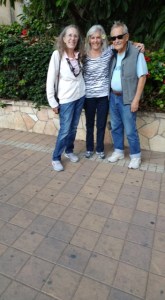
The ‘gang of three’, going out to, or coming home from another excursion in Netanya.
We all walk home to Natalie’s to make a homecooked meal. Natalie was an excellent tour guide. Most of the time she accompanied us. Or she set up a tour and we went on our own. I/R have to say. That I am a bit ignorant about historical events and history in this part of the country. I thought I would hear bombs dropping in Palestine and soldiers with bazookas ready to fire. But that has not been the case. While i can see that these young men and women are carrying live weapons, most have the magazines out and tied to the stock or some other part of the gun. Everything has been quite orderly and nonchalant, except for the taxi, bus, and auto drivers. I have learned so much from being here and the tours that we have been sharing with you.
Smit had Jewish relatives growing up. They were pretty much secular, and non-observant, except for high-holidays, but there remains a fairly comprehensive understanding of Jewish mores, culture, and history … for a goyim. Unfortunately, all the words he knows are Yiddish, and of little use in modern Israel.
What is amazing is that at some point back in the time before the crusade ages, a rare era in history occurred in both Israel and Spain, when Muslims, Christians, and Jews found a way to live with each other in peace and prosperity (and that is the history which we are traveling though now and the next few weeks in Spain). Could it ever be thus again?
On our bus tours to Jerusalem and Masada, we could see Jordon over the border, off in the distance, but it was much larger than we had imagined. We rode past Palestinian walled-off enclaves, and could see the dividing wall separating Israel from the Palestinians. It was an ugly thing, both physically, and ideologically. I cringe to think that so many Americans support the same thing for the dividing line between the US and Mexico.
On our tour to MASADA, we passed thru Qumran where a child was minding the goats and came upon a ceramic jar in which was found the oldest transcriptions of the Jewish Bible, predating previous examples by more than a thousand years, and written in the original Hebrew.
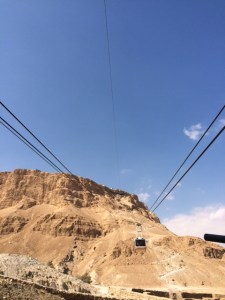
Masada, at the top of this mesa, the home of Jewish rebels against the Roman occupation of Israel, and considered impregnable … except it wasn’t.


From numerous Roman army encampments, such as the one on the right, the army built a massive ramp, reaching to almost the top. They then pushed massive wooden siege towers up the ramp to the wall, and eventually breached Masad’s defences. It’s amazing what you can accomplish using only human labor … if you’ve got enough slaves, that is.
This edifice was built around two centuries BCE (Before Common Era = replaces AD Ano Domini) by Jewish kings for times of difficulty. A stand-alone mesa disconnected from the surrounding hills/mountains was chosen by King Herod the Great, who loved the dead sea area and made this his winter palace. Although he was Rome’s puppet governor, the palace shows no Roman influence, and the designs and decorations were in strict accordance with Jewish law and custom. In later years the palace was abandoned. There was a Jewish rebellion against Rome, and the rebels fled to the mountaintop as their last refuge.
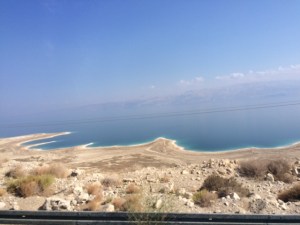
From the ramparts of Masada, the desert and Dead Sea, far below.
They survived on top and within the mountain until the Romans encircled the mountain and built a huge ramp up the side, and ultimately breached the fortifications. The Jews realized that they had no way out, and they realized that they would be forced to live against their law as Roman slaves. Rather, they chose to die free. Suicide is against Jewish law, so the men each killed their families humanely, by cutting the carotid artery. Lots were drawn for the last ten men, who then killed the men, until only one was left, who, accepting the ‘sin’ killed himself. When the Romans broke thru the last barricade, they found the weapons neatly stacked and everyone dead … but not quite everyone. A couple of women hid themselves and their children in a cistern, and they related the tale to the legion’s records keeper, a Jewish scribe, who preserved the tale in the official records of the 10th legion. As time progressed, Masada became a symbol of Jewish heroism. Now, you will have to visit Uncle Google to find the r-r-r-rest of the story.
TO THE SEA, TO THE SEA … THE DEAD SEA
Much of the fresh water flowing from the Sea of Galilee has been diverted for agriculture, people and industry. In past decades the shoreline at the spa resort we visited has retreated almost three km. This subsidence has created a lot of sink holes in areas where the shoreline has retreated, currently about 6,500 sink holes, and more occuring without warning, which make it a very dangerous area to walk on.
The saline content is increasing, making floating even easier, but in less than 100 years the entire lake (for that is what it really is) could be gone. Since this would effect Jordan and Palestine as well as Israel, it has become a problem of concern for the entire region, and a solution may be a channel or massive pipeline to connect to the Red Sea. Since the sea is about 700′ below sea level the water can be used to generate electricity, and that power used to desalinate to extract fresh water, with the remainder of now concentrated ocean water resurrecting the Dead Sea. Hey, it’ll even help with rising sea levels caused by global warming!
However all this percolates into your understanding, you can float on this water, not in, ON. Yup you can, in fact it is very difficult to submerge your legs and feet when you wish to stand. We wore our slippers wading into the water because eons of salt settling like sand ripples under the water have solidified and formed very sharp ridges of salt. The water temp wasn’t warm, but it wasn’t cold.
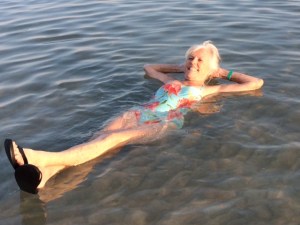
With a salt content far higher than the Pacific Ocean, Kapalili floats highr in the water than at home, but sorry, no colorful tropical fish … or any other living thing. Hmmmm, I wonder if that’s why it’s called the ‘Dead Sea’?
Ladies, it is not something for the weathered skin, therefore, it is not recommended for staying in longer than 20 minutes. Your skin quickly becomes irritated without washing off with fresh water … which is provided, would you believe, right there, in the sea. Piped down from the spa complex above and set up IN the water by the shore with overhead water-shower-off heads, ideal for Iron Man … shower off and go. By the time we walked back from the’beach’ (and it is just like a beach on the Med, with chairs, recliners and umbrelas available) to the waititng area, or, actually the tractor-trailor shuttle vehicle cabana, our soles and arches were being eroded by the salt. Smitty wanted to take a last picture of the setting sun on the Dead Sea, SO we had to hustle to catch our bus back, which meant no time for shower. Roberta’s feet were with salt sores for a week. We have been periodically soaking her ‘slippah’ in fresh water to salvage her favorite yoga slippers. ‘Berta did acquire a bag of Dead Sea cosmetic mud to add to our Vegemite for luggage load. Smit hopes it works a LOT better than his Ternia d’Saturnia mud facial!


Those sharp salt crust ridges on the sea bottom, snd that sunset photo, hard won by ‘Berta’s pained feet … sorry hon, I shouldn’t have taken the time.
A HUNT FOR THE TIBERIAN BATHS ON THE GALILEE SHORE
We ventured off on a bus excursion to Tiberius, on the Sea of Galilee (actually, another lake, albeit a big one), to avail ourselves of the ‘Roman baths’. What we found was a somewhat modern small city, where the local bus dropped us off at the hot springs ‘spa’. This turned out to be a large structure, vaguely resembling a bus station with locker rooms, a cafe, and trinket shops selling fishing related tchlotskies (‘Fishers of men’, get it?).
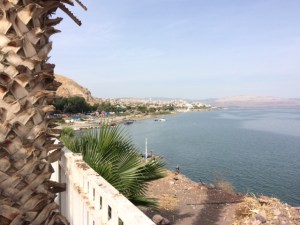
The Sea of Gallilee, aka Lake Tiberius, where Jesus recruited Peter and other fishermen and took a stroll across the lake.
After changing we exited into a large deck area facing the sea, and containing a clear, cool olympic sized swimming pool, and steps leading to a pair of somewhat murky green warm-to-semi-hot pools inhabited mostly by Russian immigrants, who hogged the hotsprings inlets. We paddled around, seeking hot spots, laid on chaiselounges in the sun, and did a few laps in the olympic pool. None of this felt even remotely Roman. After a rinse, we met at the cafe for a snack, then went out to wait for the local bus. There, across the street, and partially buried in the hill behind, was a ancient Romanesque building, in obvious good repair, advertising spa baths. By now too late to redirect, we took away a lesson we should know from Hawaii, always look around, and don’t just go where the tour bus drops you off, the driver is getting a kick-back. Not the trip we anticipated, but a relaxing, interesting bus ride, a refreshing nap on the way back to Netanya, and HEY, we managed a day trip to the unknown!
Things we will remember:
*Natalie standing waving her arms to catch out attention wherever we were so we wouldn’t get lost.
*Swarms of kids (and adults) riding small fold-up electric bikes. In fact we liked them so much we located the manufacturer, and have ordered bikes for ourselves in Kona.
*Beautiful women with dark black eyebrows and heavy eye make up, and long black hair and olive skin. Men with bald heads. Uniformed young men and women laughing and singing arm-in-arm … machine guns slung over their backs or strapped to their hip.
*Dogs dogs dogs and poop everywhere.
*Cats cats cats everywhere by the sea. No controls no spay-neutering.
*Plastic bags and wrappers galore. Some consciousness of recycling, but they have a long way to go
*Open mindedness in the realm of sex. They are, after all, building a new nation and building structures to house all the new humans.
*Almost everyone smokes and drop their butts in the sand or on the ground.
*Sandy beaches that desperately need a tractor of some sort to rake through the sand to clean it.
*Need for water spigots at Airport and in public areas. Stop using prescious water to powerwash off public walking areas of dog poop. Educate the people to take responsibility for “doing due dilligence for your doggie poo”
* Spanking new post-modernist skyscrapers with afterthought air conditioners, wiring, and plumbing stuck onto their sleek sides because they don’t do central air/heat systems.
* Traffic!
And finally, a nation of people that are bonded and united in their desire for realization of a state/nation where they will all be cared for by each other and their government. Israel is more that a State upon the map, it is a state if mind. That far from perfect, and still struggling with the make up of middle east nations, a hold-over from the post WWI British Madate, the psychological trauma of the WWII holocaust, and the flood of immigrants from Ethiopa and the dregs of the USSR, they are, and will comtinue to forge ahead in building on the ruins (literal as well as allegorical) of history.
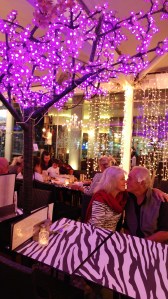
Nearing our departure from Isreal to Spain, we celebrated our 34th anniversary. Thanks for such a wonderful long-strange-trip, darlin’!
ESPANA, EL CAPITOLE CUIDAD – MADRID – 13/11/17
We arrived at the Madrid airport at around 4:30pm, after our flight from Israel. The Madrid airport is huge, with four separate terminals spread up and down the field.
Madrid airport perpetual motion attempt. The lights shine upward to solar cells which generate electricity … etc.
To get to town on public transit we would’ve had to take one shuttle to a different terminal, a bus into town with one exchange, and then find our hotel. This, of course, is while we’re dragging three rollies, caring a duffel bag, Smitty wearing a backpack, and Roberta carrying a large sling bag over her shoulder. This is not the normal Smith practice of traveling semi-light, but we are carrying clothing to accommodate climate zones from the tropics too brutal winter in Switzerland (as of this writing, our Swiss destination has already recorded a -4° f … what are we thinking of?). Learning our lesson of Rome101, we opted for a taxi to our Hotel Plaza Mayor instead of getting our rent a car and figuring out the street scene in the dark—good move — late in the evening we never would’ve found our way to the hotel.
We became very familiar with Plaza Mayor cuz it was just a block away from our hotel. It is a vast cobbled traffic-free area with a statue in the middle (Phillip III). It is 140 meters long X 100 meters wide, and is a useful navigation landmark. If we got lost we could always be led back, and from there find our hotel. At night it’s all lit up with wall-washers and decorative lights; shops set up tables for customers to stop and sip coffee or drink wine or small beers or whatever, and families stroll, push baby buggies, and watch kids running around. Every other 5 people has a dog. It’s Spanish verson of the paseo in Italia, (same activity, different cigarettes). The general feel on the street is very upbeat with a sense of anticipation; almost like a modern bazaar. And, the women here like bling. Tennies like we’ve never seen before. Women are dressed well and generally with coats because it is chilly. No hats. Scarves are envogue. The men wear tight fitted pants and wear pointy shoes, of course, and there are tight jeans and tennies worn by all ages as well.


El Hotel Plaza Mayor, and the sunset view from our room window.
Although the Plaza Mayor hotel is located on Calle Atochia, a street that leads directly from the main train station, the sign and entrance are tucked away in a little cul-de-sac street. We got ourselves checked in and situated into our room which was small but quite cozy. The hotel is listed as having an ascencior (elevator), with our luggage train, necessacito! What they omit is that the elevator starts on the first floor, and as you have all learned, that is really the SECOND floor! How small was our room? Very small. In fact we had to walk around our luggage to get back-and-forth between the bed and the bathroom, or to the window to enjoy the lovely view of sky, tiled roofs, and church spires around the plaza. We staged our luggage around, leaving a path to the aseo (WC) and were set for the night.
Things we learned right away: Spanish urban street signs are lovely enamled plaques, mounted high on building walls at corners. No two look alike. They may be done in the style of the building architecture, and compatable colors, or not. They may face the street being named, or be around the corner … and remember, there are FOUR corners! All very fine if you are walking, or maybe astride a tall horse, but if you are driving a low car, and the city bus behind you is two feet off your back bumper, and honking his horn, not useful for navigation. We will come back to this, later.
Next morning we got up earlier than most of our ‘first mornings after airplane international travel’ (for which I credit the taxi ride), went down to the basement through a maze of stairways to the breakfast area. The complementary breakfast turned out to be reasonably decent, at least the scrambled eggs were done, and we could find some completely cooked bacon. From there we went out into the city, carrying our Rick Steves guidebook with the Madrid section torn-out (per his suggestion). We spent the day walking up and down the circular walking tour, which proved to be interesting and entertaining.
The guide book breaks down the tour of the Gan Via by architectural epochs, which when pointed out, clearly exhibit the eras in which they were constructed. We gazed upon buildings and embellishments from Romanesque/renaissance, to Belle Époque, arte deco, Bauhaus, Soviet brutal (thank dictator Franco), modern (1950s), and post-modern. A very interesting arte deco hotel, the Dear Hotel (named after room rates) was particularly intriguing.
The Dear Hotel: Rick Steves (RS) is enamoured of this little botique hotel … I suspect HE can afford to stay there. He gives the rest of us the game plan to at least experience the ambiance. “Walk in, look like you belong (and dress like you can afford it), go directly to the elevator and ascend to the roof, where you may enjoy a striking panorama of the entire city of Madrid”. Which we did, immediately accompianed by a large security guard with a black suit, a buzz haircut, dark shades, and an earbud. We felt like we had our own personal NSA protection staff. The ascensior let us off in a terrace restaurant (thankfully not open, or our guard may have forced us to eat there, to justify our intrusion into this rarified locale). We walked up a steel stairway hanging to the side of the building, think a NYC fire escape 13 or 14 srories up, to the roof patio, which meandered around the central structure, and indeed DID provide the view promised. There was even a small lounging pool, attached to one of the corners, and we tested the water, resulting in a semi-frozen hand. On our descent, in the elevator our friend slid in behind us. Sneaky bugger. Asked him how his day was and he was pleasantly communicative. Upon leaving, we obtained a card, for future contact should we ever win the lotto.


Views of Madrid from the rooftop terrace of the Dear Hotel
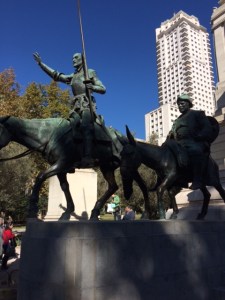
Don Quixote and Sancho Panza ride across their park in Central Madrid.
From the Dear, it was a hop across the Gran Via to a large park, dedicated in entirety to a fictional character, Don Quixote’, not the author Cervantes, but to his creation, including Sancho Panza. We looked in vain for a sunny perch to rest, but all the park benches not shaded by the many impressive trees were occupado, so we walked back into the sun toward the gardens of the royal palace and cathedral.
The jardin de Palacio is a classic hedge maze encompassing a large reflection pond lined by staturay suggesting the history of Espana, upon which to reflect. Much statuary attention was paid to hundreds of years of Roman generals, a few Moorish Caliphs, and a whole slew of Spanish kings and queens. No identifiable Jews or fascist dictator Generalissino, Francisco Franco were there, despite their respective impacts upon Spanish history. This is the land of Queen Isabella and Ferdinand whose kingdoms were united in 1469. With Madrid as basically the center of Spain, it became the hub of the newborn powerful empire, so there was lots of history to see and learn. The palace itself is huge, and encompases an especially large paved parade ground, used for royal pagentry, and the occassional execution. Directly opposite is tha Madrid Almudena Cathedral where construction was stalled for generations and only completed to welcome the visit of Pope John Paul II in 1993. We declined to tour either, but headed across the Parque Oeste.


The palace and cathedral face each other, the massive cast metal doors depict the sorting of the saved from the damned, a common welcome to Spanish and Italian cathedrals.
We had a lovely, sunny midday lunch at the outdoor café facing the park. And when we went into the main part of the café to avail ourselves of the aseos, we were overwhelmed by the Belle Époque splendor of the interior. It was over decorated to the point of excellence. We were directly across the park and plaza from the royal palace and the whole thing was just so comfortable and European that we hated to leave to find our way home for a siesta … but siesta we must.
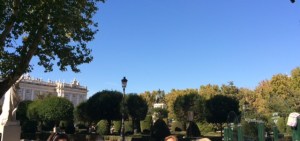
Parque Oeste, directly across from tha palace, in the background.


Across Perque Oeste we share a quiet lunch started off with a house specialty, Irish Coffee … en Espana
As we wandered the walking vias back toward Plaza Mayor, we stumbled upon Mercado de San Miguel, a local and tourist ‘open market’, open in name only, as it is entirely glassed in, and climate controlled. Inside is a cornacopia of shops, tapas stands, wine sellers, bars, curios, hustlers, pickpockets and hookers. It is thoroughly entertaining, and if you’re hungry and can’t find something to eat and drink there, you deserve to be on a diet.


Just a sampling of the almost unlimited offerings in el mercardo
We went out to the tight-knit streets looking for a recommended (by Rick Steves and our hotel desk clerk) flamenco dinnershow cabaret, Las Carbonares, which after wandering around for half an hour, we were directed toward, only to find it less than half a walking block from el mercado. The booking desk was open and we bent our credit card making an early show reservation, then finally went ‘home’ for our siesta.
The cabaret Las Carboneras: ‘The coal bunkers’, referring to a previous use we suppose. Despite being on Rick Steves list of to-dos in Madrid, being convienent, and a recommendation from our Hotel Plaza Mayor desk clerk, we were underwhelmed. We arrived at the restaurant a little bit late of our 7:30 booking, maybe five minutes or so, and the place was already packed. We were escorted to a table directly in front of the stage as had been promised during our booking in the afternoon, and promplty served a bottle of vino tinto. After plunking down a hefty advance purchase dinner/show fee of €70.00+ each, we expected a stellar evening, however such was not the case. We found the food unpalatable, and the entertainment somewhat stilted. Perhaps we were over-expectant, but the Flamenco show seemed more like the performers doing their job than the exuberance one expects from a dance form as expressive as Flamenco. We’re from Hawaii and have seen enough hula shows to be able to tell when a performer is ‘on’ or watching the invisible clock.


The flamboyant flamenco, every city claims to be the source of the purest form.
The audience (which to be fair, consisted almost entirely of a high-school age, a group from Iowa perhaps, Kansas, or someother US fly-over state judging by their accents) was mostly unresponsive if not texting on their smart phones. Maybe the late show was more lively. The multi-course meal was a disappointment, with an airline-prepared quality paella, inhabited by shell-on shrimp staring at you in accusation, somewhat greasy sausage, gristly undercooked chicken thighs, and certainly no saffron … tumeric being a common color substitution.
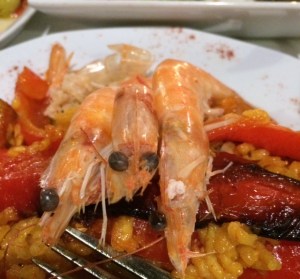
Need we say more … our paella is looking at us!
The crouqettes were dry, and the dessert was chaulky. We finished nothing. The single bottle of wine was good however. If we had another go at it, we would look further for other show options, and if we were to yet end up at Las Carbones, pay for the show only, and head back out onto the streets around Plaza Mayor for wine and tapas. It’s just a few meters down from the lively Mercado de San Miguel, which offers it’s own lively show of people-watching, music, and the food is certainly better, and far less expensive.
The open-air Mercardo de San Miguel is a great entertainment venue as well as being able to walk around and get little pinchos and tapas of one’s choosing from an almost infinate offering of varieties. Having just eaten what we could of the Las Carboneras fare, we opted for a small taverna just across the alley that we had visited earlier. The family owners were friendly, it was warm, the wine was cheap, and there was some interesting ‘Spanglish’ conversation as well.
The next day we decided to sample the almost universal Spanish breakfast (don’t these people cook ANYTHING?), cafe’/chocolate con churros (you’ve seen them in Mexican restaurants, long snakey desert strands covered in sugar and cinnamon). Well these looked like that, but were plain, greasy, and reminiscent of deep-fried packing peanuts, once tried easily passed on in the future. Even dipped in one’s coffee they were unpalatable, and they left a sheen of grease in your cafe’. After ‘breakfast’ we went shopping at a huge department store- ‘El Corte Inglis’, which is a countrywide chain, where we picked up a large scale road map of the entire country. Smitty went shopping for a pair of skinny European style jeans … kind of hipster-ish but cheap,17 bucks for a new pair of jeans! The place was huge, covering most of a city block, and comprised of who knows how many stories surrounding an inner atrium. The most interesting part of the shopping experience was paying. All purchases are carried down to a bank of cashiers, where one waits in a TSA-like snake line between ribbon barriers, until finally reaching an available cashier. The walls are lined with P.O.S. displays of all sorts of on-sale offerings. It works too. We saw moms succumbing to pleas for toys and candy, and even an apparently unplanned luggage purchase from a pile of violent pink rollies as high as your head.
We visited the Telefonica skyscraper where there was a special exhibit telling of the story and evolution of the telephone. Remember Erica phones? One item reminded us why we oft dislike visiting museums, our iPhone 5s are already museum pieces!
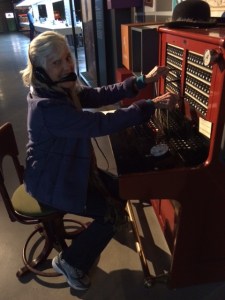
One ringy-dingy … is this the party para hablar, snerk!
After a drop back to the hotel for a siesta, we ventured out again, ending up at the famed Prado Museum. We were met by the Invisible Man, a living statue.
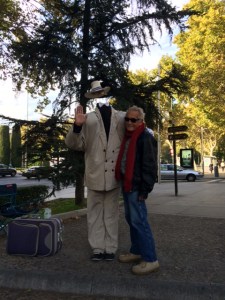
If I look a bit apprehensive, who wouldn’t being hugged by a man who isn’t there.
The Prado Museum had special exhibits of Goya, El Greco, Velaquez, and Rembrant. Picasso’s famous Guernica was at a different museum (Reina Sofia) but we pressed on learning and trying to understand more about cubism, which was a challenge. One could base an entire vacation around it’s offerings of famous art, but we honestly gave it short shrift. There is just SO much fine art, you begin to glaze over into a kind of ‘ho-hum.’ Perhaps the most moving was seeing Goya’s progression from a new standard setting romantic realist into a descent into near madness as he succumbed to deafness, stroke, and failing eyesight in his later years. And then to come out of his depression painting colors and flowers again. We left as it was getting dark and found our way back to our neighborhood on vias new to us, but strikingly similar to those already walked in Madrid, and, previously, Italy.
A final outing to Plaza Mayor, wondering around in the evening dark to find a vino tinto as a nightcap, we found ourselves once again at that friendly bar we spoke of earlier. It only seated 2 or 3 around 2 high tables and 3 or 4 standing at the bar [which is quite customary to do]. The woman who inherited the place and her husband who cooked were the hosts. We ventured forth with using our meager spanish and they responded by giving us 2 small bowls of soup. When looking at it, it was clear, had a few small flat beans in it and perhaps it was small leaf bits of cabbage. It tasted delicious. This led us to further bowls of bean soups throughout Espania. (More about this later).
On our last outing day, we decided that we had to get an uke to play for Alvaro Neil – Bici Clown’s last hurrah of riding into his hometown in Oviedo, Spain. It was because of this event of the completion of his 13 years riding around the world that instigated out trip to buy one way tickets to Europe. More about this later. We were early out onto the streets this morn, wanting to get an early start. It’s a whole nother world at this early hour of 8:30-9:00 am. Shop keepers are just arriving, sweeping, hosing down all the dog poop etc, trucks arriving to deliver food stuffs, chairs and tables being set up for cafe etc. well, obviously we were too early to buy an uke. So where did we go? McDonalds. we had heard that the Spanish folk love McD’S and Burger King. Gotta say, the green jamba juice, cafeʻ and croissant were delicious. Smitty successfully google mapped us to a music store, and believe it or not, Jake Shimabukuru has not been here but we were able to get us a Kohala ukulele.
Day three, we breakfasted again at our hotel, only to find out at check-out that our ‘free’ breakfast, courtesy of Rick Steves booking, had been used on day one, and our subsequent additional 2 nights thru booking.com were not entitled to that benefit. So our simple breakfast for two came to €24, our most expensive meal in Spain save the overpriced Las Carboneras dinner. Out to the airport in a taxi again because this town is just nuts to get around with high-speed freeways basically cutting it in half, and we didn’t want to cope with public transportation. Taxi please! We were let out at the airport, Terminal 1, and found our way to the rental car place, where we picked up our little ‘El Coche’, an Opel clone of the Fiat 500, and got ourselves headed out of Madrid while attempting to avoid the ‘motorvias’.
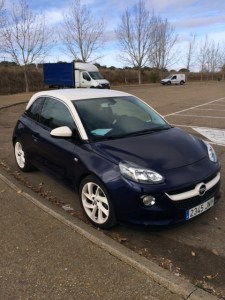
El Coche (the car) Fiat 500 clone from Opel (more about that later).
We wanted nothing to do with them … unfortunately later on we ended up on one, but that’s another story for near the end, during Smit’s return of El Coche to Madrid.
NOSOTROS VAMOS … a norte a la fiesta ‘Bici Clown’ en Oviedo. – 17/11/17
With El Coche check out, loaded, and iPad nav-aid turned on, we attempted to leave the Madrid airport … ‘attempted’ is the operative word. The international ID code for the airport is ‘MAD’ and it is true, in every sense of the word. We went around the same roundabout three times before we figured out which road actually left the field. Also, the highway designator on the Michelin map doesn’t match GoogleMap, which doesn’t match the highway signs most of the time.
What we learned about navigating Spaniah roads (within the first hour): Highway numbers are clearly marked on all highway and secondary road signs, but they change in seemingly random fashion. When navigating toward a major city, the final exit often displays only the nearest small-town destination (which is invariably NOT on the maps), and not the city you are heading toward. Final turn-off and exit signs are always placed right AFTER your last opportunity to leave your present roadway (this is especially true when approaching a toll-road entrance). The slower you are going while attempting to orient yourself, the bigger will be the truck or bus hanging on your rear bumper!
Our initial departure from MAD was much like the experience leaving Rome, but once we got away from the airport we were able to find our way out into the country, and the highways leading north to Oviedo. We did pretty well and ended up in Segovia which was not too far, maybe 2 Hours north of Madrid. We arrived in mid-afternoon, found a parking place, then went looking for our hotel after stopping in a tapas bar for a cana (which is a short beer). After our refreshment break, we wandered around until we saw the aqueduct and knew that our R S guide book recommended hotel was neaby.
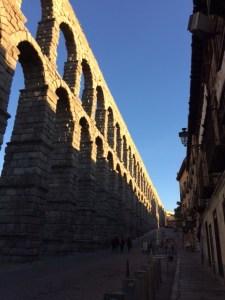
The famous Roman aquaduct is still standing after 2,000 years … what is most amazing, is that there is no mortar, the cut stone blocks are dry stacked!
Hostal (that’s what small hotels are called in Spain) ‘Residencia Don Jamie’ is nestled on a quiet side street in the very shadow of the famous Roman aqueduct. It’s a semi-quaint small hotel, with comfortable rooms, located in a can’t be beat location for walk-touring the highlights of Segovia. There’s parking available at a reasonable additional price, and the modest breakfast is free if you mention Rick Steves’ Spain guide book, and book direct rather than using a hotel ‘bucket’ on-line booking site (this has proved pretty much true across the board in Spain, and I suspect elsewhere as well). In any case, I don’t see how the apps can beat 35€ per night for a clean, comfortable, and charming hotel. The staff were friendly, English-speaking (but willing to tolerate our learning attempts en Espanol), helpful, and well-informed of their famous cuidad antigua. Our desk clerk warned us that where we were parked became resident only parking at 4:00, ten minutes ago, and that we probably would be ticketed. Fearing that we were fast on the road to becoming international parking criminals, we walked quickly back in a getting-lost-sorta-roundabout-way, and were relieved to find that we had gotten away with our parking caper. After driving back and unloading our luggage R waited while S managed to find the parking garage with El Coche. Which he did, but the door refused to open, so being a proven parking scofflaw, he backed down the one-way street and found an illegal space to park while he ran back to the hotel to get a different remote, which worked. This proved to not be the last time a garage door opener drill was executed.
There’s no elevator, but the stairwell with a crystal chandelier was so spectacular we didn’t mind the climb to our 2nd floor (remember, in Europe the 1st floor is the US 2nd floor, so always add one to your anticipated walk-up) room, which faced out onto the narrow cobbled street. We advise sorting through your luggage, carry a minimum for the night, and lock the remainder in your car (Although there were legal [we think] parking spaces on the street, we chose the additional 8€ secure parking, to avoid luggage loss or a ticket.). The hotel offers free wifi (pronounced ‘weefee’ in Espaniol), and the signal was good in our room, not always the case.
Our hotelier directed us to a tapas bar cum restaurant for dinner, so we bundled up and started out for an evening adventure at 8 PM. This is an unheard hour in Hawaii for us to commence an evening affair. We started wandering up the cobblestones toward the cathedrals, shops and tapas bars—everything was open. Strolling ‘el paseo’ takes the stress out of everything and everyone is doing it; it’s a lovely thing.
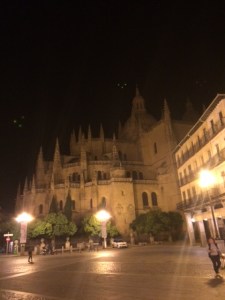
Not many people in the main cathedral plaza, they’re all in the tapas bars.
Lots of other people as mentioned before pushing their babies in strollers, couples arm in arm, families chatting away to each other. We were looking for a particular restaurant the receptionist had told us about and actually found it. We wandered in and stood at the end of the bar waiting for some attention to select our wine and our tapas. We stood there for quite a while until another man behind the bar came up and looked at us and we managed in our Spanish to mention something about soup. Well that triggered a whole ‘nother set of reactions.


Once we shouldered ourselves through the crowd, we found a table, and ordered.
Here are the protocols when going out in the evening for tapas in Espana: First of all the bartender does not care what additional things you have on your mind or are contemplating. He is there to do a job. You are to go up and tell him what your selection is and what your taste of beverage will be. Then you get it put/plunked down in front of you and you take it and visit and chat with your friends who you have come there to meet or hopefully score an evening date. We, however, being unsophisticated enough in this particular mode of interaction got the nod of the head to go sit down at a table. Well, the tables are in another room and usually with a tablecloth on top with two wine glasses – one for wine and one for water that you pay extra for. Here there was no tablecloth on the three wooden tables that were in the other room just off the bar. We sat down at a table near the doorway so we could look out at what was going on along the bar, which was rather interesting.
Here comes the story about soup. Remember beans? Well we saw that the bean soup was on the menu in the glass encased frame on the outside of this particular bar. We asked for two bowls of the soup. Larger beans, and equally as tasty as mentioned from Madrid and Orviedo beans, but a little different. All this is tricky business. There is pride in these here beans. One must be careful how one discusses the flavor, etc of the bean soup – something like a cross between lima beans, Italian white navy beans or cannelloni beans, and some other mysterious bean that has a hard “shell” on the outside and an inside that tastes like roasted chestnuts. Okay, so now you are trying to capture that flavor. Mas vino tinto. Another aspect of the protocol for this type of dining is that you are never presented with a bill. You are able to sit and enjoy whatever you’re doing for as long as you like. It’s your responsibility to go up and ask for the bill and then pay for it and depart. Lovely.
We bundled up with our scarves and jackets and sauntered back on down through the village in the hills and stopped in at a shop buying some locally made soap. We also meandered by a pastry shop which Smitty could not resist. People in this part of the country are enamored with pastries. We found our way home and up the spiral staircase with hanging chandelier down the center. Gorgeous.


Yes, the pastries are somerhing to behold, as is the great aquaduct towering over our small hostal, and proving a great navigation aid to find our way back.
Later we found that the northern Austrias version of the bean soup was far heartier and mas delicioso … mucho gusto, Oviedo!
Addendum: While we are certainly no experts, we have found the very affordable high plains wines to be quite good. We have found very palatable vino tinto in the Austrias supermercartos for 1,49€ ! (Note: in the EU they use a comma for the dollar/cents separator 1,49, and the period for the 1.000s, and place the currency designator €, after the numerals.)
Breakfast was minimal, but enough to get going … nothing like a cup of espresso duo to jump-start your day, and with cafe’, toast* & jams, muffin, zuma de naranja (orange juice) we were set to go until our impromptu mid-day roadside picnic on the road north to Oviedo, Austrias. We will certainly stay at Hostal Residencia “Don Jamie” if we overnight in Segovia again, and fondly recommend the hotel and staff to you, dear reader.
* While in Israel we were gifted a small jar of Vegemite, which we were missing since leaving home, so our breakfasts are back to the norm for us.
After our hotel breakfast we headed out for further north. Our first nav point was a roundabout not 200 meters from our hotel. There were four roads leading out in different directions, and try as we might, we could not suss the correct one. All we could manage was to take each one for a bit and see where the blue bouncing ball went. Discounting the street we came in on, we had three possible exits from town … number three did the deed. As we drove through increasingly open and unproductive country with no visible farming, very few cattle, and certainly no olive trees, we were wondering where do they get all of the oil that they use in this country. All we saw were a few desultry cows, several flocks of sheep, and many rolls of hay, most looking like they had been out for a winter or two. Spain is in a severe drought (comments later), so that may be why we saw so little agricultural activity on so much rural land.
The goal this time was to make it as far as Oviedo in the same day. And even setting out early with the intent of making it all the way to Oviedo, we almost didn’t make it.
One event allowed us a picnic stop to calm our nerves. One had us moving cones of a center barrier to drive thru the little arroyo to get going back in the direction of an on ramp, and one going around a round-about several times until the “bouncing blue ball” finally caught up with our speed and direction. After we drove around the town of Leon, the terrain became more mountainous. Many large enscarpments project up out of the earth. Many many tunnels were built and done well and kept moving us forward to our destination of Oviedo. It was a long haul but we managed to make it by late afternoon.
Driving northward from Segovia was primarily flat scrub land. The freeways were good, however not well marked; at least to Navigator Roberta’s opinion. she won’t go into details and only got us off on a few wrong, what shall we say, adventures. We missed a major interchange turn in the middle of nowhere were two freeways crossed and ended up about 20 km out of our way before we could turn around and come back then get heading north again. Coming back in to our route we were again led astray by Spanish road sign convention, this time heading in the right direction, but soon passing a sign saying “No Services Ahead” (in Spanish, overhead, in teeny-tiny letters), again posted just AFTER the last exit, and us pegging empty. Now we were worried! So we pulled into a rest/picnic spot on the side of the road to think on it.
Looking ahead I/S could see that there was a break in the solid guard rail barrier between the north and southbound lanes that was separated only by four rubber cones, so we waited till there was no traffic in sight, Roberta jumped out and towed one of the cones out of the way. The car then performed an illegal U-turn, Roberta jumped back in, and we headed south to where we could get gas. As we crossed the intersection where we had missed, now heading south, we immediately saw another sign that said no services! Fortunately, that turned out not to be true. We pulled off, got gas and a bottle of beer, and back to the roadside stop where we had a picnic stop to calm our nerves and proceeded on our way … and what do we see just three km ahead? There’s a roadside full service gas station/restaurant. I think the highway engineers put up the signs that said no services just to screw with people’s heads.
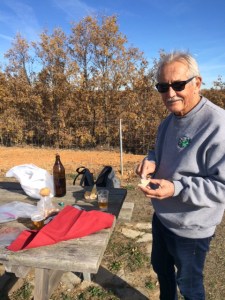
Now that we are straightened out on our route, and gassed up, we can take a lunch break in the roadside rest stop.
As we headed north we got into more and more mountainous country, including a dam backing up a huge reservoir that was very, very low. People in Oviedo said they had never seen it so low in their whole lives, so I guess the western United States isn’t the only place having a drought. The highway wound through mountains much like the Sierras, numerous tunnels, and of course a toll plaza; which didn’t charge too much considering the quality of the highway*.


Boy, do we got tunnels!
* Spanish ‘interstate’ highways are, in the main quite good, much better than Italy. But they do have lanes narrower than the US, generally no shoulders, and usually continuous guardrails on both sides. Speed limits are posted at 120 kph (75 mph) but if you drive at that speed you are running the risk of being killed from behind. I got comfortable at 140 kph (88 mph) even in a car that is a FIAT 500 clone … in the right-hand lane and being passed by almost everyone. Commercial trucks are limited to 100 kph (62 mph), so you have to look ahead, and keep an eye on the left lane in the rear-view mirror to plan your lane changes to keep your speed up. If the car coming up behind is a Mercedes or a BMW, don’t move over, no matter how far behind you they look.
Eventually we made it to the outskirts of Oviedo, and with only a couple of missed turns managed to make it to the doorstep of our next Airbnb residence. A miraculous phone call connection to the owner Juan Antonio, our Airbnb host. It was a delightful little apartment on the rooftop with pitched windows that could open if you want; it was pretty chilly for us. It had a little kitchenette, bathroom, bedroom and a tiny living room/dining room. We enjoyed this little place so much.
So, on with the bicycle story. Juan provided us with loaner bicycles from his brother-in-law, after the bike shop he contracted bikes for dropped the ball. The next day he met us in the morning, bikes loaded on the back of his car, even brought us some warm gear to wear, and headed out to the highway to meet Bici Clown and his retina of now 30 or 40 riders. Juan used his special app that translates Spanish to English in order for us to communicate to get all the things we wanted to do do before the big welcoming bike ride. This was the whole reason that started this trip after all.
Juan had not met Bici Clown, but by the time we were through with our stay we were all good friends.
THE ARRIVAL OF BICI CLOWN – 19/11/17
And now, ladeeees and gentlemennnn, may I direct your attention to the Oviedo center ring, for the event that planted the seed for our European adventure … the arrival of Bici Clown!
The world travel map of the 13 year, epic bicycle journey (this in on his fifth bike) of ‘Bici Clown’, “I am never homeless, the planet is my home. I am only roofless!”
Alvaro Bici Clown’ Neil was a guest in our Kona hale in 2012, his first landing in the US (well, as close as Hawaii qualifies, anyhow), during his round-the-world bicycle tour. Look him up at biciclown.com, a truely amazing man and a monumental accomplishment (there’s an English version, somewhere on his website). He e-mailed us early this year and invited us to his completion fiesta in his home town (city) of Oviedo, Austrias, Espania. We hadn’t planned our next travel adventure, and decided why not? We can not only celebrate, we can spend several unplanned months (We bought one-way tickets) wandering around Europe, visiting friends, and reacquainting ourselves with the old world. As well as disconnecting ourselves from the unceasing din of the current toxic American political scene (any of you facebook friends have no doubt, noticed Smit’s conspicuous absence from all social media).
So far, we have spent a glorious week in Italy, ten days in Israel with Natalie Gruen, who expatriated herself from Kona earlier this year, and the remainder in Spain, where we recently joined the ecstatic welcoming fiesta for Bici Clown. It turns out he had semi-headlined us as honored guests, and we have been embraced as familia into the community. He also had committed us to perform, so we bought (another) uke, in Madrid, and brushed up on our paina hula.
Here’s to our day for the reason of our adventure, where from here, we’re not sure, but we’re healthy, happy, and divirtiendose ‘having fun’, so la vida esta buena!
Juan coordinated getting two bikes for Smitty and Roberta to ride and he got his own bike. He picked us up on the morning of the day and even brought us helmets and gloves to help keep us warm because, we weren’t set for a big bike ride on a chilly morning. The idea was to meet Bici Clown about a few kilometers out of the main goal of Oviedo town center, and ride in with him and many others for the final hurrah as he reached his destination, where his family and his many good friends would be awaiting him. Well it was about 9 AM when we got the bikes loaded and started down the old Oviedo road. We hadn’t gotten too far when Roberta was feeling her legs on this too-small bike she was writing. We asked Juan if there was a cafe’ up somewhere ahead, and lo and behold, he lead us to a great one. We had coffee & tea and we at the café while he rode ahead. He would come back riding ahead of the pack, and alert us that they were almost there, then we would be ready to meet him at the top of the hill and the rest would be downhill (HAH!). We both thought this was a fantastic idea. There was no one in the café at this hour because it was little too early at this café beyond the rfge of town. There was a newspaper which had an article about Bici Clown arriving and it mentioned something about Hawaii. So while Juan rode on down the road Smitty and Roberta read and interpreted to read what was being said and what was to be expected. We got even more excited. Well we had our ukulele with us and we went out the side the road on a safe spot that we could watch for Juan, playing and practicing e Huli in Spanish.


Are they coming? We better get practiced up for the arrival!
We saw many cyclists riding downhill past us to join the grand finale. We waited for the side of one and in the distance we saw this cycle is coming up the
hill. He said about five minutes away. Well before we could get on our bikes and get going there were cameramen and holdinBoom mic set our mouth’s, he’ll meet us, . In the meantime the sun was shining and we were waiting for the big arrival!
As we waited alongside the road, a car stopped and the driver yelled ‘cinco minutos’, and zoomed off toward town. Pretty soon Jaun pumped up the hill, and we followed him a short way back toward town and waited at a roundabout. We got out the ukulele and started playing. Another car stopped and a professional level TV camera poked it’s nose out the window and verifying that we were the ones from Hawaii, started recording … we were rather surprised. We played for Alvaro as he rode up and grabbed us both for welcoming hugs and kisses. We fell into the pack, and started the mass ride toward the cathedral plaza with the 30 or so riders who accompianed him into the city. We felt guilty, because we were by far the slowest riders in the corte’, and Alvaro insisted on stopping at the city limits for us to catch up. It was just so much fun it was a beautiful day and we were told that the weather is not usually this good at this time of year. But for Roberta the ride through the town with a police escort and all the pressure off … we’d made it … winding through the hills with wind blowing through your hair and riding with all these excellent cycle us was a thrill never to be forgotten.
It was QUITE the arrival, with the police escort, a car leading and motorcycles blocking the cross streets, people applauding and cheering, TV news crews and interviews, a trumpeter playing the Austrias regional anthem, ribbon cutting, hugs and kisses all around, including us as featured guests, ALL THE WAY FROM HAWAII!
Nuestro amigo Alvaro ‘bici clown’ Neil, en la plaza de la catedral de Oviedo, al completar su gira de 13 años y 209,000 km alrededor del mundo (subtitulo con un poco ayudar para Tio Google)
The plaza was a scene of happy chaos! Backs were slapped, hugs, kisses and tears exchanged, with Alvaro in a mosh pit of well wishers and documentarians.
Alvaro and his sister get together again, after years apart, as I said … tears.
After milling around the plaza for a while and greeting people and enjoying the festivities, the cyclists hopped on their bikes and with police court and once again rode two or so km through the streets to a wonderful restaurant in a big urban park,


A smile break before starting off following Alvaro to the fiesta lunch.
on a sloping grassy area. Roberta was so thrilled to just be feeling so free and wind blowing through her hair riding with all these cyclists with the police escort. We all gathered for a sit-down, long lunch for over 100. Much wine/beer/Austrias hard cider, regional food specialties, inter-lingual communication (and miscommunication) involving hand-waving, face-making and mashups of several dialects.
Just a small portion of the celebrants the filled the entire dining areas of Restaurante Montana en el Parque.
Our Air B&B ‘landlord’, Juan Antonio has acted as our concierge, and since he was our amigo, we were able to get him into the overbooked fiesta. After lunch we played uke and each did a couple of hulas on command performance, to much laughter and applause. Smit transliterated ‘E huli’ from Hawaiian to English, then to Spanish, which Juan pronounced correct. ‘Berta played and sang the Hawaiian and Smit danced (raunched it up, too), then Smit played and croaked en Espaniol while ‘Berta did a sexy E Huli, it must have been understandable, because it was a big hit, and there was a professional video crew recording, so no telling where it may end up! Juan was able to enjoy some of the celebration however, he had to leave early to help his wife with the children. It was too bad he didn’t get to see the hula. He’s been encouraged to save money and come to Hawaii where he will see lots of Hula.


Kapalili, next day in la Plaza de Catedral which was filled to overflowing with people and media welcoming Alvaro home.
It was quite a day … a long day, and we were beat. Neither one of us had ridden a bike for over a year, these were too small for each, and the gears didn’t work very well, so we felt every km after getting ‘home’, and sitting down with yet another glass of vino tinto …
Our apartmento is complete, and it’s nice to have a kitchen so we can shop and fix dinner, instead of neverending tapas. We started trying to figure out where to go next. So far we have no firm decisions, or even ideas. It turns out that we are the last B&B guests, and Juan is now renting long-time, and since his tenant isn’t due until 27/11, has offered for us to stay, which we will for a couple of days to visit towns on the north coast. We have the car for another week, and it can only be extended at the actual rental desk at Madrid airport, seems to be common practice all over, Italy was the same. We’ll have to take it back to Madrid, from wherever we are when the two week rental period runs out.
Next day we drove up north to the town of Gijon, on the coast, to see the coast from the Atlantic side. It was another nice day but not too much happening in this old town. We try to find a place to park park and in doing so, ‘aha’ there is the blue sign with the large P. As indicated we drove down the ramp. What we didn’t realize was that you had to have some special card to be able to make the arm go up. We backed out, luckily nobody was behind us, but ran into some a small barrier ball that were aligned at the end of the driveway, which Smitty couldn’t see because they were low and hidden in the blind spot at the rear. Well the outcome was that we pulled off the whole backside of the bumper except for hanging on by a couple of Lego pieces and the backup light wiring! Now of course, there WAS sombody impatient to park and honking at our being stuck in the driveway. We, and all the onlookers thought we were sunk, the whole bumper was hanging off the back, held on by only one bolt Luckily it’s all plastic, and ‘Berta and I together were able to get it back on. We pulled up halfway onto a sidewalk, and between pushing, tugging, and crawling in the gutter (luckily clean and dry) under the car we got all the little tabs and slots lined up and snapped it back into place … there’s something positive to be said about cheap car construction after all! It looks like before, except for some surface scratches, and there were scratches noted in that area on the checkout (just to help the subtrafuge, we bought and applied a near perfectly matching blue from a permanent marker, so we may get away with it). No photos were taken in the interest of plausable deniability.
We wandered through the oldest part of town (always the most interesting … unless you’re a ‘shopper’, and had a picnic lunch out at the point. Sitting on some large rocks that were part of old ruins looking out at the sea and the harbor that was there, we contemplated how to hold our lego car together for a bazillion more miles to the south of Spain, and back up to Madrid. That evening we went to Juan’s house, where we got to meet his wife, Anna, and two girls 4 and 2, Laura an Inez, Juan used his special app that translates Spanish to English in order for us to communicate. We planned to borrow some tools and wire to secure the broken tabs under the bumpe out of sight, so we wouldn’t have to worry about losing it on the rough roads in the country. We couldn’t make it work, so we snugged it down with mailing tape, to be removed before return.
Juan is turning out to be un amigo veritas, and has helped us with ‘connections’ and been our personal taxi. He speaks about as much English, as we do Spanish, but has a realtime translater on his phone, so we get along fine, each being amused at the translation faux pas. Alvaro is on Kapalili’s (as he knows her, from Hawaii) WhatsApp, and we’re all meeting in Alvaro’s neighborhood in the cuidad antigua.
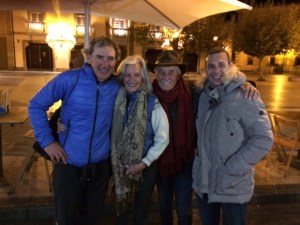
Los quotros amigos, out for a farewell dinner, before Smit and ‘Berta head south.
We enjoyed a final dinner with Bici Clown and Juan at a favorite tapas bar near the old center of Oviedo town. You can see all are happy faces in the picture below. Before the end of the night Juan drove us to BC’s present place of abode. We wound our way up a mid-city mountain, it felt like driving up Tantalus in Honolulu. At the very top we came to a several acre estate, which is owned by the Spanish potato king, another Juan, a poor peasant who took advantage of the post Franco opening up of Spain to become very wealthy selling potatoes. He is a lover of poetry, and has turned his grounds into a museum of Spanish poets, with plaques reciting poems and adjacent statuary of his favorites. He even built an entire wing of his home in honor of one of the most famous, without telling him. When the poet was quite elderly he invited him in, and the artist spent his final few years in luxury. I dont have the words to describe the grandeur, the poetry, the art work, preserved by this simple man who built his dream house atop this mountain. The night view of the city, the lights, and the statue of Jesus afar off with its own lighting was magnificent. He is also a Pat’ron for Alvaro, and has always been there to help with unanticipated expenses. With Alvaro’s return he has been gifted the unlimited use of the estate’s ‘starter house’, a small tightly knit, and classic styled bungalo, that perhaps one could describe as a well-to-do mother-in-law quarters; which can serve as his home while he plans his ‘retirement’, which we anticipate will be that of interviews, conferences, consultations and earth awareness media productions.
Alvaro being interviewed on a national TV talk show. New folding town bike gifted to him as his touring bike doesn’t work well for daily ‘around town’ riding.
What’s up for BC NOW? We shall see. Perhaps he will do traveling and cycling, training young children, spreading the word of love and teaching that we are all one world, write more books, make more videos. Berta and I were even interviewed for a media production, in which we explained our involvement in the Bici Clown epic circumnavigation of our globe. When Alvaro asked us what we saw in his future we replied we envisioned him reaching out to the public with his message that we are one world, one people, and have one job … to reverse the out-of-control corporate exploitation of natural resources, governments, people, and our very conciousness. No small undertaking, that. We wish him the best and look forward to meeting again. A hui hou. and the same for Juan. He is starting a new path for his life with managing an apartment instead of an Airbnb, and he is looking to manage a company for motorhomes sales and rentals. Alvaro has been thinking of buying a motorhome himself, so that he can have a movable home/studio, so in talking they are hopefully going to be working together on that goal.
WE HAVE GUARDIAN ANGELS! – 23/11/17
With so much excitement it was hard to decide where we should go next. We thought about heading west and going down the coast of Portugal. Was thinking warmth, trying to get to somewhere to get out of our winter gear … which doen’t consist of too much other than layering up. Then we were blessed by a most fortunate series of circumstances that happened at just the right time. Our good friends Donna and Jack, from Montana/Hawaii had informed us of their family relation who was hanging out with his wife in the southern coast of Spain for an estimated one years time. Jack’s step-brother Martin, and his wife Nancy offered to take us in at their Malaga apartment. We each scoped out the other’s blog site, got connected, and we planned to meet them in Malaga, prior to their dearture for Morocco for a two-week tour with friends of theirs. The catch, they are leaving for the trek in a few days, so it’s south we must head … toute suite! So it’s out with the Michelin, coordinate with GoogleMap, and head south from Oviedo. We exchanged adios with Juan at the apartmento, other goodbyes must be made by phone and WhatsApp.
We spent the first day driving 300+ kilometers … and occassionaly getting lost as usual, as we headed south towards Malaga. Our first overnight was in Salamanca, if you’re following us on a map at all to find these different towns and cities, it is south and west. We made it, and arrived in this little town around 4 PM. The sun was setting, it’s a rather chilly town and rainy. There is a university here, so there were many young folk walking to and from buildings secure under umbrellas doing what college students do. We, however, didn’t have our brollies and were scampering about trying to locate street names (which are on small porcelain ceramic pieces located about 10 feet up on a corner – not always consistent mind you – of some building. After a few turns around corners of buildings, Roberta has Absolutely no idea which direction we are heading; thankfully, Smitty‘s internal navigation compass winds us through and around the block and, lo and behold, amidst tables and chairs, people wandering around, he maneuvered this tiny little bug of a car, to the exact location. Roberta hops out and wanders down the street to find the word hostal above some awning and knocks on a few doors and locates where Google maps says this place is to be.


‘El Coche’ (the car, en Espanol), an Opel clone of our Italian Fiat 500, on the road, and shoehorned into the Salmanca pedestrian zone.
We’re in!!!! El Coche is garaged, and us settled into another small but comfortable room. We have some vino blanco, a little rest, then out to carouse the plaza and look for a friend of BC’s who provided the special ham for his special luncheon in Orviedo. We were a little late and some places had closed, auwe’. We strolled around looking in the shops which were open until 9 or 10 o’clock at night, had a glass of wine or two and a tapa or two … find a tapas bar, moved on to another, explored the Plaza Mayor and the evening Paseo with everyone hanging out talking and smoking, with the occassional whiff of weed (you now realize that every town has a Plaza Mayor, right?) and managed to get back to our hostel (compliments of Rick Steves’ book) without getting lost – only needed to ask directions once. We are always so thankful when someone can speak a few words of English. As least we can all muddle through together. But I will never say again “If they want to come to America, why don’t they learn English“. We are learning Spanish online every now snd then, with a little help from Uncle Google’s onlineinstant translation … great for missing vocabulary! It’s slow, but it’s a start. You think remembering hula moves is a struggle, the Spanish speak so fast it’s like trying to communicate with a hub cap that is rolling down the street. Smile. We are making progress believe it or not. We attempted to actually go and have a dinner but it was too early for the kitchens to open and we were too tired to wait, so we went back to our room and got some sleep.
Friday morning we have to get an early start if we are to make our destination in Malaga, another 400+ km day drive. We actually got a wake-up call at 7:45 am. We nearly jumped out of our skins when a phone rang in our room as surely neither of us knew how to verbalize such a request as that in spanish. We had no idea what the man said but we got the jist. We were down stairs in 10 mins and being escorted to the parking garage. Parking is a special privilege which you pay for at a premium. Somehow excavation has been done all over Spain (and likely other european countries) under these old castles, huge buildings, monuments, etc,) to put in parking.
We grabbed a cafe’ and croissant, gassed up, and headed out of town, our GoogleMap kept trying to send us east to Madrid which we couldn’t understand, so we ignored it and headed south on the paper map until we managed to get our GPS to realign and give us a new route down to Seville and into Malaga by going south. In retrospect we probably should’ve followed the first route, I think it was shorter and we would’ve avoided an epic getting lost in southern Spain. This was another long haul driving day but the weather was nice and got warmer – smile. We got misplaced once somewhere down in the hinderlands of Guadalupe. We were so far out in the boonies, although the scenery was rustic and it was nice to be off the highway, we needed to get a bead on where we were, and the bouncing ball was of no help. We still don’t know where we missed the turn, but we ended up in the smallest town we have seen, with the most convoluted streets where even the main highway through town lost its white line and it became one way lane with a red light at each end. We came to an intersection of 5 roads. All looked like donkey & cart dirt familia type of “road.” We tried them all. Finally, we just said “it’s gotta be this one” and went for it.
The vagaries of iPhone GoogleMap navigation: Some of the towns in Spain (and Italy as well) have such convoluted streets and intersections that we can’t tell which street before us is represented by the blue nav line. In these cases we pick one at best guess, drive (or walk) on, and see if we’re on or off track. If the bouncing blue ball wanders off route, we go back and try again.
We never did find out how we ended up there and not quite sure how we got back out again, but eventually we ended up back on the high-speed highway. Oviedo to Malaga is like driving the length of California in two days. And in Spain you drive FAST … as described earlier. We were cruising between 75 & 85 mph most of the time in traffic, on good highways, but with narrow lanes, no shoulders, and lots of big trucks. Even at those speeds, if you see a Mercedes or BMW in the rear view mirror, move over, they’re usually pushing 100!
Seville, which is a huge inland deep-water port and industrial center, with an old city core, is surrounded by apartment blocks and shopping streets, best avoided when driving, so we went around it without stopping for anything except the choking traffic because we happened to hit it right at rush hour. Once we passed through Seville (we’ll be back), we were back in open country again and the question of where they get all those millions of gallons of olive oil was finally answered. The countryside was covered in olive trees for as far as the eye could see. Now we know where all the olive oil is made and the aseitunas (olives) come from in Spain. We have never eaten so many olives in our lives. You would think that our skin would be nice and smooth, shiny, and lush, but it’s not. Oh well. Thousands of square miles has been re-forested with solid olive oil orchards. It’s an unbelievable number of trees, and now the question becomes, not where they get the oil, but where do they get the people to harvest all of those trees.
Mile upon mile of olive trees, occasionally mixed with vinyards, and more being planted everywhere.
Our Malaga host, Martin said it is the world’s largest reforestation project. Every town we passed had an olive oil processing factory. There were also many smaller, older farms each with huge stone ollas that stand about four meters tall and a meter and a half in diameter that they used to fill with the oil from the individual farm presses.
As we left the rolling plains between Seville and Cordova we headed down into a mountain range that separates the main part of Spain from the Mediterranean sea. We went through another, then another, and another range of hills and tunnels and this time the most expensive road toll we had come across, 12,90€. We kept thinking “THIS time we’ll see tha sea”, which we finally did, just as we were coming in to Malaga. We of course missed our final turn to get on the right road, which would’ve led us directly to the condo. We found a secondary way in but couldn’t find the address, and finally gave up. We were just getting ready to call our hosts when they called us and directed us to where Martin was standing in the middle of the road waving. He jumped in the car and navigated us thru the traffic and building construction to his and Nancy’s apt, literally into the basement of the condominium, where we met Nancy, had a glass of wine or two, and went out to dinner and settle down. We were so fortunate to have made this connection with these travellers of kindred spirit. Serendipitous one might say.
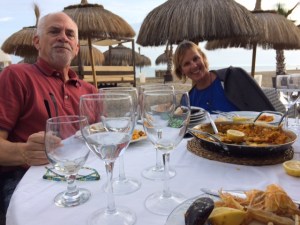
Martin and Nancy, our Malaga hosts, sharing an evening paella meal at a beach restaurante.
We’re on the sea! Sitting in a small cafe on the ground floor of their apartment building, sharing dinner, wine, and getting-to-know each others stories. Looking across the strand and the beach to the Mediterranean Sea, as flat as a lake, the sun has gone down, and the strand is a wide landscaped and lighted strip of walking lanes with benches, playground, exercise/workout park with human-powered exercise machine stations, bike lane, and a beach restaurant/bar every two blocks, right on the beach (more about those later). We find it’s not just the paseo keeping the locals up ’til all hours, folks are jogging, riding bikes, strolling, pushing prams, skateboarding, rollerblading, and any other form of mobile exercise you can imagine until long after weʻve gone to bed.
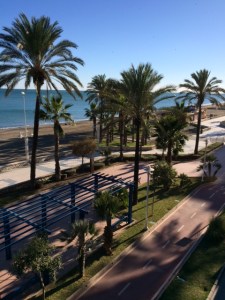
The strand in Malaga, miles of public access beach park promenade. It felt like we were in Santa Monica, CA; the climate is the same too.


Full moon over the Med, and the late-night ciclistas.
We’re now on the Mediterranean sea at Martin and Nancy’s apartment on the strand. We can look out our window and see the sea. It’s SO flat, it looks like a lake. Day one we wandered around the old town, and Nancy and Martin showed us the bus system and how to get around in Malaga, and took us to the walking quarter of the old town which is lovely. A huge high arched arcade was being set up with Christmas lights and large plots of poinsettia scattered around the vias. We spent the day wandering around looking at the plazas and the people, and had a wonderful lunch at one of the little bars before coming home, and later going out to their favorite fish place right on the the strand, where we had a big bowl of paella and roasted anchovies that are cooked on sticks in front of open fires in front of every playa restaurant. All along the playa are restaurants which are all exactly the same building design, but each of them is decorated differently and operated by a different owner. Apparently, they are built by the city as opportunities for people to open these classic seafood restaurants, every one of them having an outdoor fire built in a metal replica of a rowboat mounted on a pivot; the anchovies are roasted on sticks which are stuck in the sand and at an angle to maximize wind and heat. These are served to you on a platter all toasty and crispy. Martin loves them, I can tolerate them, and ‘Berta doesn’t care for them.
We enyoyed two days with Martin and Nancy showing us the bus routes, train/bus stations for future planning, getting the lay of the activities, museums, open markets, tapas bars, etc. we walked and walked and walked.


Palling around with Milton, Nancy, and Pablo, Picasso that is … plus food.
In the old part of town there was a demonstration of hundreds of women of all ages, and some men, claiming the end of violence against women. There was a lot of noise, banging of drums, kinda like taiko drumming, and folks with bullhorns rallying the troops.
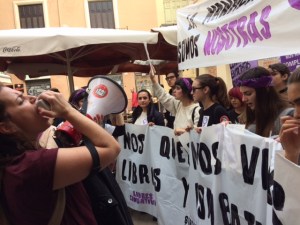
The Spanish love demonstrations, we’ve seen some form in Madrid, Malaga, and Sevilla … with Barcelona Revelucion de Independencia yet to come.
We also enjoyed seaside dinners-ate paella and delacacies before they took off for Morocco with their friends for two weeks; we got to stay in their abode. We called it the riviera.
As Martin and Nancy were getting ready for their trip to Morocco and guests with whom they would be traveling, we got on the Airbnb and found ourselves a place for a couple of nights.
It turned out to be probably the least favorable of overnights that we have spent since outback Australia. Finding it proved to be a challenge since I kept missing the building number mounted high up on the wall. Finally, we connected with the host and got ourselves settled in. The kitchen was abysmal, and the only thing we could say is the rest of the place was OK in that the bed was comfortable. The host is an absolute opera fanatic; there were hundreds of opera CDs, there were posters on every wall for operas. There was even a full set of every opera ever written. I’m sure must’ve been 50 CDs and of the lot, only three or four of them even had the plastic unwrapped off the CDs.
The location wasn’t too far out of the pedestrian area of the old town, which is one of the nicest that we have seen in that it doesn’t encompass a large square, but is a maze of little walking streets with people just pouring along them. The first night of our stay in our B&B we went walking and just happened to come upon the opening of the Navidad season on the concourse, the Alameda Principal. We could hear for blocks the music of Mannheim Steamroller blasting out Christmas carols while all the thousands and thousands of lights flashed and waved and floated in concert with the music. It finished in the English-Spanish ‘Feliz Navidad’ with everybody singing along, a thousand voices singing Feliz Navidad including in English which echoed throughout the streets. Where we were walking luckily we didn’t get too far into the crowd, so when it started to disperse we were able to get out again without being trampled. We went looking for a tapas bar and ended up in a bicycle bar which was decorated entirely with bicycles of all sorts including ‘Kona Bikes’ and a wooden bicycle, but unfortunately the kitchen wasn’t open, so the best we could do was nuts and seeds and beer for dinner.
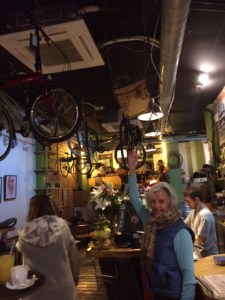
Hey Alvaro … this bar’s for you!
After Martin & Nancy left for Morocco, we returned to the condo and realized Smitty had forgotten our electronic converter at the BnB. Yee gads, It took us days of back-and-forth with our previous host before he was finally able to connect. Of course by that time we had given up and bought another one to replace it. The new one cost half as much is an identical one bought at OfficeMax … now we have two, and can charge to da max!
One of our favorite things to do has been to go to the fish markets and open air fruit and vegetable markets. Roberta has been buying spinach by the bundles and cooking up vegetables in quantities to feed a cow. Guess there’s a lack of steamed greens; everything is fried, battered, and covered with sauces. Since we have a full kitchen at our disposal, we’ve been experimenting with making pasta (now that we are Itlalian experts), humus, baked cauliflower, zuchinni stuffed with mashed potatoes, steamed spinach, you get the idea. On a walk home one day the sky was clear blue dotted with bundles of lenticular clouds. This was odd because there are no big mountains around this


The many faces of Mediterranean sunrise, still dark these days at 07:30
We’re comfortably housesitting Martin & Nancy’s apartment condo, directly on the strand above the beach fronting the Mediterranean sea. Mid to late morning it’s usually calm and sunny and there’s even some places where you can be totally out the open without being blasted by the wind but later in the afternoon the wind picks up and even with the leather jackets it’s been chilly. At night it’s downright cold, so we have been turning the thermostat up a little, lounging about working on the blog, and studying our route and stays around Sevilla, Cordoba, and Grenada for the two weeks before Christmas.


Navidad poinsettias everywhere, plus me and how I feel after too long a day
We’ve been going out shopping every day for a few bits* that we need for the dinner home cooking; we both are feeling the need for a break from tapas, which just don’t feed/fill you up.
* For our most recent home-cooked meal I purchased a respectably good piece of ahi, (tuna, en espanol is atun … go figger), exactly a pound, for 4,05€, just $5.00!
We went out and tried to find a seamstress or a Zapotaria to repair my backpack and duffel bag straps, but nobody was willing to even have a look at them, so we ended up finding a store where we could purchase thread and needles. We found one store that sold yardage and had all kinds of cloth but didn’t sell thread and needles. We had to go to a different store for the needles and thread. S/I was in the same store today on my way back from the morning shopping at El Mercarto locale, and happened to see a whole wall of socks, so I asked if they had shoes as well, since we have no real winter clothing and Switzerland is on our horizon. No needles, no thread for the cloth, no shoes for the socks … such is the organization of commerce in Spain.
Malaga has some nice attributes (access to intl. transportation for one), but it is home to 600,000 people, just a little too big for us island folk.
It’s also home to almost as many seabirds, which swoop around town, swarm the boats fishing for the anchovies, and even settle in for a Spanish siesta together.
MIDNIGHT RUN TO MADRID
Our rental car, El Coche has to be returned on Nov. 30, and we are now comfortably ensconsed in our housesit in Malaga, some 550 km south. ‘Berta cannot stand another day in the car with the crazieness of spacecraft navigation with maps that we can’t function with and the bouncing blue ball of googles system, so Smit, being a true western road warrior, is off solo in the middle of the night.
Boring alone thru the dark on a four-lane highway is not a novelty to me, but doing it in a foreign country, with different roads and signage is. I got out of Malaga and onto my route with no problems, and found a position on the instrument panel where I could wedge my iPhone directly in front of the steering wheel … great, it’s like having a built-in nav … except it’s not. About every five minutes my phone turns itself off, meaning I have to either attempt to restart it, re-enter my route, recenter my position at 80 mph, or pull over and stop to do so. Finally, I gave up, after all there’s only one major change in Granada, I’ll just turn it on a few km ahead, which I do. And voila’ just before the complex interchange, the phone goes blank again. I see my sign for Madrid, just PAST the last exit (remember my comments earlier?), and off I go, heading toward Sevilla. Ten km later I get the chance to turn around, find gas, cafe’ and a croissant, and restart my trip to Madrid.
After dawn I find myself in a near-desolate stretch of fallow farms and abandoned industrial buildings, nearly all structures tagged with massive graffiti. I think that the volume of olive oil consumed in Spain may be challenged by the amount of spray-can paint applied to any reachable vertical surface!
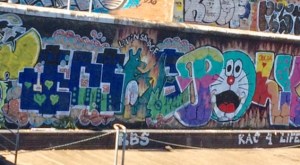
A higher than usual quality example of Spanish street art, even churches get paint.
The concrete road surface is also seriously deteriorated in this stretch to a bouncy corregated paving that causes our ‘repaired’ rear bumper to start to vibrate loose. After glancing in the right-hand mirror, and noticing the edge of the fender vibrating in the slip-stream, I slow down until I can find a pull-out, where I rearrange the tape, cross my fingers, and carry on at speed. Twenty or so km later the road smooths out, and I head into the maze that constitutes the Madrid highway complex, and complex it certainly is.
I needn’t tell you I missed my turn-off to the airport, in fact I missed several of them. Eventually I found a set of signs that clearly directed the route to MAD, until the last exit, which was, as is Spanish standard, posted AFTER the last chance to make the exit. This resulted in yet another ten km excursion in the wrong direction before I found an exit into a huge shopping complex … AHA, with a gas station. They must have had a serious problem with drive-offs in the past, because in addition to surrounding barriers, and enough survelliance cameras for a medium-security prison, they had a gate arm on the exit that stayed down until you paid.
While there I carefully removed all signs of the tape holding the fender gap in place, I once again attempted to get that last stubborn tab that had frustrated us in place. And SNAP, it popped in, leaving the fender in perfect alignment. With a now presentable, full of gas coche, I returned it with ‘Condition: OK’ clearly marked on the return receipt. WHEW!
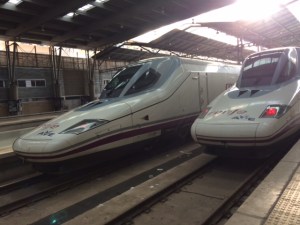
El tren rapido, the high-speed inter-city national railroad, RENFE.
A shuttle bus hop took me to the central train station, where I successfuly purchased a ticket from the Renfe (Spanish national rail system) vending kiosk, and arrived at the platform just prior to departure. Riding El Tren rapido in Spain requires a ‘TSA Light’ screening before entering the active part of the station, along with airline style check-in and boarding procedures. And why not, the high-speed trains (250+kph) feel like being on an airliner, in first-class. Except that you can get up, walk around, visit the cafe’-bar, the aseo (loo), and sit four-up across a table, even in tourist class. All-in-all thouroughly enjoyable, and well worth the 80,00€ to make my return to Malaga in a little over two hours. We’ve since acquired ‘Tarjeta Dorado’ (Gold Card) senior pases from Renfe, and subsequent train trips will be half-price … eatchetheartout, AmTrak!
El coche wrap-up: Remember that whole whine about the ‘You must return car to original rental desk location only’ policy. That was false information, aka BS. I could have dropped the car off with a modest reposition fee, at the Malaga aeropuerto, less than 10 km from where I sit. Ah, joys of international travel and (mis) communication.
MEANWHILE, back at Malaga … In the meantime, we’ve been touris’ to da max! We actually bought hop-on/hop-off tickets on one of those open-top double-decker busses, and have been riding around Malaga listing to a recorded limey lecturing us on it’s history.


The bus, and the view from the bus …
Good thing we grabbed the seats in front directly behind the windshield, it’s about like LA winter (without the raging wildfires) here … a bit chilly for Hawaiian iwi. The tickets were for 24 hours, and include numerous venues and museums, so we scheduled ourselves to bracket around a Thursday flamenco performance, which is held in MIMMA, an interactive museum. Musica Interactivo de la Musica Malaga.


The entry stairwell, with a blizzard of sheet music, an African shell instrument, and 2,000 year old Roman ruins beneath our feet, all in MIMMA. But wait …
There was little opportunity to get to play the different instruments as there were so many little kids. Remember that this is a family oriented country, so usually the whole kit and kaboodle (moms, dads, three kids, and baby in a stroller) were crammed into these small rooms. Kids played guitar like they were Jose Greco (there was a small video screen in front of each instrument for “instruction.” There were ancient saxophones, woodwinds, violins, zithers, drums and shells! Can you see in the pic with the crowrie shells hanging around the neck of a skull; this is from the Muslim influence along north African coast. The facial expressions on the children were fun to watch. This was a museum meant for children and the racket they made will hopefully engender melodic compositions for the future.
… the FLAMENCO!
OMG the flamenco was fabulous! The hand clapping, heel stomping, singing, and guitar rhythms were unbelievable. We were about 10 feet from a small stage floor- raIsed so that mics could be attached underneath as well as wheels so it could be moved to various rooms in the museum. R/I was eyeballing the feet activity for tap moves. I managed to tape the music/sounds on my phone so I can choreograph something for ‘Na Vaceros’, the beautiful Hawaiian/Spanish love song*. Won’t be quite the same without the passion that the Spaniards put into this flamenco music but it could be interesting, shall we say a Hawaiian flamdango). Anway, I am going to have my first flamenco dance lesson (12.29.17- large flower, shawl and water included. I have to come with shoes and a skirt. Hmmmm) from a professional when we get to Seville. WOW! is all we can say. The show was everything the Madrid Las Carboneras presentation wasn’t (remember that place in Madrid?)… this one was exhuberant, fast paced, spontaneous, and fun. Too bad there’s no way to share the experience. ‘Berta, with her love of hula and tap dance to date, has already booked herself into a flamenco class for our Navidad > Ano Nuevo week in Sevilla. I better brace myself … we’ll come back to this. * Would that be hapahispanic, instead of hapahaole?
Our bus tour tickets offered us a complimentary drink at Roy’s Cafe & Cocktails, located on our route back home. After such an engaging forerunner performance, Roy’s was underwhelming. While we were pleased with ourselves for finding this place and not getting lost, the free cocktail: wine sangria with two giant ice blocks in a wine glass, and the free tapas – some unspecified something, were not what we were anticipating. So we ordered two vino tintos and a pizza, which was extra crispie on the outside and cold in the middle; had to send it back for a rerun through the oven, whatever that was. Walking for a while towards our casa, enjoying the warmth of the sun as it was still chilly (we had our vests on), we mused as to how familiar we had become with the town, train station, bus pickup points and the ebb and flow of these people and their different time schedules.
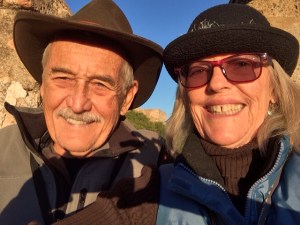
We LIKE IT when the afternoon warms us in the chill air.
Another stop was the Museum of Automobiles and Fashion, an exibition of a spectacular private collection … some simply astounding cars, well restored, and displayed with haute coutre of the appropriate years. What an incredible exhibition.


Haute fashion displayed with appropriate vintage autos. And in case you thought ‘art cars’ started with the hippies, the above is a restored original from the 1920’s


Hats, hats, and more hats, spectacular dresses to accompiany them, and a grand dame to keep watch over it all, just in case you might touch something -watch out!


Some period piece displays, the grandfather of el Coche, and a couple of $1,000,000.00 babies to whet your greed.


And finally just two of the many commissioned automotive art pieces.
Roberta went gaga with the fashions displayed on mannequins, some meant as spoofs and others representative of the era of the vehicle. And HATS. Oh Boy, Sunshine, do I have a lot of ideas for you. We will have to do lunch. Smitty was drooling over the pristine, buffed-out, high chrome, vintage vehicles. This private, not publicly owned museum is obviously the display of a passionate collector, a very RICH passionate collector, a pean to speed, power, glamour, and exclusiveness. The fortune displayed could finance a third world dictator’s (hello Donald, are you listening) excess on an extradition-free island for life. In fact, I think that’s where a few of the cars came from. The comingled displays were intelligent, humourus, eclectic, and thought provoking. There were a number of commissioned art pieces, some involving entire Rolls-Royces. And in the end, the final exhibits challanged our fascination with the automobile, the damage created therefrom, and a plea for us all to reelvuate our addiction to petroleum, and seek viable alternatives.
The story of ‘El Coche’, the car.


Top left ‘Topolino’ the original post-WWII Fiat, the grandaddy. Upper right, a late 1950s (the original) Fiat 500. Right middle, a current (retro) Fiat 500, which set off a copy-cat movement amongst all European car manufacturers, including Opel, bottom.
Another day trip led us into Malaga’s Alcazar, another Moorish fort from pre-Catholic* Spain, as are all of this era’s complexes, they are a delightful labrynth (deliberately made so, we learn later) of gardens, rooms, baths, pathways, storehouses and battlement-fortified perimeter walls. All of these varied elements are connected by aqueducts, channels and walkway gutters distributing water throughout, refreshing humans and gardens alike.


Paths, arches, watchtowers, shooting windows, & a street tunnel boring under it all.
Most of these beautiful edifices were masked by Catholic architectural overlays to hide Muslim iconography and place the stamp of the church firmly to reinforce the overthrow of the caliphate of Andelusea. While many (if not most) of Spain’s fifteenth century churches are repurposed Muslim mosques and forts, the unspoiled examples of the Moorish era are far more unified, pleasant, and relaxing than the over-embellished, elaborately decorated shrines to Mary and the seemingly endless representations of the suffering of Jesus and a bewildering army of saints and martyrs. Malaga’s excellently restored example of untouched Moorish architecture sprawls up a ridge from in town at near sea level, to a fort capping a mountain approximately 500 meters above the town … at any rate a LOT of steps and steep cobbled pathways to climb.


Rapunzel at the tower wall, yet more battlements and stairs, and the reward at the top, a taverna!
Fortunately for our knees there is also a city bus route to the mountain top fort, so two taps of our bus passes gave us a ride back to the center of the city. It was on our hike up the pathways that we saw our first Spanish stray cats.


A gallery of vistas from our climb up the fortified mount in the middle of Malaga.
We entered the magnificently overdone Catedral of Malaga, dedicated to St. Patrick. See some pics below. Tried to get a recording of the children singing but we were too slow on the elctronic uptake. The Catedral was right in the center of the old town so naturally there were teeny tiny road ways, or should I say pathways to maneuver toward destinations marked on the map. Even with GPS it was a challenge, plus a tourist ship or two was in port, so there were mucho people filling in every space. We can’t imagine what it would be like during hot summer time.


The splendor of the cathedrals is awe inspiring, whch is of course, it’s purpose. Still, Jesus did say to give away your wealth to help others, and how much suffering could all this in the many, many churches and cathedrals around the world alleviate?
Martin and Nancy, our Malaga hosts, had a book on their shelf which Roberta started reading, ORNAMENT OF THE WORLD by Rosa Menocal. Very poignant for us since it is about this part of the world in which we are traveling and the events that occurred over 800 years ago. “The author narrates the story of Islam’s development in the west , as well as the tale of how Christianity, Judaism, and Islam once flourished side by side , tolerating one another and borrowing language, art, and architecture from each other. Despite the intractable differences among these three religions they shared a belief that their contradictions could be productive and positive. “ R/ I know I have mentioned this book before, but I wanted to let all my friends know who are part of book clubs that there is a reading group guide with questions and topics for discussion at the end. Think about it.
* Note: The Christians in the era of cooperation were Visigoths, from Germanic areas of Europe. The Catholic Monarchs, under orders of whomever was Pope at the time, started the purge of non-catholics in 1492 (Columbus wasnʻt the only disaster to set sail thst year), which ultimately led to Torquemada and the Inquisition … and as Mel Brooks said, “Nobody expects the Spanish inquisition!”.
One morning I (Smit) set out on a morning shopping excursion (conducted almost entirely en espanol), which upon return, turned into a vertical experience I would just as soon missed. Coming back from the solo trip to El Mercarto, I entered the small (three people max, 1.25 meter square) ascensior (elevator) for a two floor up trip. Right in the middle, everything went black and el ascensior stopped dead, mid floor. Now here I have to say I am moderately claustraphobic, and I really needed to pee. This was not a good situation. There was no emergency light, and pushing all the buttons did nothing, except one which counted in Spanish (apparantly reciting the litany of floors). After banging on the metal door and yelling for help … in English, of course, I finally remembered, about the time Roberta responded yelling down the elevator shaft, that I had a flashlight in my phone. AH! Let there be light. Pushing the now revealed alarm button and holding it, produced instructions to call the elevator company office for service, followed by a phone number rattled off in machine gun rapid espanol. Well, no muchas gracias for that.
As suddenly as it stopped the lights came on and I started again, this time down, all the way to the second basement garage. The door opened into a pitch-black hallway, and I bolted out of that box as fast as I could move. The lights came on, but I went to find the stairs, no way was I getting back into that unfaithful machine. Halfway up the first flight, the lights went out again … it’s an hour later, and they’re still out. If I had ‘manned-up’, and gotten back aboard, I would still be stuck in the damned thing. When I got out of the stairwell one of the redidents asked if I was the one trapped; apparently, I had frightened his young daughter with my yelling (who knows what I said in the panic state I was in). If I had thought, I would have told him she wasn’t half as frightened as I had been. I’ve never been fond of elevators (except glass ones that cling to the sides of buildings, and right now I don’t care if I never get in one again … but of course, I must.
We have only a few days remaining here at our riviera condo which Martin and Nancy so graciously let us use. We have been working steadily to get this blog updated as we will be traveling rapidamente for the next month. We have enjoyed the break, the walks on the beach with feet in chilly water, collecting a few shells (there are only a few) and feeling the warmth of the sun. We noticed there were no crabs, few sea birds like those we have darting about when the waves retract from the sand but they do have lots and lots of sea gulls. They swarm together then land on the sea in a giant oasis of white feathers, resting.
We are also planning for our northern expedition after the new year. We’re communicating with Rik (warm showers guest, and orthopedic surgeon, and his paramour, Agnes, anesthesiologist!) working out a schedule to go to La Brevine, Chamonix, and maybe Tunis. We have also been invited to stay with Familia Menu (also warm showers guests) in La Brevine, CH, (just south of the France border), and think it best to go there first, then to Chamonix in mid-Jan. Afterward down to Tunis, then connect to home flight … from somewhere in Europe. UK has a travel restriction on air travel from Tunisia, so we are looking at details and alternatives to traveling to and from London. In any case, our EU Schengen 90 day visa expires on January 23, so unless we can get an extension we must leave the euro zone. In that case, we are proposing that we go to Tunis, then London for a few days, and then probably return home to Hawaii via Iceland and visiting our children in Seattle Washington. We may even get to sneak in a side trip to Whitefish, MT for some free ski days! It is all so complicated, but a fun attempt after similar travel experiences all over the US. We are so glad to not be hearing news from our country. I miss Hawaii, but HATE to go back to America.
We spent our last planned day with cleaning and catching up on blogging and pre-travel bookings on-line … Roberta doing most of the former, Smit the latter. We were packing our luggage when the door opened, and Marin and Nancy came in, a day earlier than we anticipated (they got train tickets they didn’t expect to get). There was a slightly awkward “Hi you guys are early … oh, you guys are still here?” exchange, that quickly evolved into tale tellings of our respective adventures. Ours regarding shopping for food, their’s camping with Bedouins in the Atlas mountains … an uneven dialogue if ever there was one!
We discussed our return for Christmas eve and day, and what we could each contribute for dinner. Martin told us he was making a classic Spanish dish, pork cheeks, which elicited a slightly pale-in-the-face reaction from us both. Regardless, we redistributed our clothing, and left one wheelie and a shopping bag of overflow in the closet to pick up at the Christmas reunion. We were all set to evacuate the next morning, and we slipped out early while they slept in. Off to the estacion de autobuses for our tickets to Nerja, our next Spanish adventure stop.
NERJA, aka ‘UK BY THE SEA’ – 13/12/17
Dragging our-now-slightly-decreased baggage along we’re beginning to look a little less like political refugees migrating to more peaceful climes. Well, in some sense, we are, at least temporarily.
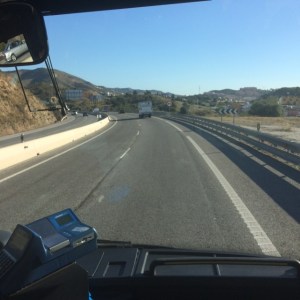
The south coast autovia, Smit’s first relaxed view of the Spanish freeway system.
Leaving Malaga for exploration of the southern coastal towns of Espana, we boarded an ALSA local bus for the 2 hr drive. A most pleasant one as it was sunny, skies of blue, and adventure in the air. The bus pulled into many coastal towns to pick up passengers, which gave us the opportunity to see the small beach towns along the way. Most were choked with towering blocks of uni-designed condos that blocked the view of the Sea and smudged out any picturesque vision one might have dreamed up. Nerja was different. Nerja (pronounced Nur’HA) is a much smaller seaside town that is home to an ever-growing number of Brits, fleeing their miserable climate, both atmospheric, and increasingly, political. While we heard many British accents now, apparently it becomes a flood of temporary Limey expats each summer. And seeing the town, I can’t say I blame them. While it is a bit congested with tourists of the British, German, and American variety, it has sufficient space to access the beach and lay in the sand and get your own sense of space, walk the paseos at leisure, sit on the avenue tables for a coffee, stroll, eat gelato, and just enjoy. We noticed smiles on peoples’ faces, a more relaxed pace (must be the salty air), and a willingness for people to stop and chat. Of course, we were obvious Americans— just by our jeans and tennies and “wierd” hats (although we think they are cool)—so we always got stares but once we ventured out with our efforts at speaking Espanol, we would get a nod, a rattling back of wayyy too much Spanish to decipher, and come to some agreement of what we think we were talking about, or ordering, or purchasing.
Once off the coastal main road (which is even further off the autovia), the town is a delightfully conveluted warren of tiny streets and cobbled lanes, older blocks of apartments with elegant large homes scattered amingst them, and the occassional bungalo, all painted glaring white. There are several lanes of shops, tavernas, cafe’s, heladoieras*, churches (always churches), all converging on the towns sole plaza, The Promenade – Paseo Balcon de Europe; and the whole perched atop a twenty meter sandstone cliff above a sheltered bay of the Mediterranean sea.


‘Berta looks like she’s contemplating running off with Alfonso XII, I might be worried, he is a king after all, but he’s kinda stiff ya know, being bronze and all. Directly below his feet is Restaurante Rey Alfonso, with it’s awsome view of the sea.
At the very end of the paseo reaching out to the sea is a circular plaza, ‘El Balcon de Europa’ (The Balcony of Europe), so named by King Alfonso XII in 1885 during a visit to Nerja after the devstating 1884 earthquake that levelled the town. Originally the site was a Moorish castle, later siezed by Christian Spain, and fortified to defend the coastline and towns from Barbary pirate raiders. Named La Bateria, it was destroyed by British warships in 1812. Located directly under The Balcony of Europe, and sharing the same spectacular view of the Mediterranean and the Costa del Sol, sits a classy, excellent restaurante that may be the victim of it’s unsurpassed and unique location. The foundations of the old fort, and clearly visible, support the restaurant and the paseo above.
The restaurante, which is reached by a set of steep stairs on each side, is a half circle with a large metropolitan style bar nestled in the back, and a glass-wall dining room that wraps around the semicircular terminus of the paseo above. One can relax on banquettes scattered around the bar, or dine while seeming to hang weightless above the waves thirty meters below. How then, one might ask, is this extraordinary restaurent a ‘victim’?
When we ate there (granted off-season, the restaurant was almost deserted. In the course of our liesurely meal, a total of five diners occupied the large dining room, and we were two of them. Earlier we had sat up on the Balcon, enjoying the sun and some nice piano jazz from a busker, and we watched many tourists look down at the fancy sign and entrance, and walk away without even consulting the menu boards at the head of each of the two stairs. Therein, I believe, lies the problem. The place is just so elegant appearing, the site so spectacular, and the location so exclusive, that people just automatically write it off as beyond their budget. Big mistake! Thankfully, we read the menu, where we discovered that the ‘entres avereged two, at most three, euros higher than similar dishes served in the myriad and quality varying tavernas. We decided on price alone to come back in the evening and give Restaurante El Rey Alfonso a try.
So glad that we checked the menu prices, we had a mah’velous seafood dinner with some fantastic white wine at the Balcony Of Europe. We got all the attention we needed. We didn’t feel awkward at all, rather more like king n queen for the evening. It was by far the best restraunt meal we have had in Spain. An excellent grilled salmon, and a wonderfuly sauteed swordfish*, vegetable medly (slightly overcooked, but flavorful), and a fresh salad to finish, all accompained by a decent Andalusian wine. The service by Tia was very attentive (to stave off boredom, no doubt), and the ambiance lived up to expectations. Our entire meal, including wine, came to less than 45,00€ … I was happy to leave a fifty on the bar. After several days of tapas or our hotel room stash of bread, cheese, and olives, it was a delicious and relaxing meal.
* I rarely order swordfish steaks in the US, finding them typically dry, stringy, and bordering on fish jerky, this was anything but.
Directly above the restaurante is the statue of King Alfonso XII (after whom the restaurate is named). He is the great great grand father of King Felipe VI. He came to this area after a terrible earthquake and mobilized the local rich to dig out the community from the bricks and stones of a collapsed Moorish castle and now we have this prominent place called Balcony de Europe.


Our balcony is the one on the right, useful mainly for drying laundry. Above, on the terrace, the national and regional flags fly.
Our lodging for the stay, Hostal Bronce, was about one step above a backpackers inn in use, but a quaint little place, well located in the old part of town. No elevator meant lugging our gear up steep stairs (all older edificios have 1:1 stairs, much steeper than American legs are used to) to our small room facing south. The clerk, a very friendly, helpful young man from Finland was pleased to tell us he had saved his favorite room for us. Well, the room was very nice and the sun welcoming, but it turns out the street is the main drag to the bars, and there were scooters and motorcycles racing past the entire time we were there. Atop the hotel was a charming terrace, and a shared kitchen. The terrace was always too chilly by the time we returned at dusk, and the kitchen was … well it WAS a backpacker’s inn kitchen after all, and best avoided. At about 2 am the boiler for the building kicked on and cycled ever 2 minutes with a vibration felt through the metal bed posts. Forget a sound sleep.


The town central church wearing her Navidad finest, and a lovely fixer-upper offered ‘se vende’ – for sale, on a side lane in the heart of the old town. You can see the solid stone construction that is the root cause of all the cold complaints to come.
Our main excursion during our stay was a tour of the Cueva de Nerja, 400 steps down, around and up and down through rambling caverns backlit by lights. It houses the world’s largest stalactite column. The main gallery is used for annual concerts and ballet, and is reknowned for it’s splendid accoustics. We have visited several caverns, and Cueva de Nerja is easily the most spectacular, and well-developed of any we have seen.


El tren de cueve, ‘Tchu-Tchu’ and just a fraction of the fantastical limestone cave features.
Riding the ‘Cueve Tren’ aka ‘the Tchu-Tchu’ the five km to get there provided us a scenic glimpse of the smaller local towns. Later we went to the Museum to read and see more details on the petroglyphs, geology, and ongoing research being done in the caves. Co-managed with la cueva, the museum houses excellent interpretives telling the paleo history* and the beginnings of the ‘modern’ community, starting with the Romans …
* Although rediscovered by accident by a group of young men only in 1959, the caves were inhabited by some of the earliest humans to occupy the north coast of the Mediterranean, over 20,000 years in the past. There are multiple cave paintings and burial sites deep within the caverns that evidence the cultural uses by early humans, and the shallower near surface cave rooms were deep in mussel shell, bones, charcoal, flint points, and pot shards that prove they were habitats for coastal dwellers.
We took several of the winding walkways down the cliffs to small crescent beaches with white sands winding amongst towering limestone blocks that have fractured from the cliffs over the eons. In fact, the coastal walkway that connects the beaches scattered along the coast has been blocked for landslide hazard. There are small bungalos carved out of the cliff bases on several beaches, any of which would make a fantastic retirement casa.


The Nerja ‘beach scene’ in winter, relaxed, laid back and almost deserted. Wouldn’t that casa built into a cave make a fantastic retreat to get away from it all?
We found the ALSA bus kiosk the day before our departure, and were pre-ticketed, packed, and rolled to the bus stop, albeit a bit scant on cafe’, in plenty of time for our next ride to Granada, the self-declared crown (as are all Andelusean cities) of the Moorish and Christian kingdoms.
Had we discovered Nerja immediately after our trip to Oviedo, we may well have just settled in for the duration of our Spainish sojurne. So, if you are visiting Spain’s Costal del Sol, and you find yourself in Nerja (which I highly recommend you do, for several days, or even weeks), relax, enjoy the beautiful and varied coast, and do not miss the chance to enjoy unique Rey Alfonso dining experience in a historical location.
GRANADA ¿THE CROWN JEWEL OF ANDALUSIA?
We arrived by ALSA regional bus and hopped a city bus to get to our Air BnB. The google map, of course, stopped working as soon as we got off the bus and so we started walking along the narrow street next to the cathedral. Think of massive concrete. No radar feed getting to the phone. We couldnt figure out which way to turn. R demurely requested assistsnce from a waiter who happened to bound out of the restaurant to serve one of the many patrons sitting outside at tables surrounded by warmers. He got the gist of what she was hand-signing and Spanglish configuring, brought out his computer, and found Calle Elvira, nudged us in the right direction and off we went.
We hustled along with the Christmas shoppers in the plaza, trying to make the wheelies cooperate—they were not liking the stones, ruts, and corrugated bricks across which they were being dragged*. We felt like we were in the back lanes of a busy Morracan souk. Just when we’re getting that gut-level feeling: ‘We’re not gonna ever find this place’, we hear “Rober’ta”. It’s Chris, who speaks some English, to the rescue. He is our host, picks up R’s wheelie, guides us around a few more narrow paths deeper into the labyrinth, totes the bag up three flights of stairs, shows us around our little abode, home for the next 5 days, gives us a guick rundown of his favorite tapas bars, the weefee, and off he flew. After turning on the portable heater, which we ended up dragging around with us from room to room like a puppy cuz it was sooo cold, sussing out the bed, and kitchen supplies, we hit the markets and street scene … vinos tintos y tapas are calling, and we have Chris’ list to work through.


Somewhere around here is our casa for the stay … straight on, a left, then a right, and here we are! Note the wheelie-killing paving.
* hint: If you are traveling to Italy or Spain, get a wheelie with BIG wheels, or use a backpack (if you don’t mimd being taken for an aging hippie). Most certainly do NOT travel with those four (tiny) wheel suitcases you see people pushing along. They’re great in the airport, but in the back lanes and cobbled streets, people had to resort to CARRYING them!
Since Alhambra was the main attraction for us, we explored how far away, bus routes, walking options etc to get there, walking up the river walk where it is above ground, before plunging into a tunnel running under the city. The streets were crowded with ‘blanket merchants’ with their small wares (jewelry, hats, t-shirts, souvineers, purses, belts … ‘¿psssst, you want marijuana?’ … spread out before them; buskers, strolling (and very insistent) African immigrants selling everything from ‘gold’ bracelets to pocket-packs of kleenex, panhandlers, preachers, and segway riders. We took in some very interesting sights, one being a very old church (aren’t they all?} with a small wedding occurring, the participants gathering outside at the exit door. We continued our walk up a narrow side road, along a canal (the river), and along the back side, or at least some side, of the Alhambra. Uh-Oh. Something wrong. Weve gone too far. Back down the narrow road toward the plaza, being extra careful not to get run over by busses, taxis, tours, and cars. Now, we get another glimpse through the wrought iron gates of the Catholic church; the wedding is over, and the bride & her new deer-in-the-headlights-stare husband appear for the well wishes. Wow Wow Wow. State of the art fashion. OMG. it was like looking at Elle Magazine or Vogue. and Hats and furs. And, of course, there was the fancy restored vintage Mercedes town car with flowers tied on the door handles (black dress-suit driver, cigarette dangling from lip, eyes buried in cell phone) waiting just up the road.
From the church we turned off the busy one-lane road, headed into the tour center, and booked a later that night guided tour of the ‘white village’ heritage area, constituting the Jewish and Gypsy quarters, along and above the river running at the foot of the Alhambra … WITH A GUIDE … good move. I could just imagine us getting lost when we got to the top, which is the Gypsy quarter, and being unable to navigate through the warren of streets. Many of the Gypsies still live in caves at the top of the mountain.
We met our guide and a mixed bag of tourists from all over the world, whose only common denominator was a functional understanding of the English language … more or less. We started out at 5 pm when it was light, coming back to the visitor/booking office shortly before sunset. Our guide walked us up and down, and around and around until we were thoroughly lost. We popped out on top of the hill onto a large flat plaza with a commanding view of the city sunset, and the night lighting of the Alhambra switching on. Excellent timing, that.


As the day died into evening the Alhambra lighting displayed the ancient fort magnificently.
Our guide showed us the wide variety of the hill commerce, from small hole-in-wall shops, to cueva (cave) flamenco bars, featuring nightly shows*. Our guide was apparently well informed, but we’ll never know … at each landmark she would stop, tell us the name of that specific place and instruct us to take photos, and then announce , ‘


… of course I know where we are. We’re right here, I just don’t know where ‘here’ is. A Jewish quarter casa cuevo. I don’t know what happened when I uploaded the pic, but I love the way it came out as a pointillist painting.
… and now, I’ll take you on a little walk to the [insert name here], and tell you about such-and-such, [insert name here], and tell you about THAT place, repeat paragraph. We got to peek into a quasi-legal ceuva flamenco bar, dug into the hill, perhaps 500 years ago, After the tour, a detour to a packed tapas bar, recommended by Chris, and home to crawl into bed, the only place to get really warm. All of the edificio antigua are cold (also LOUD), being solid stone with zero insulation, which is too bad.
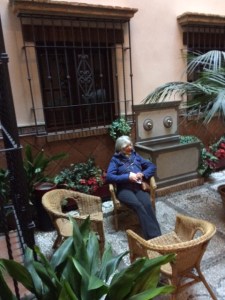
The interior courtyard, a common feature of the ‘edificios antiguas’ are so inviting, too bad they’re freezer temp.
There are so many admirable features like wrought iron balconies, or bright interior patios that invite you sit by a fountain, surrounded by green plants and flowers, to chat, read, or write. Alas, it is just too cold, so you end up back in your apartmento huddled around the puny heater, or better yet, off to a warm taverna!
Our designated time slot for Alhambra admittance was 9:30 am the following morn with instructions to be there 30 min prior. Knowing our propensity for getting lost within the first 10 min of lift-off, we set the alarm to wake up early enough to have coffee and be at the base of the hill/road by 8:00 am. Well, we were late so we had to get a move on. It was cold, Steam was coming out as breath! We set off toward the giant monolithic structure protruding skyward above all else. It was just down the road on Elvira and onto a central plaza, around a corner, and up the road. Good news: we found the correct road to ascend to the Alhambra, and about half way up, R is wondering where her physical stamina marched off to. Smit had to put on the after burners to pull R up the incline, nudge her through the giant arches, and stand in line huffing and puffing to show passport and tickets to enter. Made It!
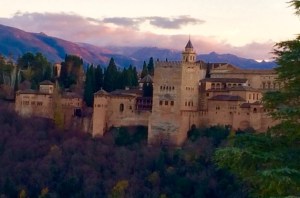
A self-contained city on the hill above Granada, the Alhambra could occupy days, weeks, a career of time, and you would still not see it all.
Words cannot explain the massiveness, beauty, history, and wonder of this monument. You see over a thousand years of history, with each successive civilization building on the ruins of the previous, often one they had just defeated in war … nothing changes excep the stage and the players, mankind keeps acting from the same, seemingly eternal script! We will borrow books from the library when we get home to glean more of the hidden mysteries and tales of those who built, lived and died here.
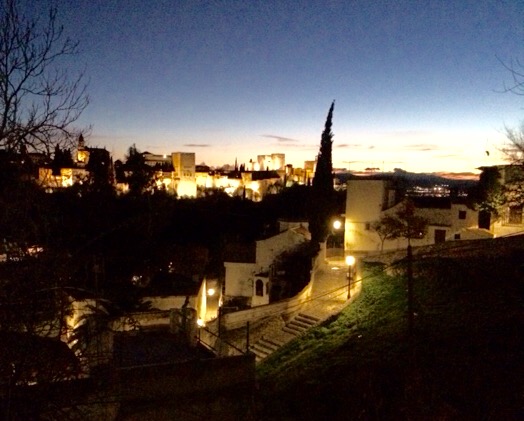


The commanding views of the city below, and far countryside, show why a fortress was built on this hill, one that encloses a wealth of gardens, promenades, fountains, and secret rooms.
Many afternoons we strolled the paseos stopping at fountains, warming benches with other codgers taking a break, and worked on mastering the art of people-watching.


There are views of the Alhambra from all over the old city, and of course a magnificent ornate cathedral. We even came across Christopher Columbus petitioning Queen Isabella for the money to sail off the edge of the earth.
It’s the weekend before Navidad, and holiday visitors are just starting their influx, so we were told. Bling and Furs. wow wow wow. Minks and all those old style furs have come out of the moth balls or however they are stored. Full length ones. And, now, dyed ones; red, green. There is no awareness of ‘little animal’ rights here.
Most eves we venture out for a look-see of the town scene, stand at a bar to have a beer or vino tinto and a tapas, and move on to another bar and call that dinner, then home to bed. We don’t seem to be able to stay up late enough to get into the spanish night life that doesn’t start til 10 pm. Oh well. On Sunday we discovered we were out of wine at our apartment, uh oh it’s Sunday, the stores don’t sell alcohol. But they still DO serve it. So, scratch our plans for a home-cooked, unfried meal; it’s back out for tapas … again. Serendipity strikes! We were standing at a neighborhood bar when we watched a patron come in with an empty wine bottle, which the bartender proceeded to fill from a tapped keg. We asked the bartender, ¿Tiendes bottelas para vino llevar? ¡Si! Valle, una bottela vino tinto, por favor. The Spanish may not have been perfecto, but we left with a 3,50€ bottle of palatable wine, to accompiany our now home-cooked dinner.


Our ‘bootleg’ taverna, with kegs of illicit vino (at least on Sunday), and of course hamones, Spain’s mainstay.
We sound like we are becoming noon to midnight alcoholics, but in Spain, that is the way of life. Water (preferably agua minerale) may accompany wine with a meal, but replace it? NEVER! The surprising thing is that, despite the alcohol percentage being the same as wines sold in the US, you never seem to feel it.
And then there is always Flamenco. We decided to forego the packaged Gypsy cavern shows, and bought tickets at a small studio/theater partway up the steep via to the Alhambra. After waiting outside in a chill wind, we were escorted into a small, high ceilinged room with a steep bank of chairs opposite a small stage erected against the wall. There was a small fountain at our feet, and balconies above; so it’s apparant that the space had been an open courtyard in the original home. A chair was brought, followed by a guitarist, who performed warmup songs until the dancers came onstage … and what dancers!


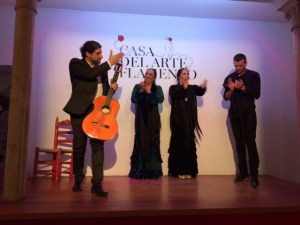
The dancers were exhuberant, passionate, and even fierce, with call and repeat challanges of song, clapping and thunderous footwork. ¡OLE!
The women were flirtacious temptresses, and the men aloof and stern, with many ‘freezes’., posturing and posing. It was all great LOUD fun, and the small audience of mostly yanks thouroughly enjoyed themselves, as did we. We must be gaining an understanding of the finger snaps, the twirling of the skirt, the riveting heel taps, and passionate expressions as we are getting greater enjoyment with each performance.
At the end of our stay we bid farewell to our warm host, and his chilly apartmento, connected with the railway station on the city bus, and boarded a fast train to Cordoba, our next cuidad antigua waystop through historic Españia. But before we left, we set out on a shopping quest: Flamenco shoes for our favorite dancer, Kapalili … so you KNOW what’s coming!
Somewhere along our travels between Nerja and Granada, we got an e-mail from Martin and znancy that they weren’t able to host us over Christmas after all. Whether it was a conflict with additional guests, or our visibke reaction to the pending poek cheeks, we may never know. But before we can head off to Cordoba, there’s the problem of the equipage left in Martin & Nancy’s spare bedroom closet, resulting in …
… THE MALAGA SHUFFLE
An early morninga ALSA bus ride deposited us back at the Malaga bus/train complex, where we rented a storage locker to empty one of our wheelies to collect our ‘overage’ back at the Edwards’ condo. By now we’re old hands at Malaga, so the bus system is sussed, and we wuickly find ourselves there, on time even. Sorting through the stuff in the wheelie and excess we managed to dispose of a bag of clothes with Martin & Nancy, to use or donate as they wish. In our defense, we attempted to travel light, but also to plan for climate ranging from the middle-eastern deserts of Israel, to winter in the French and Swiss alps … some duplications were the result.
Back on the city bus to the eststion del tren luggage storage, where we repacked all (now back to three) our wheelies and bags, and boarded a train to the next jewel in the crown of Andulasea …
CORDOBA ¡NO, WE ARE THE CROWN JEWEL OF ANDALUSIA!
A two hour bus ride and a taxi assist landed us in a very convenient location in the old district of the city, once the capital of both Roman and Moorish empires, and site of the Mezquita—another wow-wow Muslim mosque taken over by the Christians. Its known as Europe’s best Islamic sight after Granada’s Alhambra. Our lodging, Hostal Almazor, a small two story hotel with our room looking out over a small plaza, was just a few blocks away. The plaza and it’s tiny mini-mercdo next to our hostel has a fountain/trough that used to be where the donkeys came to drink water. That small store was our source to buy vino, snacks, and practice speaking espanol with the oh-so tolerant shopkeeper.
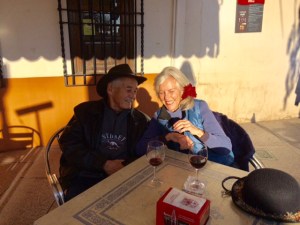
Our, ‘We made it through another relocation trip’ evening vino, sunset in Cordoba, the self-proclaimed birthplace of Andalusea.’
The first night we just had a sunset vino at a restaurante just around the corner of our hotel, then walked along the riverfront paseo before retiring from our travel-weary day. The next morning we wandered (with coffees and croissants in hand) to the Gate of the Bridge, a huge Renaissance gate built in 1571, to see about a city walking tour. By pure chance and delight, we were the only two English speaking tourists so we ended up with a virtually private tour guide, Daniel. What a charming, educated, kind-hearted, humble, carring human being. We could have been his grandparents and sure hope he makes it to Hawaii for a visit one day.
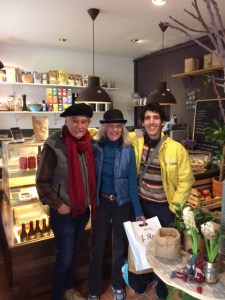
Ready for lunch with our guide Daniel, Smit wearing his brand-new ‘boina’.
Well, anyway, back to the tour. Remember ORNAMENT OF THE WORLD? Because we now had some relevant history in our brains, we were able to keep up with his spiel, understand, and dialog about EVERYTHING he was talking about. And we had him all to ourselves so we just jabbered away for hours. The weather was chilly but sunny, lighting the narrow passageways, hanging flower potted geraniums and some other flower we had never seen before. Daniel highlighted many of the statues, spots where shawls were dyed and “measured”, and creepy places such as the museum of Inquisition where you could see grisly torture apparatuses. One being a metal iron chastety “belt”, OMG!Gross. During the Dark Ages, Europe was illiterate and barbaric, thus, the latter. In Cordoba, thank goodness, things were changing as it was a haven for religious tolerance, artistic expression, and dedication to philosophy. And the sciences – the first cataract removal was done here way back when (although there is disputed evidence that Egyptians performed surgical treatment of cateracts thousands of years earlier).


The street of flowers, and found on the wall the authentic recipe for gaspacho, because Cordoba, in addition to inventing flaminco, also claims to have invented gaspacho as well. Sorry you have to interpreate from the Spanish yourself.
Two great thinkers of ancient Cordoba were Seneca, in the Roman era, and Ibn Rushd, often Latinized as Averroes. Statues of these guys were also placed around the old town, although things didn’t go well for either. Seneca was ordered by the Roman emporer to commit suicide, which he did, so discouraging his followers that many of them did the same … now THAT is dedication to a philosophy! Averros managed, through his writings to offend the orthodox Islamist Caliph of his time, who ordered him exiled, and his works burned, but at least he got out alive. Near the only remaining synagogue in the old Jewish quarter (the rest were destroyed by Queen Isabella, or repurposed as churches), is the statue of the great Jewish philosopher/physician, Maimonides, who was exiled, by a strict Islamic caliph, and fled to Morocco, and then Egypt in the mid 1,100s. The synagogue, now a museum, was built in early 12th century, and is believed to have been used for religious purposes right up to 1492, when all Jews were forced to convert or expelled/fled from Spain to avoid the attention of the inquisition.
Enroute to find our return out of the labrynth of streets, Daniel found Smitty a habadashery for men. Smitty had been looking for months for a beret without success. In Spain they all have a little bill on the front (think New York newsboy hat). Well, this particular small shop in Cordoba has been in this same spot, run by the same family for over 100 years. The owner even pointed to a couple of the people in the picture that hung on the wall over stacks of hat boxes of some members in his family tree. He mentioned he had every kind of hat and found the perfect one with all of Smitty’s specifications. Smit was a happy camper. Now people don’t speak to us upon first glance in English but in French, so we are really in trouble cuz neither of us can parle France’.
What Roberta particularly enjoyed whilst being in this small shop “waiting to be served” was another customer, male, of 70+ yrs of age, Spanish, well dressed and taking great pride in selecting the perfect hat. The dialog between el senor and the haberdashery owner was of poignant pointing, shaping, readjusting so that there was just enough room between the tops of ears and the bottom of brim, so eye glasss or hearing aids were not compromised, had a slight tilt of the brim to the saisfaction of the wearer, and, of course, was the perfect shade of coloring. The sale was made, the hat wrapped in light tissue paper, and carefully placed in a slick hat box to be carried home.
We were all a bit famished with all this walking, sharing, shopping, and learning, so we decided to go for lunch at Daniel’s favorite vegetarian restaurante— yea! More verduras (greens). Great Meal. Great Sharing of cultures. A Serendepitous meeting.
The Mesquita Mosque-Cathedral and Bell Tower, a former mosque that was the center of Western Islam. In the 15th century, with Christianity on the rise, the Moors were driven out (or left on their own after learning of the inquisition) the Catholic church took over the structure, and Instead of smashing down the whole building, left it intact and just added a pulpit and altar smack dab in the center of the more than 800 columns with red bricks and white stone arches.


A thousand year old mineret is inside the ‘pregnant’ tower that surrounds the original mineret.
As saint after saint was added to the Catholic pantheon, and subsequently adopted by wealthy patrons, private chapels were added, shoehorned into perimeter alcoves* around the central main alter and choirary. Its a little odd with all the gold and Catholic religiosity stuck up against the walls of beautiful mozaic tiles, ah well … who knows.The way our world is going at the moment, another conquerer might come along and change the facade once again.
* A common practice in the age of great chathedrals. Prominant families donated hug sums of money to demonstrste their piety, wealth, and high station in the community to create a place where they could be served private mass away from the commoners, as well as ensure their passport directly to heaven without all that bothersome and painful indeterminant-number-of-centuries waystop in purgatory.


Above Cordoba, at the top of the tower, did we mention it was ‘chilly’?
Yes, of course, we had to climb to the top of the tower – all 194 steps. Great views of the city. Originally, the bell tower was preceded by a minaret erected in the times of Cordoba’s first caliph Abd al-Rahman III*, around 951 AD. According to a scribe “one could use two staircases to climb the tower, separated by masonry in such a way that two people going up at the same time would only meet at the top”. The locals call it the pregnant tower as the ‘new’ construction was built around the old.
* A tolerant religious and political figure, he allowed the Visigoth Christians and Shephardic Jews to remain, and assimulate into his newly established Moorish empire, leading to the golden age of religious, philisophical, intellectual, and scientific tolerance that was led by Cordoba (and celebrated in ‘Ornament of the World’). This egalatarian era was quickly quashed by the Catolica Monarchs, and their religious watchdog Torquemada as heretical, and Spain was set back hundreds of years.
Our big evening outing was Cordoba Equestre, a spectacular equestrian show put on by the Royal Stables of Cordoba showing the passion and spirit of the Andalucian horses. And, as a double treat, there was a flamenco dancer doing solo and duets with a horse. Hopefully these following pics will give you a little taste of the pagentry, costumes, and horsemanship we enjoyed.


Passion, music, and interspecies communication!
Wandering toward our hotel home after the show, we were looking for some place to pop in and have dinner. We heard some great loud music coming from a large restaurant/bar. We elbowed our way in and perused the lower and upper floors. There was music playing, people dancing, and waiters up and down the stairs serving all kinda of drinks and food. We thought maybe a wedding or private party was happening so nudged our way back down the stairs and through the pulse of people. All the tables had a reserve sign on them. Odd, since no one was apparently in the mood to sit. So we smiled and communicated something to the waiter that got us a great corner seat. We had a lovely dinner, tried some new wines, and enjoyed the ambiance of youthful adults and a hip music scene.


Wandering the old city always brings surprise edificios, from ancient fortresses to faux romanesque fascias from later centuries.
Another evening we ventured out to see the Christmas lights and carolers in the plazas. One group, primarily women, all wore the same tan serape and tan hats (like the horse riders wear). They were accompanied by several male guitarists of ages 60+. There were clappers (flamenco style) and finger snappers, and an occasional castenettes and tambourine player. We followed them for awhile enjoying the comradery of the locals singing along with them before fear set in that we might not find our way home through the maze. So about-face we did.
To our eyes, this city had few dogs and zero cats. They also had a “zamboni-like” piece of equipment that kept the streets, alleyways, and plazas clean. The locals were friendly, paid little attention to to us, the odd tourists, but were always willing to give directions when asked. We would love to come back in the Spring when all the flowers bloom and a big contest is held amongst the locals for the most beautiful patio. But now Navidad is almost upon us, and depart we must to Cadiz, where we will have a short stay to celebrate Christmas among strangers … what tales will emerge?
All aboard as we depart Cordoba for Navidad in Cadiz.
CADIZ, FELIZ NAVIDAD! – 24/12/17
A train ride of approximately two hours on a local commuter train gave us a chance to see things at a slower pace and to cogitate what we were going to do for the next two days: Christmas Eve day and Christmas Day. We were booked into a hostel* near the train station, where we managed to get our bearings from the Intormation center, who must be on contract with the hop-on-hop-off bus company because they seem more interested in getting you on a tour than answering your own personal questions or providing directions. Without too much rerouting of ourselves, we found ourselves up the cobble-stoned hill, along the narrow corridor street running down from the church on the top of the hill, and into the doors of Casa Caracol, ‘snail house’.


* Which turned out to be a real hostel, not a Spanish ‘hostal’, bunk bed dorms and all … with matching jam jar glasses. Sleeping loft at the top of a steep ‘ships ladder’, shared bath – through the lobby, past the dining nook and wood stove, and through the kitchen… puts the ‘fun’ in ‘funky’!
We were met by warm smiles, in a warm, and warm feeling flash-from-the-sixties hostel that felt more like a funky crash pad, than paid lodging. We were given a private room on the ground floor*, and introduced to some of the other hostelers. No “Here’s your key, have a nice night” here. We were escorted into the group of folks sitting around a large round table, or bumping into each other in the adjacent open communal kitchen, and intruduced to everyone there. There was a cheery wood stove, our choice of seven shared baths on five floors, all to a groovy constantly changing background of eclectic music choices … classic rock, cool jazz, funkadelic, space synth, classical, Tibetan throat singing, and only very rarely Spanish rap. Then off we went to explore the neighborhood. Found a restaurant with tables set up outside, sun shining down, and an ambiance that exuded “come and sit down and have a glass of vino tinto,” so, of course, we did.
We took a post-prandial walk along the beach and took in long deep breaths of the sea air. Explored new walkways and found three Roman sarcophagi. Interesting how and why they make giant granite tombs with the likeness of its resident carved in 3-D relief on the top exterior. Cadiz is a small town surrounding a harbor on one side and facing the open Atlantic ocean on the other, relatively flat except for the immediate hill upon which we were staying. Later we went shopping at the corner ‘Supermercato’ for the fixin’s for our Christmas dinner contribution to be whipped up in the happy kitchen meelee next day, followed by a night ramble through the paseo to see Cadiz’ version of Festival de Navidad on Christmas eve.


Cadiz, as do all Spanish cities, lights itself up for the holidays. We expected to see crowds of celebrants clogging the vias and plazas, but the streets were totally deserted.
We gave up around 23:00 (11:00 pm to only the US in all the world), and climbed our travel-weary bodies up the ladder, where we fell soundly to sleep. We learned the next morning that the Spanish stay inside until the stroke of midnight, then simultaneously swarm out to celebrate the arrival of El Niño en masse!
On Christmas day at the hostel breakfast of home-made crepes with various fillings were served to all comers, and it didn’t take long for a pre-feast party atmosphere to start. There were many interesting, fun, curious folks from all over the world here in this spot for these two days. England, Japan, Canary Islands, Hawaii, Sevilla-American expat, France, Canada, & America. Friends of the staff stopped by for well wishes, and the owner (a 30+ year of expat Brit), showed up to share the festivities. There were always 2 or 3 languages being spoken simultaneously. Cultures, ideas, politics, and advice was shared on many different levels. There always seemed to be someone cooking in the open area kitchen. Food was shared on a large round nook style table. The ebb and flow of people kept the conversations and the food and vino moving, and the music led to spontaneous dancing when room could be found.
We ventured out for brief walks in between rain showers, to see the beautiful Christmas decorations in the plazas.


Our cheerful, cramped and full of international banter Christmas dinner. Top row, left to right; the owner opening yet another of the seemingly endless bottles of Spanish sparkling wine, a sampling of the chefs du joir, the beautiful ladies of the gang. Bottom; the international rainbow, and then just part of the gathering, which ebbed and flowed throughout the day.
Christmas over, one more night, and it’s off back down the tracks to Sevilla, which (not surprisingly) claims to be the real and true heart of Andulasea, and heart and source of flamenco … ole!
SEVILLA ¡NO, NO, NO, DO NOT LISTEN TO THOSE UPSTARTS … WE, AND WE ALONE, ARE THE CROWN JEWEL OF ANDALUSIA!
We are becoming pretty train savvy now. Wheelies maneuvered through the narrow streets, juggled around the cobblestones, and jerked through the ruts…and they are still in motion, with their tiny wheels still somehow attached. Since Seville is another city with a labrynth of small, twisted roads, we opted for a taxi to find our next abode for 4 nights. It was another several hundred year old old Moorish style of concrete block triple storied bldg with a small courtyard area to sit and visit and use their wi-fi. Absolutely freezing. We had to huddle around a small table in our small dining room next to our bedroom and find the sweet spot to make the electronics work. A portable heater was provided but after one night it stopped working.


Signs of the season; ‘burgler Santa’ seen all over Spain, attempts a 2nd story job (well, actually 1st story in Europe), and a bus welcomes in Christmas.
Requested another and the old style portable heater was provided. There were two bathrooms with sink and showers to share with other guests. One of the bathrooms was just added on to fill Air B n B requirements, is our guess, as if you didn’t duck your head to enter it, you would be knocked out and sprawled half in and half out of the tiny bathroom. If you did make it in, the showering was fine BUT the toilet was situated so close to the wall that if you sat on it normally, your knees hit the wall. So, you had to sit cross-ways. Could have been up to six other guests, as far as we could tell from the other doors that led to the courtyard. So, lining up for the bathroom for normal-sized-people and not deformed midgets was not a rare occurrence. Enough of this.
After getting situated, we hit the back streets exploring the Santa Cruz District. What a fun and interesting place. The people are much friendlier here, smile more, and provide a greater variety of food. Since we are a bit “over exposed” to the opulance of gilded gold, we spent less time in the cathedrals and Alcazar and walked to explore the gypsy and Jewish quarters to gain more understanding of the history and cultures. One outstanding feature in the Santa Cruz neighborhood is the Plaza de la Encarnacion, home of the Metro Parasol, known locally as ‘the mushroom’, an enormous jigsaw puzzle of structure that covers the market place, rearing several stories into the open sky, and straddling Calle Imagen, one of the main streets of the district. There is an elevator that whisks you up to the ‘roof’, where you can stroll along an undulating pathway in the sky and view the city, and the bust plaza directly below. The elevator costs 3.00€ each, and there was an hour long wait. There are also supposedly stairs, but they were locked, so we took a bye on the lift.


The Metro Parasol, aka the Mushroom, looming over the Plaza de la Encarnacion the marketplace, and Calle Imagen.
R’s first mission was to locate where the flamenco class would be held in a couple of days. We crossed the Guadalquiver River (the same river in Cordoba) and entered Triana District. It seemed as though every 100 feet the “street” changed names. We found a huge market place and wandered around, in, and through it. Found our address, which was right next door to the market place. A regular door size door leading into a typical edificio apartmento, with a push button notification system on the side of the building with four buttons, no names. What would you do? After no response from 3 of them, an answer spouted forth from #4. “Digame”. Well there was no communication between us, unfortunately. R got back to the computer site where Flamenco class was booked to get the phone # of Eva. Success! The class room was INSIDE THE MARKET PLACE, next to the fruit stall, fish lane, and eatery around the corner, come back at 17:30 for the class.


Triana, all decked out and swarming with merrymakers for the holidays. No class pics, but here’s Roberta striking a pose in the Flamenco Museum theater aisles.
Okay. At that hour, the marketplace is almost completely closed down, 3 nice chairs plus a bench with cushions are aligned in front of the door with No sign. Okay. Must be it. There were 4 women plus Eva – 2 French speakers, 1 Spanish speaker, and me. Eva managed to do all three. The basic steps and theory were covered and we got right into the tapping, finger snapping, and ole’. We all had a great time and left with big smiles, a huge rose to take home and a short video of us dancing. We later found a CD at the outstanding museum of Flamenco, which was not only informative, but highly entertaining as well.
We wondered around til we found our “home neighborhood” and headed for an outdoor resturante. We were finally up late enough to enjoy the parade of people on the paseo and outside table tapas and dinner offerings.
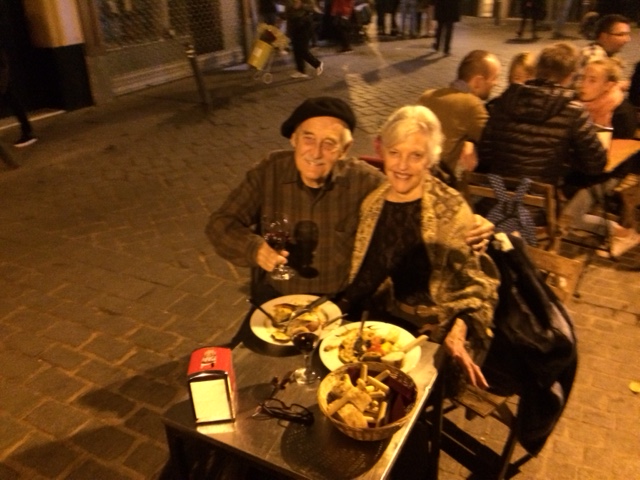
Dinner in the streets of Sevilla. All over Spain tavernas and restaurantes just stake out and take over major parts of the sidewalks, plazas and in this case, streets. Everyone, including the municipalities apparently, take it in stride and just go around.
I guess we were having so much fun that we lost track of the days. As we were getting ready to embark on yet another day of looking at gold and silver everywhere, a knock on our door produces the host with cleaning equipment, new sheets, towels and scowls, asking what time we were vacating, in Spanish, of course.. yikes. Half hour before check-out time. Zooommm. Called the hotel we were booked for one night hence, Christmas Eve. They had one opening left. We’ll take it. Jammed everything into the suitcases, wheelied them out to the lobby, cab happened to be driving by, got it loaded up, and away we flew to Hotel Maestranza 11:59 am. No time for goodbyes and no one around in the cold central patio. Did we mention it was cold? And not only the building, but the proprietors as well, who gave us a ‘do not recommend’ rating on the Air B&B site … our first in years and dozens of stays.
Into our new abode Hotel Maestranza for 3 days – New Years Eve, Day, and recoup day. We had to call, and fortunately they had one room vacant a day early. The hotel was opulent in the Belle Epoque style, with a warm helpful staff, warm rooms, and zero amenities. Our most expensive lodging to date, and they don’t even have tea or coffee … not even Nescafe’ instant. Luckily, the small narrow street is almost wall to wall tavernas, cafe’s and restaurants, so a few steps out the door earned us excellent coffee and croissants for under three euros each.


Entry and enclosed interior courtyard of our new lodging, just around the corner from Plaza Nuevo, the main gathering place for the New Year ringing in.
During our stays in both venues we rambled out and about, up and down the twisting vias antiguas, and the modern boulevards. Partly business such as recharging Smit’s Vodafone SIM card, partly looking for specific buildings or attractions, partly window shopping, and mostly getting lost and finding our way back again. Sevilla has a shopping district to rival the densest ‘haute courtier’ labels anywhere, where else could you find a hundred year old taverna bracketed by Bulgari and Herme’s and Colors of Bennington (remember them?) across the street. St. Lauren, Rolex, Brietling, they have them all, in abundance. Needless to say ‘window’ prevailed over ‘shopping’ for us. Smit was on a quest for boots in preparation for our pending sojourn in the Swiss and French alps, but finally gave up and made do with multiple socks in his desert boots.


Just a few of the striking buildings, narrow alleyway surprises, and vistas of the city.
New Years eve arrived, and we started out through the Plaza Nuevo to meet Eri, one of the Casa Caracola internationals we met in Cadiz, at a bookstore/cafe’ in Alameda de Hercules (so named for Roman pillars that still stand at the entrance. Eri is a Eritrean-born, Miami-raised expat American woman, permanently settled in Sevilla, after several years in London.


‘Berta in the early evening empty streets before the crush, and wandering through an illuminated maze with Eri.
A totally cosmopolitan woman living singly abroad by means of free-lance software development, and a wealth of knowledge on the realms of geopolitical, financial, cultural, and party venues. We met as the cafe bookstore as it closed early for the festivitie and strolled the plazas together chatting about everything that popped into our heads, until at Plaza Nuevo she left us for a pre-planned engagement. We started a random circulation through the plazas Nuevo and San Francisco, watching the celebrants, and keeping a tight grip on each other lest one be swept away in the crush. Shortly before midnight we found ourselves ‘entangled’ with a pair of groups that hailed from Portugal, UK, Germany, and the US. They collectively had functional English, and a LOT of champagne … I don’t know where it was stashed but there were always several bottles in circulation, and if anyone saw an empty hand a fresh bottle was procured, popped, and passed around. By midnight we were all quite jolly, and the countdown was culminated with hugs, kisses and ‘Feliz y Prospero Ano Nuevo’s all around. Oh, lest we not forget this new tradition to us, eating a grape at each peal of the bell at the stroke of midnight.


Champagne prep before venturing out into the last hours of 2017, amidst a swirling light show of celebrating humanity, including someone setting off HUGE blasts!
New Years day we slept in (didn’t everyone?) and when we finally went out, we had to search for several blocks before we found a cafe’ open and serving. There was a veritable army of street-cleaners attacking the debris left in the plazas, and by afternoon it appeared the night before never happened. We searched out a sunny bench to warm up and catch up on our blogging, at least until our iPad batteries died. We started out layered up, and ended up stripped to t-shirts until the sun passed behind the trees and we started putting the layers back on.
The perils of al fresco journalism in the park. I don’t know what our readers think of our scribblings, but the pigeon made his opinion clear.
We decided to have a late lunch at a real restaurant, being ‘tapas-ed’ out. We chose the one directly opposite our hotel room window, and settled into a real meal. R chose oxtail stew, which was served with whole cross-sections of tail, while S opted for the regional espinacas/garbanzo dish, although he did mop up a fair bit of the stew gravy with the course bread. A siesta followed, before heading out later for the usual tapas and vino tinto. We got ourselves repacked for our next travel leg, Sevilla > Barcelona, by ALSA autobus … an 8+ hour trip. We originally had ‘planned’ to take the train, but when we went to the station to book we discovered that the next available seats were on the fifth of January! The bus revision was lengthy, but at least it cost only a third the train fare, small comfort when your sitting awake all night listening to the guy across the aisle, or the one sitting directly behind talking loudly into their cell phone.


New Years day, empty plaza. The best gaspacho we’ve ever had. If there’s a line, it’s a lottery outlet. A beautiful belle epoc building. And finally a totally random, beautifully executed ceramic tile advert for a 1920s vintage Studebaker automobile.
Smit got up early, and wandered out for a cafe’ and to take a few more pictures, after which we checked out, leaving our equipage in the hotel storeroom while we had a last ramble, and a look to see if we could finally get into the Real Alcazar. Not a chance, the line stretched for a half-kilometer … we shoulda heeded Rick Steves advice and purchased entrada premiero tickets well in advance. Oh well, next trip, it’s been here for a thousand years and will be still when we’re long gone.
Finally, we retrieved our bags and wheeled out to an avenida where we could catch a cab to the estacion de autobusses, and a long (15-hr) sleepless trip to Barcelona, which not only doesn’t claim to be the birthplace of Spanish culture … it claims to not be a part of Spain at all!
BARCELONA – are we still in Spain … or not? January 3 – 6/2018
We were scheduled to be here on the 2nd but we never booked train reservations and it was just too crowded with all the Seville-ites leaving that there were NO seats … for the next four days! We barely got seats on the bus. The bus stopped at every small out-in-the-boonies place on the 1,000+ km route through Valencia, so that it took 15 hours to get to Barcelona Nord station! There was the guy across the aisle on his cell phone (loudly) his entire leg, replaced by a kid directly behind us whose phone rang constantly (how many phone calls do YOU get at 03:00?), and then two gnarled old men who argued for 200 kilometers. Between the rural (some roadside) stops, and the characters boarding, we almost expected to see crates of chickens tied to the roof by the time we arrived. We did get out at almost every real station stop just to unpretzelize our bodies. Most of the folks were wearing hats or hoodies (keep away the ukus) and ear buds. We had a stash of bread, cheese, wine, and fruit so we amused ourselves for part of the trip. We arrived at some demon hour around 05:00. Hobbeled out to go find cafe, pastries, and WC. Next thing, Smitty is in a panic cuz he left his cell phone on the bus. Well those busses don’t stick aound too long. He ran to the upstairs check-in counter; luckily someone was there … at the end of a line of people booking tickets. Finally, “Ahh, the bus is still somewhere in the station, here is the coach number”. Off he goes toot suite, found the bus, and caught the driver’s attention as it was entering the washing drive through. Bravo! got there in the nick of time. Ahhh, now we can get on with the day. Caught a taxi to Somnio Hostel on Calle Diputacio, in the heart of the ‘new town’ part of Barcelona, just 1/2 block from the once famous, now infamous (hang onto your wallet) ‘Las Ramblas’ boulevard that bisects downtown.
It’s about 7:30 am. We ring the doorbell, one of about eight by the door, that states the hotel’s name. No Answer. Good grief. Shades of the Flamenco fiasco. When repeated pushing didn’t get us a voice to which we could communicate, we took advantage of the front door opening, two construction workers — must have been moonlighting as they were hauling out tools and a bunch of concrete bits bagged in something. At least we were now indoors out of the wind and warmer. About 8:00 am a very nice young Asian man came down stairs and explained that no one was at the reception desk. Well, we were a couple hours earlier than we had estimated we would arrive (although the desk sign did say opens at 08:00). We were offered cushy seats in the waiting area, tea, and coffee. However, to get there, we had to either use the elevator that must have been built when Isabella was making her take-over move. You had to push through two small wooden doors, with what felt like gaelic muscle force, to release the catchment device at the top of the doors which electronically connected to we-don’t-even-want-to-guess. Or, we could climb up 45 steps lugging 3 pieces of luggage, a back pack and a tote bag, and a duffle bag. We opted for the small crate box lift and got ‘er done in two rounds. We amuse ourselves reading flyers about Barcelona and plot our day when, finally, around 8:45 am someone arrives and checks us in. Then we hit the street looking for breakfast and a laundromat. The Splash ‘EcoMat’. Great place. Not far from our hostel. Modern, soap included in the wash, change maker available, and pictures to explain how to operate everything. Since it is not very often one gets to do laundry, you take advantage of washing EVERYTHING. Which means that you have nothing to wear. R ends up wearing S’ sweat pants and layered t-shirt and S wears some old baggy jeans he has kept & a sweat shirt. Out for a cafe and coissant to kill time, back to get laundry folded and return to hostel to change into our clean (and still warm) clothing so we don’t look like refugees.
We decide to tackle the Las Ramblas walk. With RS’s book in hand for his walking tour, we head for what we think is the “top”. Well, after 30 min of walking and nothing jiving with what we are reading in the book, we take a bench break to suss the situation. Can’t make an agreement on what to do. Off to get a vino tinto and discuss it with the Bartender, who, of course, doesn’t speak English. But, with the help of a cpl others, we get pointed in the direction we should be going. We were now at the very end of the opposite direction we should have gone. We’re hungry and spot a Thai Food Resturant … Oh Boy. We politely waited for our turn to be seated. Who would have thunk it. The Spanish must be enjoying FOOD other than tapas. We ordered and couldn’t get the food into our mouths fast enough; they even served wine. Chicken pad thai, shrimp salad and lots of greens, mushroom limpadas, and basmati rice. After all that, we were in much need of a siesta. Got up later and walked around the town at 10:00 pm to see the sights and sounds, and discovered a great small restaurant, ‘2254’, where we enjoyed a real meal, prepared by an Italian immigrant chef, served by a friendly and attentive waitstaff, and woman floor manager from Russia, Julia, of all places. We liked it so much that we came back the next night before leaving Barcelona.
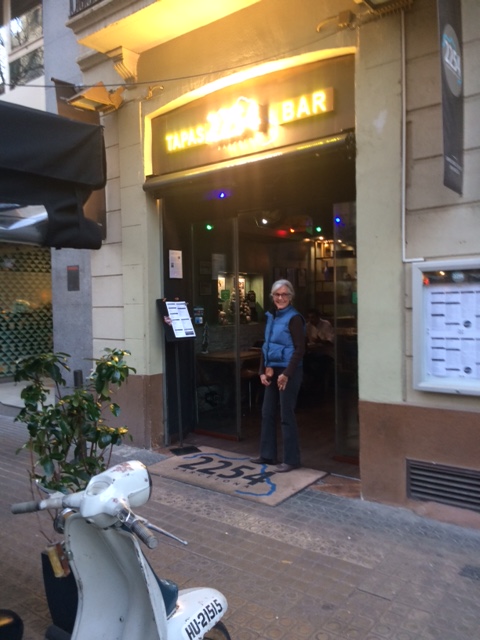
‘2254’, our ‘regular’ restaurante for dinner in Barcelona
The next day we ventured down Las Ramblas again and got ourselves situated as to N, S, E, & W. Had a great self-guided tour with RS’s book, strolling up and down Las Ramblas to Placa de Catalunya, where a childrens holiday fantasy village the size of a football field had been built, entirely of shipping pallets. At one point we ducked into a supermarcato for take-out salads, empinada, and fruit smoothies; and we settled onto chairs for lunch. Right next to us was a young man with no arms sketching extraordinary pastel pen works with his feet. Even though he was doing art in a public space, without soliciting or begging, a policeman ordered him to pack up and move along. That didn’t sit well with us, or others watching, and several of us offered up euros (bills, not coins), and one woman, representing a media platform of some sort asked him to allow her to interview him for publication.
Later that afternoon, we ventured out on a public bus to see the Gaudi* park above the city. Again, we had not made reservations (you’d think we’d have learned by now) and therefore couldn’t go see inside the center, but we were able to walk around the park. A beautifully created abstract vision of aquaducts, walkways, scenic vistas of the Barcelona bay and city. It was nice weather, so being outdoors was great.


Capping a hill above the city, Guardi Park is a fantasy in abstract stonework.
We got together with Alvaro ‘Bici Clown’ on WhatsApp (highly recommended for travel), and worked out a meeting time and place for the next day, Friday. He was in town to do a radio interview about his cycling tours, and was staying at a friends Mediterranean casa about 40 klicks east of the city.
* Antoni Gaudi http://whc.unesco.org/en/list/320 was a pivotal architect at the turn of the 20th century, introducing a baroque, organic style that came to be called ‘modernist’, and sent Spanish designers in particular spinning off on theretofor unknown directions. His building remodels and new construction were done, for the most part without plans! Gaudi would construct a model, then remain on the construction to orchestrate the myriad contractors like a maestro leading the philharmonic. Looking at the results, music is actually an apt allegory for his fantastic shapes, volumes, finishes, and architectural details. Alas, his spectacular career was cut short by an untimely and fatal confluence with a trolley car.
Next morning we met in front of our hotel (Alvaro having just ridden in on his new super-high-tech Brumpton folding bike), which proved to be directly across the street from the radio studio, within two blocks of Cati’s parental home, and the almost miraculous ‘Isle de Contention’ where owners hired upstart architects in a one-upmanship ‘battle of the neuvoriche’ of the day. All others were eclipsed by Gaudi’s masterpiece, ‘Casa Batll’o’.


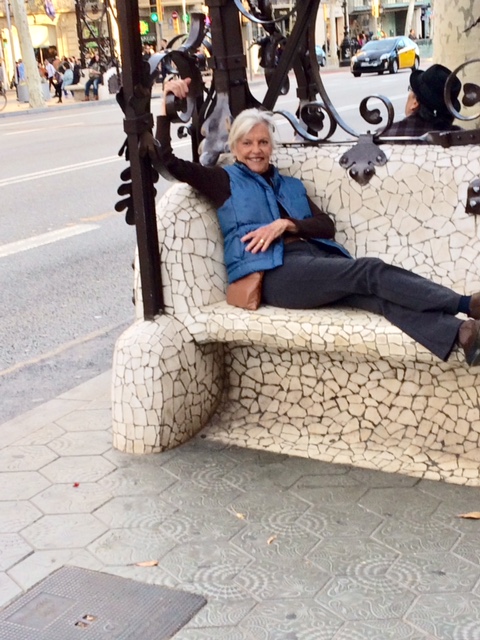
The ‘Isle of Dispute’ also includes street furniture and lamps designed by genius Gaudi.
Alvaro was with a good friend, our tour guide for the day. Cati Aurella is from Barcelona and manages seminars, conventions, and tours on a regular basis. We met her and her husband in Ovieto, Spain when BiCi (Alvaro) ended his 13 years of cycling the globe with a grand celebration. Now Alvaro, after being footloose on the globe for over a decade, has just purchased a motor cavaran to use as a base for his new career giving lectures and presentations, with a ‘one planet-one people’, and ‘find your true passion and pursue it as your job, and you’ll never WORK a day in your life’ message. He was more excited about his new bike than his beautiful, fancy new motorhome!


Our private guided tour through the old town of Barclona …


… tapas lunch, politics, laughs and more.
Cati showed us many many things we had missed on our self-propelled Las Ramblas excursions. So we have been compiling a list of “must visits” for another trip to Barcelona. Some of the things we did manage to squeeze in, were a visit to a hand made shoe maker, exploring the inside of a magicians store, where Alvarao was delighted to check it out to find new and interesting things to include with his magic stories he tells, and a fantastic chocolatier/nut/coffee roaster. We spoke with a woman whose shop had hundeds of masks on her walls, who does the painting, applique, and finishing at her desk cum art table. How fun!! There are two major balls a year where people join in on the gala event and wear their masks.


Roman ruins, marionettes, masques, ancient shoe maker’s shop now computerized, and soeaking of politics, what Barcelona (and most of the rest of Europe) thinks of today’s USA.
We stepped inside the 4-Cats restaurant, where Picasso frequented as a boy. There are three museums dedicated to Picasso here. On our wanderings through the old city we went through a small plaza with a terraced building above one end, both were adorned with the Catalan flag, in defiance of the Spanish national government. She explained that this was the still-beating heart of the Breakaway Catalunya political movement, which was brutally supressed during a referendum attempt last fall, and that there was another vote scheduled. She is subtly working toward independence from Spain, and is sure they will succeed.
We took a break for lunch, vino and tapas at another handy plaza taverna, then we crossed old town, and back into the ‘straight streets’ of the newer planned city, where we accompanied Alvaro to his radio interview before parting ways to take care of other matters. https://m.youtube.com/watch?v=sDenGvXhrlE Cati was able to coordinate tickets for us to visit the Casa Batll’o building redesign done by Gaudi. Entering the structure is more like being in a sculpture than an apartment building. It is truly a masterpiece of personal expression, that these writers have not the skill to describe. These are some pictures of the buildings by day and then by night during our visit arranged (gratis, 20€ ea. fee waived) by Cati.
Imagine being in an era when the radical change of painting, music, dance, and literature is starting. Fantasy and non-linear representations of the world are emerging all over Europe, you’ve just finished your university training, and someone offers you big money to do remodeling to a building of rather plain construction. We figure he either had great imagination or was on some spectacular psychedelic drugs. His father was a wrought iron builder-designer and provided much added embellishments to the exterior and interior details of the building, and Gaudi was able to inspire construction workers, artisans and artists to create an other-worldly vision of an alternate reality in ordinary building and finish materials. Looking at the fantastic shapes in metal, ceramics, glass and wood, your response is ‘you can’t DO that


The maestro himself, stepping from the grave in holographic projection, led us through his masterpiece, Casa Botllo. From inside or out, you are immersed in his vision.
Next morning at 4:00 am found us hustling a taxi (our location was also just a hundred meters from the district taxi stand, where cabs are staged 24/7) for flight to Geneva, Switzerland. Would you believe that the “young crowd” (we were lodging in the university environs, after all) was just flowing out of the dance bars … one bar looked like there was still a rave on-going from what we could see through the open doors. Our taxi driver was very well spoken in English, well Spanglish anyhow, and was firmly opposed to splitting Catalunya from Spain. He admitted he was a transplanted Spaniard, but did make a compelling case. He was especially concerned about potential financial fallout, citing several large companies that have already moved out of Barcelona, ‘just in case’; and lamented that the differing factions were fracturing families, the mainstay of Spanish (and Catalyun) life.
Our pre-dawn departure invoked memories of HNL ‘Freeway II’ east-bound departures
We arrived early enough for a relaxed (as relaxed as it ever is) check-in and boarding, and soon found our pre-dawn selves banking out over the sea before turning north toward Geneva, Switzerland. It kinda felt and looked like leaving Honolulu at night with valley fog and lights on the water.
Aloha, RoBerta/Kapalili
http://www.freerangekupuna.wordpress.com/
Aloha, RoBerta/Kapalili and Smitty
End of BOOK I
BOOK II
PROLOGUE
Aloha ka kou, HANA HOU!
What happened, where did we go next? Above ends our ‘planned’ trip, from here on out we’re wingin’ it … to some surprising unplanned destinations and experiences. Why so long in reporting our (mis)adventures? Smit forgot our traveling iPad, with all our recent writings and pics in the lobby of our Rekjavik hotel (one of those unplanned destinations), and it took all summer and then some to recover it.
But we’re back, and although late, we’ll catch our dear readers up to our wanderings planned, or not. We’re back home and re-phoned and Smit is re-FaceBooked, so you can contact us via comments, e-mail, phone or WhatsApp.
BOOK II
Where shall we go from here? We’ve said our good-byes to Alvaro and friends, Espania, and the many fiestas, and are looking somewhat hazily, toward the future. Invitations have been sent to visit Warm Showers cyclists that have shared our Kona hale, and so we’re taking our tropically adjusted bodies off to Switzerland and alpine France in the dead of winter … this could prove to be interesting!
OFF TO THE LAND OF FONDUE, YODELING, AND ABSINTH – 01/06/18
Our pre-dawn departure from Barcelona proved to be a rainy, gray, blustery arrival in Geneva, and it was a very smooth transition from airplane to shuttle-bus to hotel. Lovely. Since we were so early, we put our luggage in storage and caught the trolley-tram to downtown Geneva. It was a dreary day, cold, rainy and not many people out and about. We rode to the end of the line, not sure of what any of the announcements said in France’. We stopped in at a small cafe. 3 males of apparant arabic decent were sitting around a small table discussing something of great interest. The ‘waiter’ acknowleged us with a nod. We pulled out a couple of small wooden chairs from around a small round wooden table. We asked for a breakfast menu; waiter nods to the basket of croissants, brings 2 plates and 2 cafes. Guess that is it. An older woman with short grey hair, tallish, thin, enters and speaks with the waiter, takes a table by the door, carries a newspaper from one of the vacant tables to hers, and awaits her cafe. Shortly, another old woman of shorter stature arrives and sits at a table on the other side of the door, orders a wine and slowly sips her morning beverage before departing. An older man arrives, sits outdoors to watch the passing human parade at 9:00 am-ish in the chilly morn.


Another old town, Germanic, this time. The central fountain, Russian Orthodox church.
Thus fortified with our French breakfast, we started out to explore the city. We saw the man-made geyser, The statue of the defenders of Geneva, against whom we were never clear*. The cathedral, Russian Orthodox Church topped with gilded onion domes, and the Art and History Museum. At the latter, we went to the restaurant first to get warm and eat something. A type of curried pumpkin soup spiced up with special herbs. Yum. It was so good that we both had double helpings of it which were served in glass pyrex dishes the size for brownies, more-or-less. We also got our first Swiss sticker shock, two bowls of soup and a small roll each, and a chocolate-chip cookie we split, about $30.00 USD at the Swiss Franc exchange rate.
Highlights at the museum: the usual post renaissance art, heavy on the Flemish style, fewer martyrs writhing in exquisite holy pain, with cherubs looking on in appreciation and a plethora of bucolic landscapes featuring frolicing lambs, staid cows, and languishing milk maidens. Much of the ‘industry’ part was dedicated to the defense of Geneva against invaders *still not clear, featuring a large collection of harbequesas, cannon, flintlock rifles and pistols, crossbows and suits of armor. A period room was created showing a wealth of well-worn Louis XIV furniture, tapestries, and an entire stairway installed in one corner. One room consisted of a Rube Goldberg contraption the size of a city bus fabricated of … how to describe it? … a moving junk collection of belts, cranks, pullys, rods, bells and other clanking bits, all controlled by a foot pedal stationed in the center of the large room. A BIG hit with a family passing through with a pre-teen boy! There were, of course, the requesite bits of Roman ruins, statues, sarcophagi and mosaics scattered about a damp, chilly courtyard.
We explored an old church, the old part of town, and managed to find our way back on the bus to our hotel. We had ideas of going out again later, but a hot shower, warm bed, and organization of train trip for the following day took us to moe-moe (nighty-night) time.
La Brevine’. 07/1/18-14/1/18
Taking the train Geneva to Neuchatel proved simple and easy, and stress-free, since there’s one every hour, going to anywhere at all in Switzerland, in any direction. The trains? Clean, fast, quiet, on-time, did I say fast? They actually bank into the curves like airplanes! We took a local bus from Neuchatel out into the country to our host’s village. We sat in the front seat so we could see all the beautiful scenery. The road got more narrow the further we drove into the country. The bus driver was so polite to all the passengers, saying “bonjour” in that melodic way the French have, waiting to start up the bus again until after the older ones had been seated. We rounded corners and pressed deeper into the foothills of the Swiss Alps, ’til we entered a broad valley and reached our road side stop for La Brevine. A quick phone call to Nico and he was there in a matter of minutes to pick us up and shuttle us back to his familia.
We met Nico, Silvia, Joey and Laura 5 years ago when they came to HI to cycle some Hawaiian islands. The kids were only 7 and 10 then and had just finished cycling the length of Chile. Warm Showers is the program equivalent to Couch Surfing. For cyclists instead of ‘surfers’. This is one physically fit family!!! Dad Nico and mom Silvia are both rock-climbers, and have introduced the kids to the sport. Nico is also a paraglider pilot, and has climbed numerous Alpine peaks to jump off and fly over the Swiss or French countryside … http://www.wild-lights.com I’m sure the kids will be strapping on paraplanes as soon as old enough too. They bought a decommissioned border crossing customs house that they are updating into a more family-style home, located on a single lane unpaved road leading to the France/Swiss border, 500 meters further on. There’s LOTS of room, a huge garage/shop, organic garden, chickens, all overlooking a beautiful serene farming valley.
We set out on a short hike up the back of their property toward the border. The story goes that the Border Patrol used to patrol the “roadway” and gate which has (had) a type of pad lock. One night some robbers of an ATM machine made their get-away up this road to France, in a stolen truck with the entire ATM machine inside … No one knows if they were ever caught, but they never bothered to lock the border gate again.
We took Advantage of the “warm weather” and went for another walk/hike to Le Daub River. One of the borders between Swizerland and France is in the middle of this river. The flow comes to a cascading waterfall where locals like to gather with their dogs and friends. One elder man took his alpine horn (remember RE-eeeee-co-LA?) to practice … beautiful sound amidst the trees and rushing waters.
Not sure many of you know about the apretif called absinthe, the notorious wormwood laced ‘Green Fairy’. It was banned as a dangerous hallucinogen in most countries, including Switzerland, until about seven years ago. Well, Nico is ‘since boyhood’ chums with one of the traditional (bootleg) distillers (now legal) and we went with him to the distillary to see how its made and to meet the “brewers”, Phillip Martin and his father, Francis Martin, who gave us a thorough education of the stages of development, after which we tasted some of the brew. One must be careful for too much could cause you to see the Green Fairy. Yes, we did buy a couple of bottles.
To learn more about this beverage steeped in intrigue, history, and protocol, we went to the Absinth Museum in La Valote. Now we are experts in the art (which is like a Swiss version of a Japanese tea ceremony). We almost missed the hidden doorway tucked in behind a bookshelf/cabinet. See what you can find on the internet. https://www.absinth-originale.ch. Very interesting.
The trip to ‘not Berne’
We set off on a day trip by train to Berne, off to see the famous animated tower clock. The train stopped and it sounded like an alternate name (many Swiss towns have two names, one Swiss, one French or is it German), and passengers said yes, this was the place, when we were the last ones left in the coach, we got off too. We went to the ‘i’ marked tourist info kiosk, and the lady said, yes there was a famous clock, but she wasn’t sure if it still worked or not. Still, she gave us directions, so off we marched uphill to the old town … they’re ALWAYS uphill, aren’t they? We saw old churches, lots of winding covered walkways, stairs, canals, and a couple of clock faces, but not ‘the clock’. Rounding a corner on a non-descript cobbled square Smit saw a wall sign that said ‘Glycine watches’ and came to a dead stop. His pilot father wore a 24 hour self-winding Glycine watch from the Viet Nam war campaign, that Smit now has. It still works great, but the crystal is scratched, and no watchmaker has been able to find a replacement. Peering in the shop, sure enough there were ads for the ‘Glycine Aviator’, and this was the actual home office (the factory in a different part of town). He rang the doorbell and a woman answered that she would be right down. And she was. A well spoken, stylish young woman, well versed in the history of the watch, it’s inception*, and yes, the crystal is available. We’re to document and photograph the details, and they will send us the crystal, and the documentation of the watch. Alternately, we can send the watch back, and they will clean and refurbish it as new. She said, based on the time frame it is one of the original ‘aviator’ series watches, and a uniquely valuable timepiece (actually, it lives in a safe, no need watch in Hawaii!).
* The watchmaker was on a flight to South America in the pre-jet days. When the pilots found out they had a Swiss watchmaker on board, they invited him up to the cockpit, where they tokd him they needed a special kind of watch for pilots, and described the needed functions. He went home, designed and manufactured the first ‘aviator’ watch, and they are the mainstay of Glycine to this day.
After more wanderings along the lakefront, and a quick lunch in a bakery, we headed back to the railway station, and caught the next train back to Neuchatel. Only when we described our return trip did Nico explain that we had never reached Bern, but had gotten onto the wrong train going to Biel-Bienne rathere than to Bern, a trip less than half the distance. Oh well, another trip we’ll go see the clock.
We couldn’t leave the Swiss without sharing a Fondu. Nico provided us with an evening delight of THE REAL DEAL:
- Only the man of the house prepares it.
- Don’t add stuff to it along the way.
- Put a lot of white wine in the bottom of ceramic pot, if you have one, or a very best pot that you have.
- Add FONDU cheese; stir slowly, continuously, for about 25 minutes. Sometimes stir in the shape of a cross. (Swiss are not typically religious so I think this is to hope for the best fondu.)
Now the bread used for poking onto the end of the special fondu fork has to be a particular type. Sorta soft, not to hard on the crust, and not too crumbly then cut into square chunks 1/2”-1″ sq. The first person to drop his bread in the fondu has to pay for the next bottle of wine.
In addition to their full time jobs, Silvia took on the responsibility of “mothering” a boy scout troop. And when it evolved that there was no place to ‘house’ the meetings, they asked the city for some acreage to build a log cabin. Check it out on their web page.
Joey was only a wee babe, when they, and friends, built the cabin from scratch. Cutting down trees on the lot, “logging” them, peeling the logs, dragging them to an overhead trolley system they built, through the forest to transport them to the building site. There they were sized, notched, planed, and set tightly into place. The logs are so well fitted they are still tight with no chinking, 15 years later. Now for the past 15 years, the cabin in the woods is such a treat for the scouts, including girls too (Swiss scouts are gender neutral) to enjoy. What an undertaking!!!!
About those jobs. What an interesting career life they both have. Sylvia is a tunnel engineer, working on the amazing tunnels lacing the mountains of Europe. We heard stories of a tunnel bore breaking into an unknown limestone cavern, that led who knows where. The bore was shut down while the caverns were explored, and Nico got the chance to go spelunking with the investagation crew. Nico is a software designer, currently working on mapping ancient lake village sites, using very sophisticated gps driven photogrammerty … oh, and he’s one of the divers doing the underwater surveys in the lakes … which must be done in winter, when water clarity is at it’s best. They are also both adventure photographers, and have an interesting web presence at the site previously mentioned.
With all this great cheese and bread in Swiss, crazy as it may seem, we went to a Turkish Resturant in downtown Le Locle. Because, you see, Switzerland is a melting pot of all ethnicities. So, since we had never tried Turkish food, this was the day’s selection, which also proved to be one of Joey’s favorite snack sources.
INSERT PIC
Now, if you want to try a “high end” outing, take a helicopter to this flat grassy area (or it could be full of snow, or water) and walk to a Swiss specialty restaurant near-by for champagne and whatever your choice for a meal.
The weather has been warm in Switzerland during this mid-January time. There was a big dump of snow, then warm winds from the south blew in which caused everything to melt…guess the ducks were confused. There was flooding in most areas, ponds created, and farmers’ pastures/farms turned into launching pads for ducks, geese, and swans. We were fortunate that a two-day winter front moved through, and we were able to see the region covered in a fresh blanket of white for a couple of days.
INSERT PIC
We enjoyed walking to the local cheese, bread, and mini market for supplies. Here is Smitty and Joey walking home from a trip.
Now, you are all aware of Swiss watches. And, everyone here does wear a watch. So, Nico, took us to Le Locle to the Horloger Museum. Anything and everything you ever wanted to know about timekeeping was in this three-story historic building, artfully displayed. There were tiny wires so small you could baretly see them, to music boxes set inside of beautiful boxes with little watches embedded. All the systems set up for calendars and mechanisms to make calculations for years with additional days etc. And, the history from eons ago when man started to calculate time was here. Even a fancy little music box with a stash of false beauty marks inside, in a special little compartment was there as a reminder of the ingenuity for us women, and men too, one would suppose, as a code: where it was placed on the face was to offer a clue as to her availability for the night.
If you want to go, follow the signs to Le Locle.
INSERT PIC of R n s at road sign
I mentioned the physical fitness of this family, oh, by the way, the children come home from school mid-day for lunch break, rest, homework, whatever. Then back to school and extracurricular activities, which for these kids included, rock-climbing, music, downhill and cross-country skiing, cycling and we forget all-else. Then the dinner event unfolds, which was always delicious. Speaking of music, Joey’s grandma gave him a beautiful classical guitar that was hers. He taught himself how to play via the Internet, a teacher at school on his free time, and some tips from grandma. Another guitar was purchased for Laura and she is working on her skills and apparently has a good voice. She was a little too shy to let us hear, but we got her plunking on our uke. Well, what a perfect family to hand over the ukulele we have been carrying from Madrid, Spain and all the myriad stops in between and various modes of transportation. So now there is a ukulele playing in Switzerland.
Joey completed his 15th lap around the sun and all his grannies, including us, were there to celebrate a fantanstic dinner anddesserts made by Jacquline. Hugs all around, and the uke being passed along for trial strums led us to the grand
finale.
INSERT PIC
A finale of “fireworks” – something very unique was done. It looks like sparklers, but it’s actually steel wool, stuffed into something like a beater or gravy stirrer, lit by contact with a battery*, and tied to a small rope then swung around in the air. *It’s an ol’ Boy Scout trick Smitty explains, one that can be used when your tinder is wet … and you ‘just happen’ to be carrying a wad of steel wool and a 9v flashlight battery.
Well, this wonderful family is bound and determined that we are not leaving Switzerland without seeing the ALPS. Nico, Silvia, Jacqualine & Michel’ and us, all motor ‘en caravan, to various sites, only to be smudged out by clouds. We took a wonderful walk through fresh snow to another view of Le Daub (that river that divides France from Switzerland on one side). We ultimately succeeded in seeing the Alps. As a reward, we “hiked” to Sommatel for a beverage to warm up. Ahhh Glu wine, the best we ever tasted. Lovely old building/farm house probably. And the story goes that Michel’s father, Nico’s grandfather, used to walk up the hill to this little restaurant in winter with his wife/grandmother to dance and then they walked home after. How Romantic!
Our final farewells were made with hopes that we could all meet again soon as Nico got ready to drive us to the Neuchatel train station.


 Free Range Kupuna Sea and Beyond
Leave a reply to Judy Cancel reply