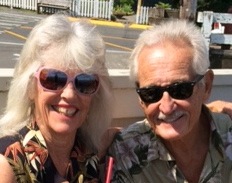
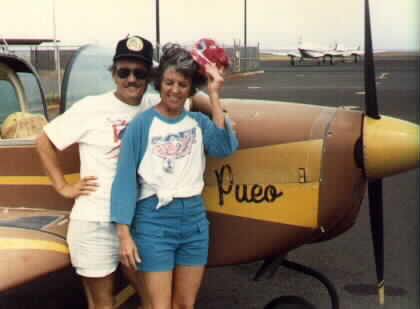
George (Smitty) and Roberta Kapalili Smith
Prologue
Smitty was born into aviation. George Sr. was a B-24 bomber pilot in the WWII European theater, and continued on with a career as a command and instructor pilot in the USAF. However, he refused to teach me how to fly, citing that family shouldn’t tech each other life-dependent skills.
As life and fate would have it, I finally started flying lessons in 1978 at KOA, the Hawaii Kona coast airport.
Some years later I met I met the love of my life and we started our adventures together, with the warning to her that “I come with airplanes”. A few years into our marriage I came across the ‘Pueo’, the very plane I trained in, and we bought it.
Grumman AA1-B Yankee – the day we purchased it at HNL. The little plane
that carried us to every island airport in Hawaii, until we sold it years later.
New airplane, new skies …
It’s late August and midmorning, my wife Roberta and I are enjoying coffee and Danish in the dining car of the Amtrak San Joaquin train, bound for Hanford, California, which lies just up the line from Bakersfield. After a night squeezed into cattle car class on the Honolulu to San Francisco ‘red eye’, the simple pleasure of sitting at a table to eat, rather than battling a fold up tray, your elbows akimbo in your seat mate’s dinner and the seatback in front in your face, is a treat. Air travel may be fast, but even first class which we rarely see, can’t compare to the leisurely pace of a meal on rails. Well, some air travel is fast.
We’ve left the Emeryville station in the east bay, and are rolling through the Sacramento River delta, along a levee roadbed. On a clear hot Saturday the canals on both sides of the tracks are filled with pleasure boaters. We watch as water-skiers, motorboats and jetskiis weave criss-cross wakes, like aquatic afghans on the surface. A small commotion among our fellow diners causes us to look out the window and up. First one, then two more colorful ultralight floatplanes appear beside our train. Bobbing and weaving together, they look like high-tech dragonflies. Bright aluminum and rainbow wings in hot pink and purple, lime green and yellow, white and electric blue they over take our dinning car, raspy engines muted by glass and the sound of steel wheels on rails, they sound like horseflies buzzing against the window. I press my face against the glass and watch with some envy as they disappear toward the front of our train. Suddenly, they are zipping past on the other side, so soon they must have done wingovers over the engine. With the combined speeds of our opposition they blink by in a riot of color, and climbing away in formation, head north as we roll on east toward Stockton.
So different”, I think, from our DC-10 boring through the night, bearing 300 and more people and crew across the sea at over 500 miles per hour. These fragile manmade tropical birds of aluminum tubing and flower hued nylon. Rowdy fliers playing tag with trains and ski-boats (if these were registered aircraft the Federal Aviation Administration, given the ‘N’ registration numbers, would have the pilot’s licenses for lunch), stunting, air dancing on a whim and a prayer and playing unconscious homage to the past. Unburdened by regulation, radios, flight plans – flinging themselves against the air with no protection from the wind of their passage. How like those early birdmen beginning this century, perched on the beaks of fragile craft fashioned from wood, fabric and wire … here in the closing years of that same century. Far we’ve come from the first struggles into the skies, to the moon and back. As I turn back to Roberta at our table I realize how connected, how dependent the airmen of the past were on the railroads, and how soon, we too will be.
Spread out on our table, amid the coffee cups and pastry crumbs, is a pile of aerial navigation charts, ‘sectionals’ of the western states, our planning map, a AAA road guide to America, a plotter, and an E6B computer (mine, a 30 year old ‘whiz wheel’ gift from my Dad, and filled with time/distance/fuel/wind drift and all the arcania of two generations of flight), hand operated, no batteries needed. ‘Berta and I are plotting our current position, using the surrounding hills, streams, radio towers, cement plants, and yes, railroad tracks to locate us as a fast moving dot along the picket fence line that represents a train track to airmen. Our dining car has become a time machine, slipping us back decades from mass transit near sonic flight to a simpler time and place, in our own sky above the tracks.
We own, with my father, who is a 76 year old lifetime aviator, a 1946 Aeronca Champ N2973E, named ‘Buddy’ after George Sr. as a youth. As a boy, Dad stopped whatever he was doing on the Texas plains, plowing behind a mule, milking, tending livestock or hoeing cotton, whenever an airplane flew over. Those twenties and thirties airplanes, constructed of steel tubing, wood, wire and fabric – pulled by low power engines and slow turning propellers. As is our Champ, Buddy. Dad learned in the Champ’s progenitor, an Aeronca C-3 ‘bathtub’ which not only looked its namesake, but purportedly flew little better. Washing, fueling planes, sweeping hangars and mowing the field, he earned his lessons, an hour a week, – until one day when the owner wasn’t looking, he soloed himself. Reprimanded but not fired for his offense, he worked toward his wings, finally hard won and paid for on the forge of the air war over Europe during World War II. Over fifty years he has hauled bombs, passengers and freight, fought in three wars, patrolled our shores, pipelines and highlines, sought lost aircrews and uranium ore … and taught fledglings, civilian and military to fly.
Fifty-plus years old this year, 73E is much like those airplanes of Dad’s prewar youth, room for two and a couple of bags, each behind the other; formed of welded tubing braced by wires and clad in brightly painted fabric. Her cockpit is shaded by a single wing overhead, and wide sliding windows offer view and ventilation. Buddy sits on a pair of fat cartoon tires, followed by a small tailwheel that looks stolen from a shopping cart. She too, is unencumbered by electronic navigational aids, radios or complex equipment, even a starter. She is brought to life by hand, slow pulls with the switch off, then a shot of priming fuel, and “contact, throttle, brakes” … if we’ve done it just so, and held our mouth right, the engine starts with one energetic swing of the prop. Once animated, she leaps gleefully into the air and makes her way skyward for up to two and a half (with reserve) hours, at about 70 – 75 mph (on a good day), until we are seriously looking for our next gas and restroom stop.
73E is equipped with a battery operated hand-held comm radio and voice actuated intercom. The push-to-talk switch is mounted on the back of the front seat, reachable front and back, and convenient to the throttle and mixture controls, for communications in the pattern. Foam ear plugs and the headsets block out most of the engine/prop noise, and a suction cup rear-view mirror stuck high on the windshield allows eye to eye contact when we talk. And we do, a lot. Motoring not-so-far above the ground we comment on the weather, our remaining fuel and time-to-land, the trucks passing us on the interstate below, the smells wafting through the open windows, and we conjecture about those below, as we glimpse a bit of their lives from above.
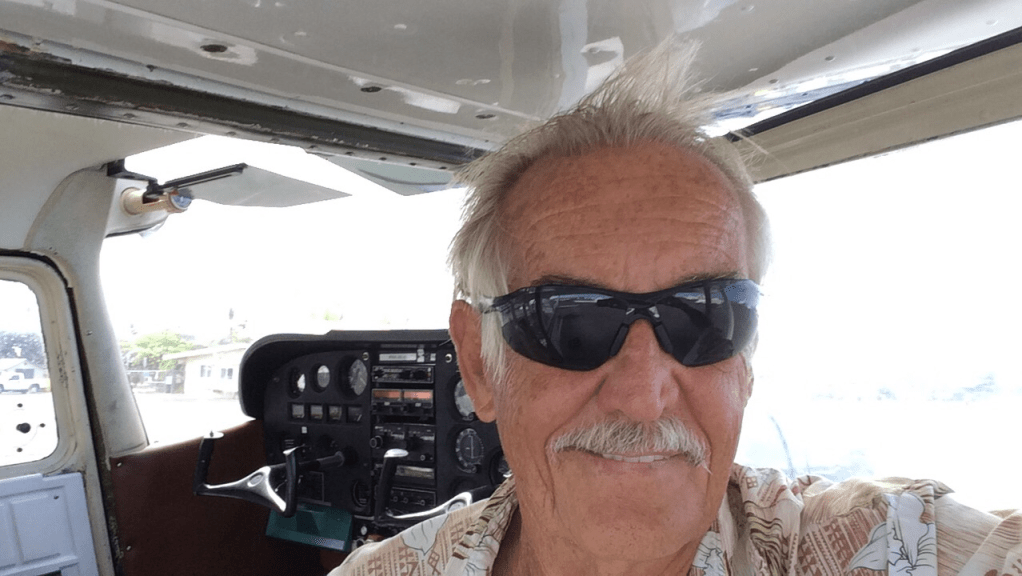
Boarding is an exercise in
Like those early aviators and aviatrixes, we navigate by looking over the side – comparing the roads, rivers, mines, towers, lakes, grain elevators and tracks with the symbols on our maps and the pointing of our compass.
As our train turns south out of Stockton, through the fields and orchards of California’s great valley, we keep our place on the track lines of our sectional chart. A real-time lesson in aerial way finding for my new navigator, Roberta – our rolling classroom held firmly to earth by steel rails. Thinking ahead to our actual flight, II picture our view from the air, 1,500 to 2,500 feet above ground. The junked cars and abandoned farm equipment are diminished, row crops, trees and the green circles of automatic sprinkler irrigation stretch toward the hazy horizon, defined and held in place by ribbons of steel.
Days later, having carefully weighed and measured, put aside and packed our light weight back packing/camping gear, first aid and survival kit, water bottles, a few tools and a lot of sectional charts – we take off into an afternoon guided by those same rails. Nicknamed the “Iron Compass” in the early days of flying, railroad tracks often lie true north and south, east and west, laid out on surveyor’s section lines they point arrow straight to river valleys and mountain passes, where they wind along the path of least gravitational resistance. Those of us who fly low powered airplanes in the high and hot regions of the west often plan our trips along rail routes, following the gleaming lines of steel through passes across mountains whose peaks we could never top, but beware the tunnels.
We are led south, toward Bakersfield, then to the east and the foot of the Tehachapi pass with it’s famous ‘loop’ where long trains cross themselves winding in a spiral up the steep mountain grade. Climbing out over the head of the pass we slant down toward grassy Mountain View Gliderport, our first fly-in campsite.
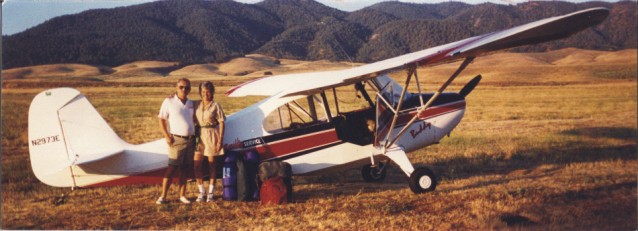
The ‘Three Musketeers, ready to load up and take off
‘Bert, Buddy and I are all of an age, my wife and I were both still in nursery school when 73E flew out from her factory field in Ohio. But Roberta is an island girl, born and raised in Hawaii. Cradled by the ocean, she grew up on the slopes of sea mountains that reach and top the clouds. Her horizons have been bound by the sea, her travels measured in minutes and hours, not days and weeks. There in the islands, with destinations close and trips short, where trains belong to history, the rail beds have been transformed to roads and bike paths.
But here, in the sweep of America, the trains still live and the rails reach out, sometimes paralleling the interstate highways, guiding us and our frail craft across the great deserts. Expanding Roberta’s horizons and refreshing mine, our days lead us up and across the Mogollin rim, circling Meteor Crater and flanking the Painted Desert/Petrified Forest, to Albuquerque, New Mexico.
Leaving Albuquerque into a flaming dawn, we watch as the blood red hills open into winding river valleys, with dawn mist whisping into the rapidly heating desert air. Maintaining a typical 1,500 feet AGL (somewhat higher thru passes) we cross the Raton Pass and head up the eastern shoulder of the Rockies, sailing on the edge of the prairie seas.
Our trip planning is based on two hour legs, for safety and comfort. Throughout the west, we have few gaps requiring longer flights, almost always there is a small town airfield with fuel and FBO services. On this trip we met many Champ fans, and were escorted into hangars across the country to view 73E’s sister ships.
We avail ourselves of FAA flight services, checking weather for each leg, and filing VFR for our entire trip. Although we do have our hand held, external antenna 720 channel transceiver aboard Buddy, we don’t want to worry Flight Following if we are out of contact, preferring to file NORDO, and use our radio for airport contact and pattern communications.
Throughout our trip, briefers were helpful and friendly to the man and woman, many of whom offered to trade places with me. As the days passed we developed a ‘following’ among the briefers. ‘Hand-off’ briefers would ask how our leg went, and what our final destination and plans were, even if out of their area, and reminisce about Champs they had flown. All our contact, including PIREPS was by phone, with the exception of two contract control towers, Flagstaff, AZ and Sun Valley, ID. Naturally, the taildragger gods ensured that I embarrassed myself sufficiently landing at both of these fields!
In over three weeks of almost daily flying we had only two briefing problems. At Hot Springs, NB I stood in the pay station on the FBO porch, on hold for a windy 10 minutes, while the FSS talked with the manager at his desk thru the wall. We were a few minutes late due to headwinds, and they were complaining that I hadn’t called to close my flight plan, when my airplane was clearly parked at the fuel pump. Later, during our briefing from Fall River Mills, CA, the briefer missed the fact that the College Airport, Sacramento, CA was closed to transient traffic, forcing an enroute detour to the Nut Tree for our planned Sac. RON. Minor problems both, the lessons are: Close your flight plan (I did) and be clear on your briefing requests (I didn’t).
Following railroad tracks, highways, and section lines we cross the Oregon trail into Scottsbluff, Nebraska. We overnight, and wake to a dreary, drizzly two hundred foot ceiling. After a great breakfast at the airport cafe, followed by a DUAT duet and some discussion with transient IFR pilots, we decide to pop up for a look north under the slowly lifting overcast. Two miles out and facing gradually rising terrain, it looks too much like scud-running to us … so we perform a discretionary descending 180 and plunk ourselves back on the ground.
Borrowing the Candlelighter Motel courtesy car, we head out to spend a wonderful WX morning browsing in the Scott’s Bluff National Monument Museum, hiking a short stretch of the Oregon Trail, reading pioneer journals, and listening to the Ranger tell stories of cross country adventures with her husband in their C-140, “I’ve learned more about towns I never even wanted to see because of bad weather!”
After several hours, in the early afternoon, it finally partially clears and we head north, to fly over, but not find, thePresidents on Mt. Rushmore. We turn at Crazy Horse, after decades, emerging from his mountain (but interestingly enough, not depicted on the sectional) and stop for a couple day’s break in Spearfish, South Dakota, for an EAA Chapter fly-In and an evening at the Oberammergau Passion Play (our erstwhile destination for this trip). Our WX delay cost us the Fly-In ‘Iron Butt’ award, which we lost to a full-tilt bells & whistles IFR Long-EZ in from DNV (hollow victory, that), but the camaraderie, steak and sweet corn and cold brew were welcome. Chapter 806 president Brad Young is the co-proprietor, with his wife Sandy, of the Eighth Street Inn a wonderful historic B&B, located in Spearfish, and highly recommended to any passing pilots, flying or driving to or through the Black Hills.
After a morning spent sleeping in (Roberta) and changing engine oil and air filter at Black Hills Aero (me), we head west across Wyoming, to overnight at Powell, WY, giving us a dawn crack at the Continental Divide. At one FBO fuel stop planning session, in Buffalo, WY, we had the Cheyenne, Billings, Great Falls and Salt Lake City sectionals all laid out on the floor, weighted by soda cans, ash trays and one stray Lycoming piston, figuring our route. Leaving Buffalo, we hauled ourselves into the air, before the Champ really wanted to fly, to crow-hop over a herd of prong-horn antelope that broke cover alongside the runway straight into our path. Further along, we asked local pilots the pass of choice to Yellowstone. I had been planning on using the Colton Pass, but Sylvan was recommended. The weather liar predicted 10kts right on the nose … he had the on the nose part right! With the stick looking like a butter churn, we struggled through estimated 25 – 30 kt headwinds in the high Sylvan Pass, at the limits of our climbing ability, and in cold morning air at 10,200′ angled past granite cliffs into majestic Yellowstone, for an overnight at the pilot’s campground on the field. Western state style chain tie-downs, fire boxes, tables, trash containers, cleared tent sites and hot showers (as with courtesy cars – fuel donations are optional, but much appreciated) are available free. This campground is well maintained by the Montana Aero Division (fine aviator folks, all). This is bear country, if you are carrying food, hang it in a tree away from your tent, do not leave it in your airplane … that could be very expensive! A bear can open a Chevrolet like a sardine can, just imagine what she could do to a Bonanza!
A day with a rental car offered us a quick partial glimpse of the Park and it’s inhabitants. We had seen Old Faithful spewing from the air as we crossed the park, heading for Yellowstone West, but fuel considerations kept us on a direct course (we landed with 2.4 gals, 35 minutes in our Champ). Next morning, fortified by courtesy coffee from a friendly Airline Station Agent, we make a short run to Sun Valley for a couple of days with friends. Near Arco, ID we cross the Mountains of the Moon National Monument, which looks just like our home on the west side of the Big Island of Hawaii. At Sun Valley landings are uphill, takeoff downhill, watch for sudden strong crosswinds, regardless of reported wind direction
After a short break visiting old friends we continue west across southern Idaho and Oregon No railroad tracks there, and damn few roads either. My by now very competent navigator, steers us on a two hour DR course from Owyhee Reservoir to Burns, OR, with only lay-of-the-land reference and a single cross check on a lone power line. One more fuel stop at Lake View, and we are back in California.
Throughout the west – every town holding a small airport offers haven, often small and unsophisticated, a hangar or two, a gas pump and a lover of the sky to share our adventure and serve us and our mount. We’ve camped under our wings or fled to road and track side motels when we yearn for a hot shower, hot food and a soft bed. We’ve been welcomed by ancient hotels and B&Bs. We’ve driven loaner cars (someone should publish a photo essay on these) almost as old as their rural airports, to small town motels and diners, and to the museum where the Park Ranger tells of pioneer hardships and shares flying tales of she and her husband following the roads and tracks across the country in another little airplane, decades ago.
There is an enduring quiet strength in the heart of our western lands, and in the hearts of those who openly share it with passing travelers. Peopled by those who make their living on and from the land, farming, ranching, mining – small towns for generations have shipped the fruits of their labor and received the bounty thereof by train. They are still tied by the rails. Their grandfathers and grandmothers left home for their war on those rails, and some returned, in honor, to be buried in that same land. And above it all, rising from small town grass strips and sprawling, now half century old, concrete military training fields, the aviators followed those rails.
And some of us still do. Oh yes, we are often looked at askance by other pilots. A business man in a newly renovated Grumman Tiger sporting enough antennae for elint, and a panel like the Space Shuttle was convinced we were both certifiably insane to be wandering all over the country … in a Champ? But that is what Buddy and her ilk are made for, and flown with planning, discretion and caution, there is no experience like traveling in her. Seeing, feeling, smelling this great land low and slow, above.
Below, those quiet people are still there, on family farms and ranches that dot the west, showing up on our aerial charts as small black squares, annotated ‘farm’ or ‘ranch’ and sometimes flanked with an ‘R’ in a circle, indicating a restricted or family airstrip, welcome in an emergency to any passing overhead.
And from small towns, old masters like the two Buddies, George Sr. and N2973E, still pass down the art and lore of traveling the skies, the magic dance of heart, eye and brain, hand, foot and seat-of-the-pants, following the rails.
Straining our way against headwinds through the last northern California passes, we are now truly above the fertile Sacramento delta. Flying our last leg down to Hanford we see the same tracks we rode weeks before, and that I rode as a child from LA, visiting my aunt in Fresno.
We have ridden the air back to our beginnings, and below, the Amtrak San Joaquin makes it’s way south toward Bakersfield. We can’t catch it.
Postscript:
Since this story was written, Buddy has moved to Montana. My daughter Justine and I flew 73E up to Whitefish on a three day trip in 1986. Last summer Roberta and I headed out to Oshkosh ’98, a wonderful trip, returning with Dad. We waited out weather in Cody, Wy with the Private Explorer crew, finally saw the Presidential Heads, listened to arriving Harleys in Sturgis, SD, flew over the Deil’s Monument and the Badlands, watched a riverboat steam up the Mississippi and flew into OSH with 13 other Aeroncas, two of which groundlooped on landing. Dad and I crewed back together, while Roberta took the AmTrak. We got ‘mislaid’ (never ‘lost’) once, landed at two fields that were published for fuel … but didn’t have anyone on hand to sell it (enforced relaxation time). Survived what Dad described as the worst landing he ever made (in 25,000+ hours) and discovered a broken tail wheel spring clip (the probable cause of our ‘excursion’). We suffered no damage, resisted the temptation to scud run, endured a week in Brookings, SD (actually 48 hrs ‘real time’), discovered some egregious errors on several sectionals, and had a wonderful time – both ways.
After a clean up, oil change and minor maintenance, Buddy is better than ever … well, that depends on who is making the evaluation. When we bought 73E, the plane was a 9.5, inside and out, and had 260 hrs, since major airframe and engine. She’s now up to 580, or so, and has suffered some bumps and bruises (call her an 8/8), but she’s flying, and so are we … and isn’t that what it’s all about?
Postscript v.2.0
Even further along, the beginning of the last year of the millennium … on January 2000 I set of on a long sad solo trip to deliver Buddy to her new owner in Apple Valley, CA. After a false start created by clear ice precipitation (no visible moisture, but ½ hour into my departure I made my discretionary 180 return final by sticking my head out the side window whilst slipping to flare) I made Challis, ID. This is really not too bad in an Airknocker in mid-January Montana mountain flying, the vfr corridor just seemed to open up before me all the way south. Morning found me totally socked in, and light snow, but the Champ was tucked into a nice warm hangar, and I headed out to the local hot springs with a good book, an overnight reservation, and a promise from the proprietress to bring me back to the airport if the weather cleared … it did! I got as far as Jerome, before wx and impending dark grounded me. Next am was a race to beat a front out of town, and I mean a front that would have kept me grounded ‘til spring! This was a morning I was really glad that the Champ did NOT have a starter, believe me, no Die-Hard battery can last as long as a man determined to get the hell out of Dodge! I made it out and heading east with snow blowing horizontal, but still vfr … the leg to Toole, UT averaged me a ground speed of 110mph, at one time I computed a ground speed of 130mph – no wonder I got off the ground so fast. The trip down thru Utah, Nevada and Calif. was relatively uneventful, until my arrival in Apple Valley. I landed into winds of 25kts, gusting to 40 or so, I prepared for wind shear, and found it … after that it was a challenge to get the Aeronca to quit flying.
Buddy, at her new home in Apple Valley, CA
 Free Range Kupuna Sea and Beyond
Leave a comment